
A lot of things get thrust at you in Midtown Manhattan. Many of them are religious. As I was out on my lunch break, a Buddhist monk walked up to me on Second Avenue. He thrust out a pretty token that looked like those skinny cards that used to come in with Sugar Daddies. I get a lot of things held out at me, and since I can imagine how dispiriting it must be to have people ignore you all day long, I have taught myself to take their chit as a matter of reflex. The monk looked pleased. We were outside 815, the headquarters of the Episcopal Church in the United States. I reached out my hand and he said “Buddha peace.” That was nicer than most of what I’d heard from the people who worked inside the church to which I’d dedicated years of my life. Without a beat my Buddhist friend continued, “temple donation.” I had to wave him off with a smile. Religions, no matter how placid, are out to earn a buck.
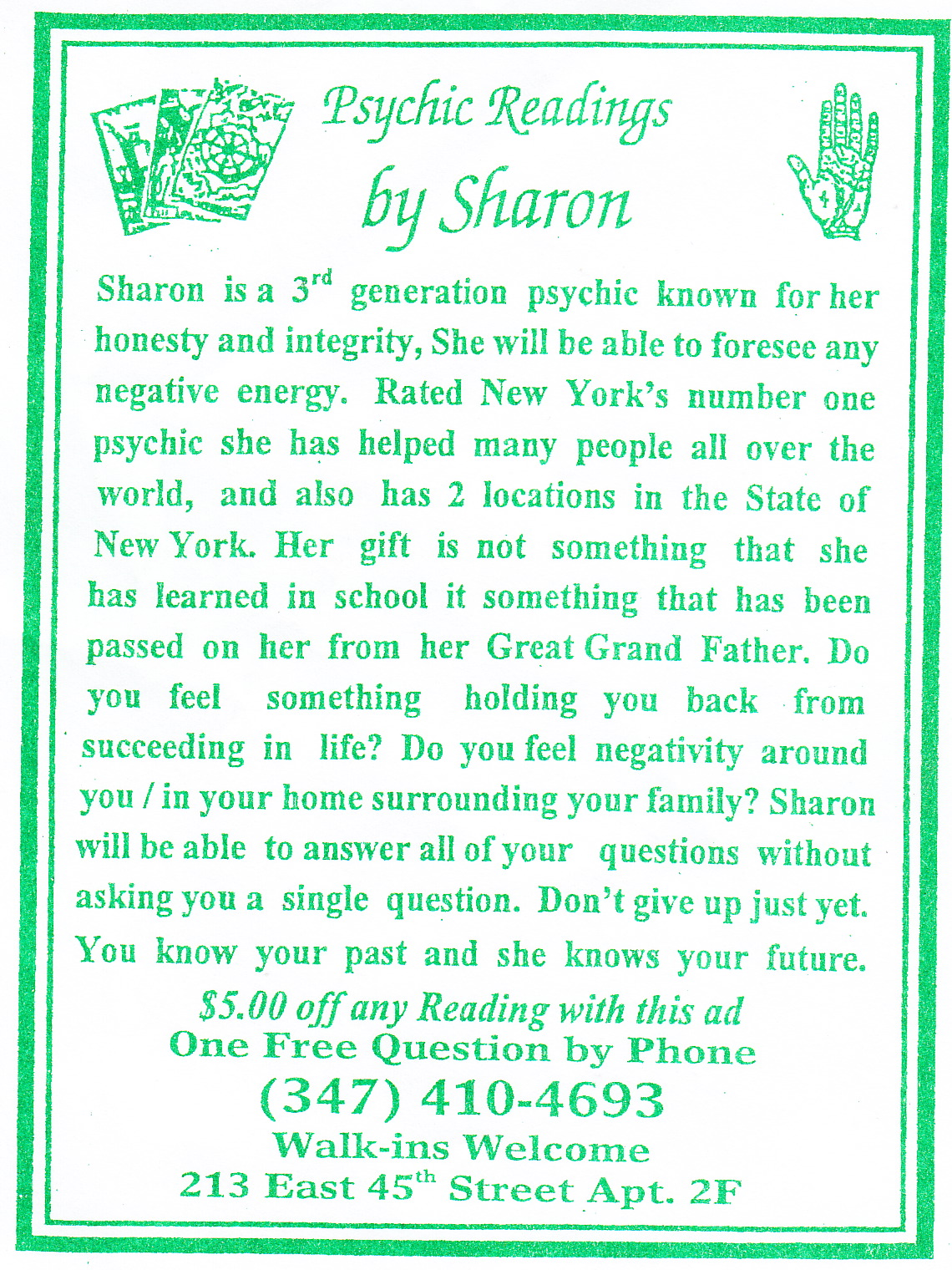
In the neighborhood of my office lurks a psychic named Sharon. I wouldn’t know Sharon if I ran into her, but I suppose the reverse wouldn’t be true. Actually, I have no way of knowing if she’s really psychic or not. She has guys. These guys hang out on the four corners of my block and hand out fliers for Sharon’s psychic readings. The guys with the leaflets aren’t psychic, I take it, because a walk around the block, on which I recognize each and every one of them, always lands me back in the office with a pocket full of psi. I see that Sharon is a third generation psychic and that she is adept at foreseeing negative energy. I would advise her not to walk past 815. If I bring in my slips of paper I get five dollars off a reading. I don’t know how much Sharon charges, but I do know that I don’t need anyone to foresee negativity in my life. I’ve got a hard enough time dealing with it when I don’t see it. And I save five bucks each time.
I sometimes wonder, as I walk past 815 Second Avenue, if anyone in there knows how badly one of their faithful was hurt by priests and bishops who had the blessing of the church. No one from the central office ever consoled or tried to comfort a person whose career had just been lifted off the rails and flung off the cliff by the machinations of some of their own. Even now those who go in and out the doors as I stand there have no idea what was done to a lonely guy on the street. In the name of the church. I think of the hollow sound of coin ringing in the coffers. I think of Judas trying to return his thirty pieces of silver. I think of money lenders’ tables being overturned. I think of Buddha peace. One hand holds out a medallion for me. The other is palm up, waiting for a return on the sacred investment.
you shall know them
 Steve A. Wiggins