Stupid Burnt Lizard

The kaiju monster film has evolved significantly, as my post on Godzilla Minus One may indicate.  Monster boomers grew up with Saturday afternoon kaiju, although we never heard that word.  (Or at least I didn’t.)  Godzilla was the most famous, but some people trace the origins of the idea to King Kong.  The kaiju, or “strange beast,” genre features outsized monsters that, when they come in contact with civilization, wreak havoc.  Many are primarily symbols of atomic fear, and after watching Godzilla again, I settled down one uncomfortably hot summer afternoon to watch Monster from a Prehistoric Planet, a wildly misleading title for a movie also called Gappa, which is more accurate but less eye-catching.  A gappa is a “triphibian beast” that does equally well on land, water, or in the air.  I do have to wonder if Michael Crichton saw this film before coming up with the idea for Jurassic Park.
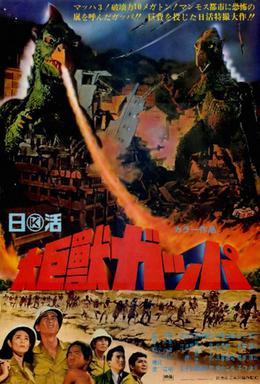
A wealthy publisher wants to open a tropical island resort in Japan.  (You see?)  He wants to fill it with exotic animals, and among those in the model are dinosaurs.  His expedition to collect specimens leads a Japanese crew to discover a newly hatched gappa, which they take back to Japan.  (The publisher, concerned that their find has been exaggerated, utters the title of this post.)  Meanwhile, back on Obelisk Island, the gappa parents return and aren’t pleased to find their baby gone.  They head to Japan to stomp around, Godzilla style.  It takes the sole survivor from Obelisk Island, a young boy, to figure out that the parents really only want their baby back.  The publisher, scientist, and journalist (all male) don’t want to give it up.  The female lead, also a journalist, convinces them that they must.  Japan is saved.

Kaiju have more recently become somewhat believable, and even a bit scary.  The monsters themselves seem to be metaphors.  It’s no accident that these early movies, such as Gappa, expend much of their screen time on explosions.  From the artificial volcano on Obelisk Island to the model tanks and missiles, to the plumes rising as the gappa lead to destruction, things are always blowing up.  The Japanese think at first that “Gappa” is a god, but the local boy who survives is emphatic that “Gappa” is “no god.”  Yet the locals are careful not to raise their wrath.  These movies aren’t great in any traditional sense, but they are imbued with reminders of war—no god—and the lasting damage it causes.  And the wealthy can lead to the destruction of many cities for the sake of making money off of a stupid burnt lizard.

Parthenogenesis

It’s only a matter of degree, isn’t it?  I mean between reptiles and mammals.  While our common ancestor was quite a bit older than Lucy, we’re still fam, right?  I’m not the only one, I’m sure, who read with interest the New York Times story about the female crocodile who recently gave birth without the help of a male.  It’s called parthenogenesis and, according to the article, it’s not as rare as we might think.  Birds and amphibians do it.  Some fish even change gender under reproductive pressure.  And if you’ve seen Jurassic Park you know the implications might be larger by an order of magnitude or two.  My mind, however, wanders to mammals.  Then primates.  Then humans.  If our distant cladistic cousins can do it, can we?

The key appears to be males leaving females alone long enough.  As Malcolm says, “life will find a way.”  Life amazes me.  While we can’t count on it happening for each individual, life has a way of reemerging when you think it’s gone.  Previous owners of our house neglected a green ash tree growing in a location far too close to the house itself for many years.  Granted, it was on the north side where you seldom have any reason to go, but that tree sent out progeny that I’ve had to try to eradicate for five years now.  As much as I love trees, when they’re growing into the foundations of your house, they’re a bit of a problem.  I snip off the water shoots whenever I find them but they keep coming back.  I’m sad to cut them but I admire their persistence.  Life’s persistence. It’s will to carry on.  It continues even when we think it can’t.  Never forget the water bears!

Just a few days later the Times ran an article about the strong possibility of life on Enceladus, one of Saturn’s moons.  Personally, I wouldn’t be surprised.  I’m absolutely certain there’s life elsewhere.  It makes no sense for it not to be.  Life evolves to a point, it seems, where the “intelligent” variety seems to become arrogant.  I embrace our reptilian and amphibious and piscine cousins.  Even our insect and arthropod family.  Our plants and fungi.  Life is amazing and we seldom stop to ponder just how wonderful and mysterious and resilient it is.  A lonely female crocodile decides to have a family.  Phosphates spewing from an ice-cold moon whirling around a colossal planet that wanted to be a star.  Life!  How can we not be stunned into trying to admire it in its many, many forms?


Dinosaur Planet

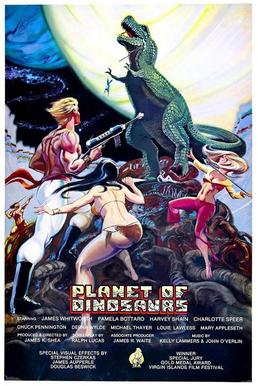
Time, as the crew of the Odyssey finds out, can cast things in a different light.  Admittedly I watched Planet of the Dinosaurs because it was free on Amazon Prime and I was having trouble keeping awake on a weekend afternoon.  It’s the kind of bad movie I’d’ve loved as a kid, and if I’m honest, I still do.  Although it was released in 1977 (it’s hard to believe Star Wars was the same year) the award-winning (!) stop-motion dinosaurs are so unbelievable that it hardly seems possible that the film’s budget was almost all spent on them.  It certainly didn’t go to pay a writer because the dialogue is about the cheesiest I recall ever hearing.  Jurassic Park was still a decade and a half away, after which no stop-motion dinosaur would ever be credible again.

Still, bad movies aren’t all bad.  In fact, there’s an aesthetic to them.  For me the real draw, as with an Ed Wood movie, is that these directors were struggling against an inadequate budget.  This isn’t in the Spielberg league.  And you can only afford so much.  The idea is akin to that of Planet of the Apes—which benefitted not only by a better budget but by a script by Rod Serling.  A planet similar to earth but caught in a different time.  And it’s a chance to explore what it would’ve meant for people and dinosaurs to coexist, which, despite some ark hawkers, never happened.  If it had we probably wouldn’t be here to make bad movies about it.

Our set of nine castaways manage to survive with only four eaten by dinosaurs.  And when these stop-motion reptiles aren’t on screen, the people are filmed walking, inanely talking, or thinking that a stockade of sticks and twine will keep out nine metric tons of Tyrannosaurus Rex.  There’s an attempt at social commentary when the vice-president of the company funding the mission realizes that he’s not the boss among castaways.  Where there’s no money, the balance of power shifts.  Of course, he gets impaled by a Centrosaurus.  At the end, the five survivors have settled down, built a house, and started having children.  They look pretty good for having survived on dinosaur meat and berries.  It helps that the corporate VP isn’t around.  I watch movies like this because, like James Shea, I’m on a tight budget.  And Amazon Prime often dictates what I watch when I’m having trouble keeping my eyes open. 


The Parable of the Dates

Speaking of resurrection, a news story I saw on Agade, apparently originating in the New York Times, tells of dates.  The kind you eat.  These dates were newsworthy because they were grown from seeds two millennia old, found in an archaeological dig in Israel.  The story shows just how tenacious life can be.  Seeds dead for centuries came back to life and bore fruit.  Things like this fill me with an optimism about this thing we call life.  Two thousand years is a long time to be buried.  These seeds nevertheless came back when the conditions were right.  There’s a parable here.  The parable of the dates.

Tardigrades are remarkable.  Sometimes known as “water bears” or “moss piglets,” they are actually microscopic animals.  Google them and take a look.  The amazing thing about tardigrades is their ability to survive.  Although they are animals, they can go three decades without food or water.  (Not quite the same as two millennia, but trees have their own remarkable abilities.)  Tardigrades can survive temperatures as low as absolute zero and higher than boiling.  Scientists study what makes these little critters so sturdy, but the takeaway for me is that life is remarkably resilient.  Given that Republicans and their ilk seem set on destroying the planet, it is comforting to know that life will continue, even if without our particular species to appreciate it.

The idea has been expressed in many ways over the years.  Doctor Malcolm in Jurassic Park says “Life will find a way.”  Stephen Jay Gould wrote in Bully for Brontosaurus that when we talk of the destruction of the earth what we really mean is the end of our own survival.  The planet—life—can and will persist.  The funny thing is that we don’t really have an accurate understanding of what life is.  If a tardigrade can be revived after thirty years without water, isn’t this an exuberant expression of what life can do?  And what about the Galapagos Tortoise, surviving a century-and-a-half?  If we leave them alone, sea creatures can live even longer.  Bowhead whales last two hundred years while at least one Greenland shark doubled that.  And the news story about dates raised from two-thousand-year-old seeds indicates something wondrous about life.  It persists.  These dates are from the time of Jesus and the Roman Empire.  Some trees, such as the bristlecone pine, have been continuously alive for double that span.  We should be in awe of life.  And we should act like it, for it will outlive us by a long stretch.


Dinosaurs, Old and New

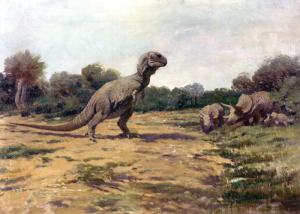
T._rex_old_posture

Tyrannosaurus rex, aside from being a photogenic movie star, was one of the top predators of its day. Ironically, in the Jurassic Park original trilogy (which would have been, more appropriately Triassic Park) tyrannosaurus rex becomes the ultimate protagonist, while unfeelingly killing to meet its own instincts. Since saying “tyrannosaurus rex” wears you out, we’ve become accustomed to calling the great carnivore t-rex. Everyone knows t-rex when they see it. Its a sign of danger, aggression, and unthinking acquisition. In one of nature’s great ironies, however, t-rex had tiny arms, nearly vestigial. What it wanted it had to get with its mouth. To live like that you have to grow pretty big, so big that nobody else can really challenge you. Punching is out of the question.

I’m often struck as how appropriate dinosaur evolution is to the human situation. Dinos (because “dinosaurs” is also too long) grew to be the top life-forms of their day. (We like to think of being the top. The perspective from down here in mammal land, in those days, was pretty different.) If you’re big enough, who’s going to stop you from taking what you want? Endless rows of teeth and a constant hunger can do wonders for evolutionary development. But then, extinction. Recent analyses have shown that it wasn’t as simple as an asteroid strike. It seems that many features of nature conspired against the dinosaurs, including the tyrant lizard king. T-rex had evolved into the monster featured in many pre-teen nightmares, only to be replaced by birds and mammals. Maybe it grew too big to be supported by the planet that allowed it to crawl out of the slime eons before.

In a recent photo of a Trump rally, one of the signs of a supporter had flopped over leaving just the word “rump” visible. I had to ponder this. T-rump. “Dinosaur” is a word used today to mean something that has outlived its time. Ideas, as well as such practices as, say, claiming that one race is superior to others, have rightfully gone extinct. There are those who say that t-rex was less a fierce carnivore than a scavenger. A vulture rather than an eagle. They claim that such a large snout and such small arms better suit one who picks at that which is already dead instead of working hard to bring down the more challenging beasts, often with horns. I’ve always thought dinosaurs were very appropriate metaphors for the human situation. Even Jurassic Park was superseded by Jurassic World, after all.


The Found World

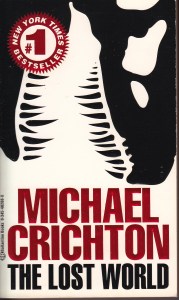
LostWorldChallenges will make you do funny things. One enjoyable dare has been Modern Mrs. Darcy’s Reading Challenge. With a modest twelve books in twelve months goal, the specific target is to read the types of books laid out. Into one of those categories, for me, fell Michael Crichton’s The Lost World. It’s sad that I feel I need so many disclaimers—I never really outgrew my love of dinosaurs—such escapist literature is indeed a guilty pleasure. Crichton could write a quick read, not bothering to pause for literary hindrances, and this novel fits the bill. It always surprises me when at the end of a traumatic story where friends die (this time ripped apart by reptilian carnivores) that the protagonists escape and never mention the dead. They joke, explain holes in the story, and generally look forward to a better, raptor-free future. There is, however, some food for thought here, among the lucre-grubbing sequel to Jurassic Park.

The first religious element that caught my attention was resurrection. Ian Malcolm rather convincingly died in Jurassic Park (and even an unconvincing death works for most people). In The Lost World he’s suddenly back again, with a barely disguised deus ex machina, and is as diffident as ever. The other former protagonists know better than to return to an island full of dinosaurs. Resurrection is a time-honored literary trope. So much so that it’s sometimes difficult to believe that death is in any way permanent. Well, come to think about it, the dinosaurs too are resurrected. Do reptiles have souls? Crichton’s dinosaurs seem to.

Then, just over halfway through the story, I was stunned. The chapter, or section, called “Gambler’s Ruin” explains how science and religion (or the humanities in general) are really the same. I couldn’t believe that a bestselling novel actually took the point of view that scientific objectivity is just as fraught as post-modern literary theory. There is no way to observe without influencing. When a conscious presence enters the equation, the facts have to counterbalance in return. Many, of course, would disagree in principle. Still, this unexpected bit of profundity stopped me in mid-chomp. Materialism, beguiling as it may be, doesn’t explain Heisenberg or Schrödinger. It takes a resurrected mathematician to do it. No wonder chaos abounds in this world where dinosaurs still rule the earth.


Top Predator

Jurassic_Park_III_poster

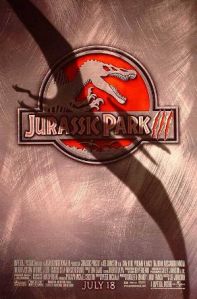
The reboot of Jurassic Park, Jurassic World, has been on my mind. Back in the early days of this century I hadn’t bothered to see either Jurassic Park II or III. The original, despite its faults, was like a childhood dream come true. I’ve always felt that dinosaurs (along with vampires and pirates) made for the best movies, although space has to be right up there in the top since 2001 (not the year, the movie). Since the summer I’ve made a point to carve out time to finish out the holy trilogy of dinosaur flicks. I liked the character Dr. Malcolm in the original, but he should’ve never been the main character of the sequel. The Lost World almost lost my resolve to see the series through. The story was unvarying: humans meet dinosaurs, dinosaurs chase humans. New and innovative means of trying to contain or exploit them try to demonstrate the evils of hubris and greed, but dinosaurs always prevail. Jurassic Park III was a bit better, going back to the original formula but adding something bigger than Tyrannosaurus Rex—the Spinosaurus. It was unbelievable, however, that a paleontology doctoral student couldn’t recognize it, thinking it a mere Suchomimus. At the turn of the century, new dinosaur finds had suggested that Spinosaurus was larger than T-Rex, and the movie reflected the new top predator of the time.

It is the little boy in me that keeps me coming back for dinosaurs. Some of my favorite toys were cheap, molded plastic dinos, and when my daughter was young we bought her all the more realistic (and pricey) Safari versions. When I get to the store, I still stop and look at the species we never acquired and make a wish. I think it’s because dinosaurs represent something we can never have. Species that grew to enormous size and had armor-like skin, and even, if some paleontologists are to be believed, considerable intelligence. Of course, that may just be the movie talking. In a world where all things are equal, we’d never stand a chance against dinosaurs. They are like reptilian deities.

When Amanda Kirby (ironically, the only adult to be addressed by first name in the movie by new acquaintances; the males are called by their titles even after they’ve been through several dinosaur attacks together) sees the incubators at the compound, she says, “So this is how you make dinosaurs.” Dr. Grant (let’s give him his title) responds, “No, this is how you play God.” Playing God is a trope as old as science itself. Planting crops to grow where you want them to grow is playing God in its own way. Creating uncontrollable forces that can destroy you seems to be a uniquely human trait. And so my imagination is drawn back to dinosaur days. Those who make the movies tug on wishes that any mere creature would have: to create its own gods and somehow manage to survive them. Hubris, it seems, is just as human as dreaming of dinosaurs.


Monsters, in Theory

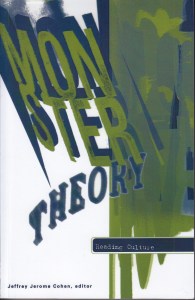
MonsterTheoryI want to understand monsters. I suppose that’s pretty common among Monster Boomers, but the thing is academics have been slow to give credence to our creatures. Yes, monsters are a throw back to the Medieval Period or worse, and reflect superstition, the supernatural, and things that go bump in the night. Our scientific worldview has no place for them, but they continually come back to peek in our windows and stomp on our cities. Horror movies, for example, consistently rate high in box-office grosses. And even adults, if caught in unguarded moments, might confess to enjoying the uncanny. So it was that I read Jeffrey Jerome Cohen’s Monster Theory: Reading Culture. Yes, it’s dated, but by humanities’ standards, it’s not too bad. Jurassic Park, one gets the feeling, was the rage when the book was being written.

As with most collections of essays, this is a Forest Gump of papers. Some of them were quite good and others were that kind filled with po-mo nougat. The one thing that was missing, sadly, is, well, monster theory. I’ve read just about every academic book available on monsters. I have yet to find a serviceable theory to help make sense of them. Yes, there are plenty of theories of origins—where monsters come from—but how to we handle them? Everyone knows that a stake is useful for vampires and a headshot is necessary for a zombie, but what are these revenants telling us really? Why do we still, when we can carry the internet in our pockets and call for help in the middle of nowhere, fear monsters? How do we construct, rather than deconstruct them?

Psychologists, of course, have a couch day with monsters. They represent parents, or phobias, or penises, or any number of things that make us uncomfortable. But how do we know a monster when we see it? Monster Theory, for example, has two chapters on conjoined twins. Now, at the time “monster” was a term used occasionally, but it is highly insensitive, let alone politically incorrect, to refer to humans that way. Then there were chapters on vampires and ghosts. Well, I suppose the dead can’t help their state either, but if they come back they could at least behave. Monstrosity is a concept, like religion, that we just can’t live without. We need our monsters in the dark just as we need dreams and desires. The question is what to do about them, and even after reading this weighty tome, I still don’t know.


Random Science

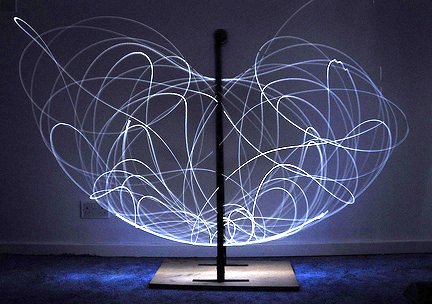
Our world is defined by science. Empirical method demonstrates again and again and again that physical properties follow the same tired pattern without any divine intervention. Saturday was Rutgers Day. Instead of our usual visit to College Avenue to sample French cheeses, we went to the Busch Campus of science and engineering. There we were treated to a 90-minute physics lesson that consisted mostly of demonstrations for the kids with things blowing up, glowing, and being broken after being dipped in liquid nitrogen. Outside the building we watched a chaos pendulum which a grad student explained never followed a predictable pattern. Back in the day when I was subjected to religious rules stricter than any laws of physics at Nashotah House, I used to read about chaos theory. It is the most biblical of scientific ideas. As anyone who’s watched Jurassic Park knows, it means that ultimate predictability is futile. Well, there’s more to it than that, but I’m merely an amateur.

Returning home, I read an interview with Matthew Hutson, about his new book The 7 Laws of Magical Thinking: How Irrational Beliefs Keep Us Happy, Healthy, and Sane. It is now on my wish-list, but I haven’t read it yet. Despite the fact that Hutson is an atheist, he recognizes that magical thinking is both healthy and unavoidable. A door creeps open for the scholar of religion here. We are able to see that non-rational thought is human, so very human. We don’t often think about how driven we are by our emotions. When we see a friend we ask, “what do you feel like doing today?”, not, “what do you think like doing?”. Visiting someone recovering from hard times we ask how s/he is feeling, not thinking. Emotion is, after all, built on the root of “motion”—it is our motivating factor. Seldom is it scientific.

Not to demean science. I have read science books and magazines on my own since I was a teenager. The truths that have been revealed through science are endlessly fascinating and pragmatic. They work in a way religions seldom do. Nevertheless, I became a scholar of ancient religions, studying them scientifically. In the Middle Ages it was said that philosophy was the handmaid to theology. Truth was revealed, not discovered. Reason, thankfully, began to show the way forward. The epithet Dark Ages gained currency for a reason. Science is our means of comprehending our universe, and yet, superstition is hardwired into our brains. I am glad for the scientific worldview even when the chaos pendulum still swings crazily, unpredictably before me. Seldom do those in my field get to consider themselves Renaissance women and men. The pendulum swings where it will.

George Ioannidis' chaos pendulum


Misjudging Dinosaurs

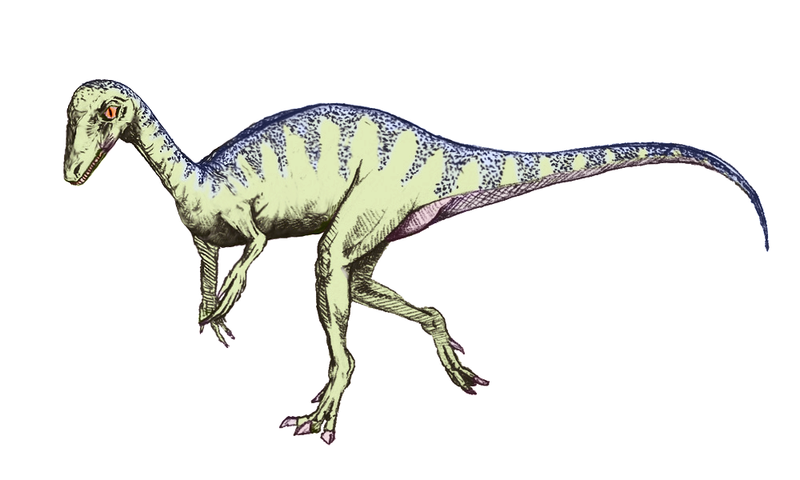
Two dinosaurs diverged in the middle of evolution, and I’m not at all sorry that they both flourished. One became an herbivore, harming no one but plants, while the other grew into a carnivore, eating its siblings. That’s the way of this evolutionary universe. The Eodromaeus and Eoraptor split took place near the very inception of the dinosaur form, with the most basic of existential options: eat or be eaten. Noted paleontologist Paul Sereno has been excavating these Argentinean Lilliputian dinosaurs and has detected that the species, while similar, had irreconcilable food preferences.

Dinosaurs are often relegated to the age of children. When we grow up, we’re supposed to take interest in more modern developments and leave the dinosaurs in the dust. Their value, however, is often underappreciated. We learn about our world by examining theirs. Identification is subtle and sometimes wrong. Little Eoraptor is now thought to have been the plant-connoisseur, despite the terrifying, Jurassic Park-sounding name. We call them what we think they might be. Further discovery often changes the complexion of the picture.

When forced into a choice of more adult occupations, perhaps I unwittingly rebelled, choosing to study ancient religions. Like dinosaurs, religions evolve. As a child it was far easier to tell the preferences of dinosaurs since their morphology often gave them away. Religions are much more subtle. We are told that some dinosaurs survived in the form of birds. Many, many millennia of evolutionary pressure reduced their size and morphed their scales into feathers. Sometimes it’s hard to recognize a carnivore even when it’s just outside your window. That’s the way it works. Some follow the herbivore track, others prefer the way of the carnivore.

It's not the Eoraptor you think you know (from WikiCommons)


Jurassic Playground

Over the weekend I watched Jurassic Park for the first time in many months, perhaps even years. Despite the caricatures that substitute for believable characters, the dinosaurs are mostly believable and the warning tone appropriate. Throughout Dr. Malcolm cautions against “playing God” – an interesting perspective for a character who ascribes so fully to chaos theory. So when the television was off and the dinosaurs once again safely extinct, I continued to ponder this notion of “playing God.”

Quite often the phrase occurs in two main contexts: those of science and ethics. When humans have discovered the naturalistic explanation for a phenomenon and devise a human means of altering it, we are then in the realm of “playing God.” It seems to me that this is only a difference of degree from what people, and other creatures, have always done. Does not every action we take have endless ramifications? In our own little chaotic system, our decisions and activities impact others just as surely as a T-rex stomping through the park. It is only a matter of degree.

As human beings we may be the only animals that consciously “play God,” but the truth of the matter is that we are all pieces in an intricately interconnected system. Animals, even plants (behold the kudzu!), influence the activities of others, changing courses of rivers, degrading the environment, blocking the paths of ants, ant-eaters, or ant-eater eaters. What could be more natural than “playing God?” This, of course, doesn’t change the ethical angle, but throws it open much wider. Should we clone dinosaurs? Should we clone people? Don’t ask me – I’m too busy playing God in my own little corner of the world.

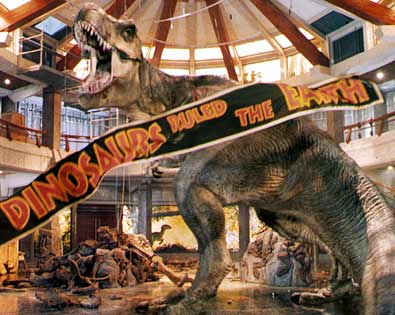
T-rex plays God


Missing Links

Dinosaurs hold a fascination like few other creatures. Perhaps it is because of their exotic and tragic rise to dominance and their meteoric plummet to obscurity. Maybe it is because of their impossibly creative adaptations to their environment leading to frills, fans, and pointy bits in unexpected places. It might even be that they reveal our own future to us. Whatever the reason, dinosaurs still rule.

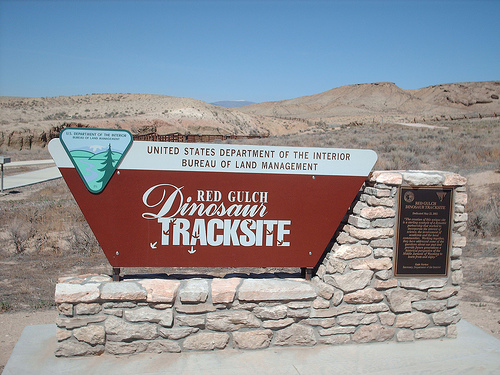
In the news yesterday, a man was arrested for stealing a dinosaur. Not a Jurassic Park living model, but a fossil excavated from private land in Montana. A few years back I took my family on a dinosaur-based trip to the west. Trundling across the endlessly flat eastern half of Wyoming, I insisted that we turn down a rutted and washed out dirt road to an obscure site where dinosaur footprints had recently been discovered. Rolling into Red Gulch (seriously!), we were, surprisingly, not the only people there. Staring down at my feet next to the fossilized prints of some ancient carnivore was like feeling the very pulse of evolution. There was no fear of divine retribution here, just a sense of tangible continuity with a long and very distant relative on the tree of life. Creationists insist that dinosaurs and other creatures were each separately created, fearing, I suppose, an interspecies miscegenation, in keeping with their overall fear of sexuality. I was envisioning myself shaking claws with cousin dilophosaurus.

There be monsters here

Over the years we’ve made many dinosaur trips, stopping at dinosaur museums in North and South Dakota, Montana, and Colorado. Once, at Makoshika State Park in Montana, where you can walk along and see dinosaur fossils in situ, we heard a couple exclaim to the flustered park ranger, “but how can that be when the world is only 6000 years old?” Dinosaurs are symbols. They represent the ultimate in stature and environmental dominance, while at the same time hosting brains that struggled to rival a humble grapefruit. As I read the other, more serious, headlines I realize how much we are like our very distant cousins.


Make Room on the Ark — Another New Dinosaur!

Enter Aardonyx celestae! A new dinosaur announced yesterday in South Africa is being hailed as a missing link in the sauropod chain of development, much to the chagrin of Creationists. I have to admit that I never outgrew my childhood fascination with dinosaurs, and when we purchased the life-like models for my daughter as she was growing up I secretly coveted them for myself. The rate of discovery among new genera of dinosaurs is between 10 and 20 per year, meaning that the maybe 20 different dinosaur types I knew as a kid has ballooned into well over 500 different species and 1,800 genera. Late at night I still hear the call of paleontology and I slip Jurassic Park into the DVD player and weep.

With each new dinosaur discovered Noah’s ark must evolve into a larger boat for some among the Creationist camp. After all Genesis says “two of every kind” lumbered aboard. The newbie this time is a proto-sauropod, a missing link between bi-pedal herbivores and their earth-shaking descendants who required four tree-like legs to support their immense weight. It seems that Noah must have been quite the engineer to handle all this displacement. And it is a good thing too — scientists predict that the new genera to be discovered represent only about 30 percent of the total, and the number will likely continue to climb for a century and a half yet.

Dinos

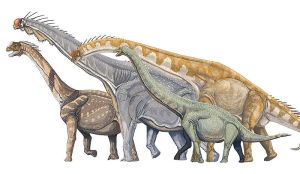
Wikipedia proto-sauropods race for the top deck

So it seems that the God-of-the-gaps grows smaller while the ark grows larger. Of course, the dinosaurs might have evolved into all these different genera over time, but then, Creationists can’t allow for that, since it would admit room for evolution. And that seems about as likely as the Church of Jesus Christ of Latter-day Saints backing anti-discrimination laws against homosexuals!