Dinosaurs, Old and New

T._rex_old_posture

Tyrannosaurus rex, aside from being a photogenic movie star, was one of the top predators of its day. Ironically, in the Jurassic Park original trilogy (which would have been, more appropriately Triassic Park) tyrannosaurus rex becomes the ultimate protagonist, while unfeelingly killing to meet its own instincts. Since saying “tyrannosaurus rex” wears you out, we’ve become accustomed to calling the great carnivore t-rex. Everyone knows t-rex when they see it. Its a sign of danger, aggression, and unthinking acquisition. In one of nature’s great ironies, however, t-rex had tiny arms, nearly vestigial. What it wanted it had to get with its mouth. To live like that you have to grow pretty big, so big that nobody else can really challenge you. Punching is out of the question.

I’m often struck as how appropriate dinosaur evolution is to the human situation. Dinos (because “dinosaurs” is also too long) grew to be the top life-forms of their day. (We like to think of being the top. The perspective from down here in mammal land, in those days, was pretty different.) If you’re big enough, who’s going to stop you from taking what you want? Endless rows of teeth and a constant hunger can do wonders for evolutionary development. But then, extinction. Recent analyses have shown that it wasn’t as simple as an asteroid strike. It seems that many features of nature conspired against the dinosaurs, including the tyrant lizard king. T-rex had evolved into the monster featured in many pre-teen nightmares, only to be replaced by birds and mammals. Maybe it grew too big to be supported by the planet that allowed it to crawl out of the slime eons before.

In a recent photo of a Trump rally, one of the signs of a supporter had flopped over leaving just the word “rump” visible. I had to ponder this. T-rump. “Dinosaur” is a word used today to mean something that has outlived its time. Ideas, as well as such practices as, say, claiming that one race is superior to others, have rightfully gone extinct. There are those who say that t-rex was less a fierce carnivore than a scavenger. A vulture rather than an eagle. They claim that such a large snout and such small arms better suit one who picks at that which is already dead instead of working hard to bring down the more challenging beasts, often with horns. I’ve always thought dinosaurs were very appropriate metaphors for the human situation. Even Jurassic Park was superseded by Jurassic World, after all.

Top Predator

Jurassic_Park_III_poster

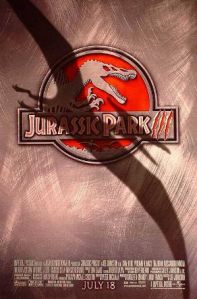
The reboot of Jurassic Park, Jurassic World, has been on my mind. Back in the early days of this century I hadn’t bothered to see either Jurassic Park II or III. The original, despite its faults, was like a childhood dream come true. I’ve always felt that dinosaurs (along with vampires and pirates) made for the best movies, although space has to be right up there in the top since 2001 (not the year, the movie). Since the summer I’ve made a point to carve out time to finish out the holy trilogy of dinosaur flicks. I liked the character Dr. Malcolm in the original, but he should’ve never been the main character of the sequel. The Lost World almost lost my resolve to see the series through. The story was unvarying: humans meet dinosaurs, dinosaurs chase humans. New and innovative means of trying to contain or exploit them try to demonstrate the evils of hubris and greed, but dinosaurs always prevail. Jurassic Park III was a bit better, going back to the original formula but adding something bigger than Tyrannosaurus Rex—the Spinosaurus. It was unbelievable, however, that a paleontology doctoral student couldn’t recognize it, thinking it a mere Suchomimus. At the turn of the century, new dinosaur finds had suggested that Spinosaurus was larger than T-Rex, and the movie reflected the new top predator of the time.

It is the little boy in me that keeps me coming back for dinosaurs. Some of my favorite toys were cheap, molded plastic dinos, and when my daughter was young we bought her all the more realistic (and pricey) Safari versions. When I get to the store, I still stop and look at the species we never acquired and make a wish. I think it’s because dinosaurs represent something we can never have. Species that grew to enormous size and had armor-like skin, and even, if some paleontologists are to be believed, considerable intelligence. Of course, that may just be the movie talking. In a world where all things are equal, we’d never stand a chance against dinosaurs. They are like reptilian deities.

When Amanda Kirby (ironically, the only adult to be addressed by first name in the movie by new acquaintances; the males are called by their titles even after they’ve been through several dinosaur attacks together) sees the incubators at the compound, she says, “So this is how you make dinosaurs.” Dr. Grant (let’s give him his title) responds, “No, this is how you play God.” Playing God is a trope as old as science itself. Planting crops to grow where you want them to grow is playing God in its own way. Creating uncontrollable forces that can destroy you seems to be a uniquely human trait. And so my imagination is drawn back to dinosaur days. Those who make the movies tug on wishes that any mere creature would have: to create its own gods and somehow manage to survive them. Hubris, it seems, is just as human as dreaming of dinosaurs.