In the Water

On a list of hard-to-watch horror, I found the South Korean offering The Isle.  I was feeling particularly brave that day, I guess.  I was unfamiliar with Kim Ki-duk’s work, and looking for something that wouldn’t cost me any money to watch.  I found out this was one of those vomit or faint body horrors, but it is otherwise filmed so beautifully and gently that the contrast is downright shocking.  It all takes place at a low budget fishing platform rental business where the proprietor is a mute woman.  She ferries customers to their platforms, delivers food, and female companions, and occasionally takes revenge when customers treat her badly.  One day a fugitive arrives.  She doesn’t immediately know that he’s on the run, but she’s intrigued by him.  She prevents a suicide attempt and the two begin to bond.
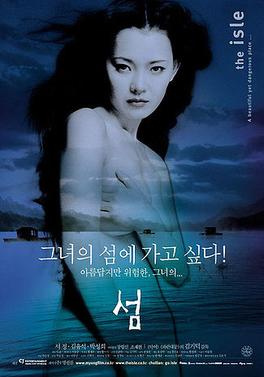
Wanting to make sure her customer is satisfied, she starts bringing him a prostitute, but she gets jealous when they start to bond.  When the police come to find potential fugitives, he again tries to kill himself in a particularly gruesome way.  (Probably one on the vomit scenes.)  The proprietor again saves him and hides him from the police.  Apparently drawn to that type, she gets close to him and sees the prostitute as a threat.  She kidnaps the woman and when the prostitute falls in the water, hands and feet tied, she drowns.  The proprietor sinks her body and when the pimp comes looking for her, she drowns him.  The fugitive now realizes that they both have murder in common, but he feels trapped and escapes with her boat until she uses a reverse method of his suicide (another vomit scene) and he rescues her.  The police discover the bodies of their victims and the two take the platform house to a hidden location.  Apparently Kim Ki-duk likes enigmatic endings because the final scene is the proprietor drowned in a partially sunken boat.

I’m not quite sure what to make of this one.  I would agree with the hard-to-watch assessment.  Not only are there gruesome, self-destructive acts, I’m pretty sure that some animals were harmed in the making of the film—particularly fish.  I’m not often in the mood for body horror, but sometimes when I’m trying to save money, I’ll settle.  I very much doubt I’ll ever watch The Isle again.  K-horror is sometimes compelling, though.  This one manages to be emotional, and of art-house quality, but the only monsters are humans and they seem more to be misunderstood than anything else.  And I didn’t vomit or faint.

Another Host

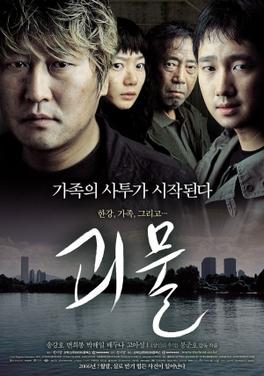
Several months ago I wrote about The Host, a movie I enjoyed but had watched by mistake.  By that I mean that someone had recommended The Host (2006) and I watched the completely unrelated The Host (2020).  (You can’t copyright titles.)  I waited long enough that the right Host became available on a service I use so it was, in essence, “free.”  This one is a Korean monster movie, directed by Bong Joon-ho.  I’d previously seen his excellent Parasite, and The Host didn’t disappoint in either the social commentary department or in the heart-felt monster tale.  In the latter department it has some common ground with Godzilla Minus OneThe Host begins with chemicals poured in the Han River causing a mutation that becomes a big problem.  This monster kills many, but the story focuses on the Park family where a ne’er-do-well father (Gang-du) disappoints his daughter and siblings.  Then the monster carries off his daughter.

The government, wishing to hide the origins of the creature (an American military facility did the chemical dumping) invent a virus story to keep people away from the river where they have trouble locating the monster.  Meanwhile Gang-du learns that his daughter is still alive, being kept as a future meal in the creature’s lair.   His father, sister, and brother all come together to try to find her, having to work around the corrupt government response to the crisis.  In other words, there’s a lot going on here.  The monster is believably rendered and its interactions with crowds of people don’t strain the imagination.  I do have to wonder if the creators of Stranger Things were familiar with this film.  Again, there’s some overlap there.  There are some holes in the plot, or it may be that I didn’t quite get everything (quite likely regardless).

It’s easy to see why the movie won so many awards.  The question that haunts me is whether this is a horror movie or not.  There are definitely horror aspects, but the overall feel is a meaningful monster movie, which isn’t really a recognized genre.  Monsters sometimes—often, in fact—bring out the best in people.  Without giving too much away, we can say that about this movie.  A family torn apart is reunited by a monster.  It doesn’t end well for them, but they have learned something by the experience.  And the movie is impressive from a cinematic perspective as well.  So now I’ve had two Hosts and although quite different from each other, both are recommended.


Wondering Wailing

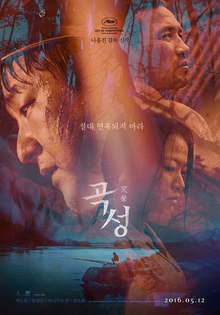
You have to wonder, it seems to me, if the western, imperialistic gaze sometimes overcompensates for its past sins.  We remain reluctant to say we don’t understand something and sometimes even declare such things superior to what we produce.  That was the feeling that came over me upon reading about The Wailing.  Don’t get me wrong—I like K-horror well enough, but I’m not sure that I would say, with some critics, that it leaves American horror in the dust.  It’s good, yes, and it’s very long (two-and-a-half hours seems too long for a horror film).  The story doesn’t answer all the questions it raises and I was looking for some kind of religious message.  That’s why I watched it in the first place.  

What’s it about?  That’s hard to say.  The best that I can do is it’s about the doomed family of a Korean police officer in a small village.  As others have pointed out, this movie has ghosts, demons, zombies, exorcisms, and other horror standards.  There’s a considerable amount of Christian versus shamanism interplay.  And it seems okay, when someone else is doing it, to suggest a foreigner is the Devil.  None of this is intended to take away from the fact that the movie is effective.  I particularly found the shamanistic exorcism scene fascinating.  The thing is, you never really learn if the self-admitted Devil at the end is working with the shaman or not.  Or if the third potential villain, a woman named “No Name,” is in on it with them.  Or maybe I’m looking at this from the wrong angle.  Maybe the policeman’s family is simply doomed.  Nothing they can do changes that.

The movie suggests that such things are like fishing.  You can’t be certain who’s going to take the bait.  According to those who know, apparently a deleted scene at the end helps to clarify this a bit.  There is a lot of talk about belief, and a Christian clergyman confronting the Devil.  For me, however, I need to be able to follow a story well enough to figure out whether I’m misinterpreting or not.  The problem with a movie this long is finding the time to go back and rewatch it.  It opens with a quote from the Bible and it uses biblical tropes, such as the cock crowing three times, to make some strong points.  In fact, the opening quote from Luke 24.37-39 implies that the ghost may be God.  One thing is certain, I’ll be mulling over The Wailing for some time.  And maybe someday I’ll start to understand.  In the meanwhile, I’ll still watch and appreciate American horror, inferior though it may be.


Urban Tiger

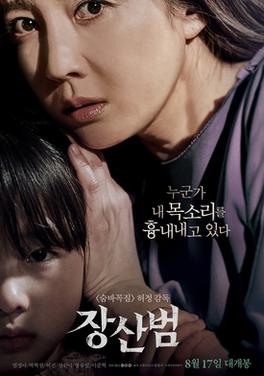
Many things are universal.  Ghosts, for example.  What ghosts do and how they behave, however, can be culturally specific.  The Jangsan Tiger is sort of a ghost and sort of a creature, and it has a religious backstory.  Of course, I’m referring to the Korean horror film, The Mimic.  I found it while looking for Mimic on Amazon Prime, but that definite article made this one free and it had received pretty good ratings.  Released by the careless trespass of a murderer, the Jangsan Tiger stalks a family that really just needs a break.  The parents, Hee-yeon and Min-ho, lost their son five years ago.  They move to Mt. Jang with their daughter (Joon-hee) and his mother, believing that the distance from Seoul will do them some good.  The Tiger, however, has other plans.

Apart from the well-timed jump-startles and stings (this movie “got” me more than once), the story is filled with pathos.  Parenting is probably the biggest emotional gamble a person can take.  The Jangsan Tiger imitates voices and convinces its victims that it is someone they love.  The children actors are particularly effective and their crying is difficult for any parent to watch.  This is horror that pulls at your heartstrings.  The family, as expected, begins to crumble under the pressure.  Religion comes into it because a shaman, ostracized from society, had summoned the Jangsan spirit in a kind of Faustian bargain.  He sacrificed his daughter and now that he’s released again, sacrifices others who are lured into the cave on Mt. Jang.

Interestingly enough, the actual mountain Jangsan—the movie is based on an urban legend—is in real life the site of an active mine field.  Somehow this moves the film from urban legend territory into that of parable.  Many of the scary stories we tell our children are intended to keep them safe from dangers they really can’t comprehend.  Adults plant minefields to make the land unsafe.  The real tiger prowling those lovely hills is one that walks on two legs.  And what that monster craves is human sacrifice.  Now, I can’t claim to understand the entire plot of the film.  Between subtitles and the lack of cultural experience, I’m merely a spectator to something that feels deeper than just a movie.  Those who spend time with horror know that it’s often sophisticated and intelligent.  It’s a genre that appeals to both the mind and to religion.  There’s a reason the shaman stands between worlds.