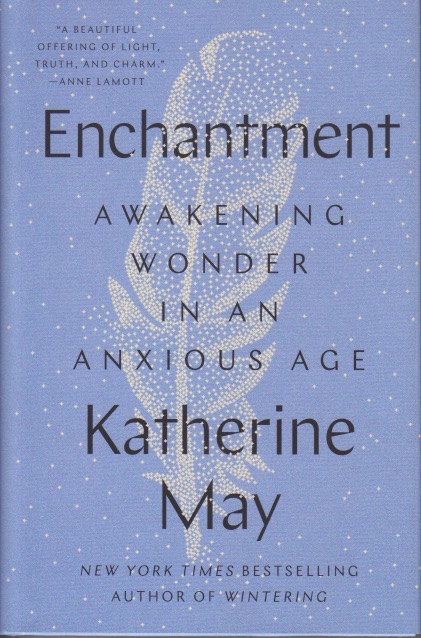
Craving Enchantment

I really want to know, but just can’t figure out, how to write like Katherine May.  My wife and I read her book Wintering and now have added Enchantment.  In many ways I seem to be like May; we may be different shades of neurodivergent, but I understand what she says.  Indeed, at one point in Enchantment she talked me down from a writer’s dilemma that had me worked up for days.  But I can’t write like her.  I have times when my rhetoric for a blog post or two might come close, but I have tried to sustain it for an entire book, so far without success.  My background was perhaps too sullied by academic writing, although May is also an academic, so I may simply be making excuses for lack of talent.

That’s too bad because Enchantment is meant to improve your outlook.  Subtitled Awaking Wonder in an Anxious Age, it consists of life lessons the author learned during the pandemic.  I often, if I allow myself in this constant struggle for my time, experience the sense of wonder May describes.  I enjoy walking in the woods, watching heavenly bodies, staring into a river or pond, and trying to draw lessons from such things.  Lately, however, I find myself rushing through them because I have something else I have to do.  Daily, it’s the 9-2-5, of course.  That schedule overloads my weekends with things that have to be done even if I want to spend time appreciating the enchantment I can find, if I have the time.  Sorry, I’m letting the anxious part take center stage.

This is a wonderful book.  I admire the way that May is able to face down her own struggles with grace and remain open to possibilities.  I found such things much more readily when I was at Nashotah House.  There were moments between classes and there were semester breaks.  We lived in the woods.  By a lake.  There was wonder there, for the taking.  Having a young child to introduce to the wonders of nature definitely helped as well.  Children force you to see through new eyes (it’s not a surprise that May has a young son when writing).  Too quickly we grow up and let capitalism tell us what to do.  It takes so much from us and gives so little.  I’m looking out my window at nature, as I write this.  I know it has enchantment to offer.  I also know that work begins in fifteen minutes.

Springing

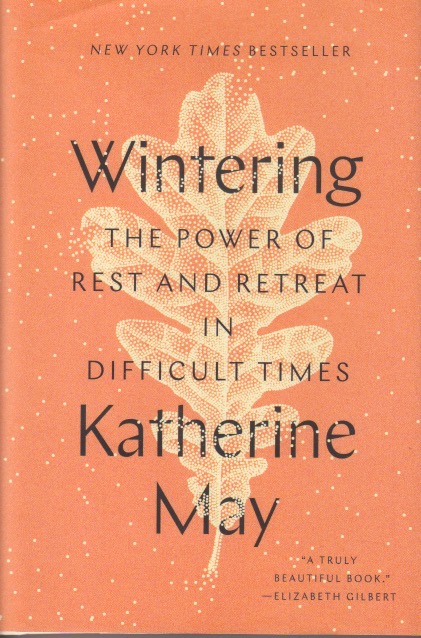
Life, for everyone, has difficult times.  Katherine May has a reassuring, but not always cheerful way about her.  She calls troubled times Wintering.  The subtitle of her book explains that it’s about The Power of Rest and Retreat in Difficult Times.  My wife and I read this one together.  It reminded me, in some ways, of Barbara Brown Taylor’s Learning to Walk in the Dark.  In a society vapidly preoccupied with an often shallow happiness, admitting, even pondering the things that are difficult is an act of courage.  May has a disarming way of writing, a humility and self-deprecation that are an antidote to the brazen self-assurance we too often see in the media.  She looks for lessons in her own experiences of pain and loss, and yes, surviving through winter. 

Winter is often a quiet time of reflection.  In our bright, loud, beeping, buzzing world we don’t take much time for such things.  Indeed, capitalism (which is generally not deep, although deeply engrained) doesn’t encourage it.  “The more you can work,” it whispers in your ear, even while sleeping, “the better you’ll feel.”  Winter slows things down.  Makes life a bit harder.  Think of all those days when you just don’t feel like going outside in the cold, snow, and sleet.  When the chill drives you next to the radiator, covered in lap blankets.  When it’s dark most of the time.  Such are good times to think.  As May shows, when you turn a difficult situation around and look at it from different angles, truths about yourself, about life, begin to emerge.  What is it we’re after that keeps us running all the time, dangerously overheating?  We need winter.

The anecdotes here are deeply personal.  This is particularly difficult for a writer because many of us face rejection frequently.  When you’ve poured yourself into a book, blithe casting aside by agents and publishers hurts.  I admire the bravery and the wisdom of writers like May.  She shows that wintering is possible, and that it is followed by spring.  Lives, she notes, are cyclical.  We can find quite a lot of meaning in that.  I often find myself fearing winter.  The heating bills.  The wearing of many layers of clothes for months at a time.  The dark and cloudy days.  Yet a good part of me welcomes the retreat.  I know that, in the cycle of the year with few days off from work, that if I can make it to Halloween, some rest—some wintering—awaits.  And that is a hopeful thought indeed.