
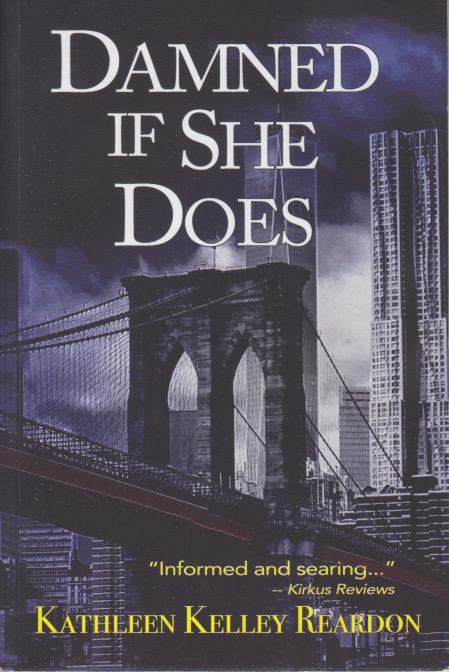
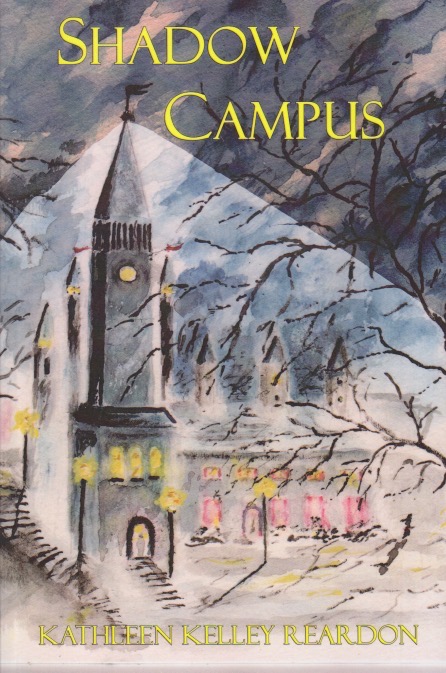
I’ve been to quite a few academic conferences in my life. Some have been held in neighborhoods declared “unsafe.” I even had a job interview in a hotel room (such can’t happen now) with a college that didn’t want to pay the fee for using the society’s services. (A friend who’d also interviewed with the same school said to me afterwards, “I thought they were going to jump me!”) (Neither one of us got the job.) I even went to a conference where I had to drive through a crime-ridden neighborhood to get to an off-site hotel. But I’ve never been to a conference where someone was murdered. That’s the premise behind Kathleen Kelley Reardon’s Damned If She Does. Reardon’s keenly aware of the kinds of issues women face in the professorate. There are some unsavory guys in the profession and power is very difficult to wrest from those who hold it (generally white men). In this follow-up to Shadow Campus, she tells Meg and Shamus Doherty’s experience with murder, and more, at an academic conference.
Academics are so necessary for studying things closely, opening up true understanding. They are, however, people too. And people can be petty, vindictive, and selfish. They’re usually not inclined to murder, however. I’ve been meaning to read that book about the murder of a religion professor at the University of Chicago several years ago precisely because such things are so unusual. In dark academia, however, events like that are fairly common. The thing is, many academics are also quite smart. If someone were to put their mind to an undetectable murder, hmm. The old gray matter starts churning.
In Damned If She Does, the apparent motive is publication in prestige journals. In the end, it turns out that there’s more to it than that, but it’s somehow believable that a matter like publication could lead to homicide in academia. As an editor, and writer, myself, I know how important publication with specific presses can be. Even after doing this for over thirty years, an acceptance notice creates a sense of validation like no other. Dark academia explores such territory. I suspect that I’ve always been a bit naive when I’ve attended conferences. I go, present papers, and keep interactions, well, academic. I’ve heard whispers of them being places of temporary flings and I’ve seen colleagues use them as places to party. On occasion I’ve seen established scholars very inebriated. They’re people too, of course. And as long as nobody is murdered, the code seems to be that what happens at a conference stays at the conference.
 Steve A. Wiggins