What the Devil

Apart from being one of the most controversial films of all time, The Devils is also devilishly difficult to locate.  For as influential as it was (you can’t tell me nobody in Monty Python saw this before making Holy Grail) it has largely been buried, at least in the United States.  It doesn’t stream and to get a viewable copy you are limited to a Spanish language import DVD and have to manually select English as the language if you want to hear it as produced.  The question is if you do want to see/hear it.  Written and directed by Ken Russell, it is over-the-top.  Chaotic and cacophonous, it’s almost distracting and somewhat boring for about half its run time.  Then it turns incredibly violent and grotesque.  So why did I watch it?  Well, for one thing, it was something I knew I could’ve included in Holy Horror, had I been able to access it then.  For another thing, I’d read about it many times and was determined to find it.
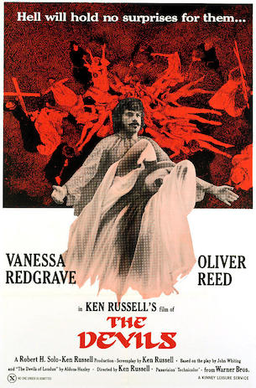
Based on historical events (but stylized to the point of abstraction), the film is about the Loudun possessions of 1634.  Nuns in an Ursuline convent began displaying the kinds of tics that girls would display in Salem some 58 years later.  A local, unconventional priest, Urbain Grandier, was accused of bewitching them and was burned at the stake.  The film makes much of the political machinations taking place, and revels a little too much in the behavior of the nuns.  It also enjoys portraying medieval torture methods and has an almost Clockwork Orangesque feel to it.  Released in 1971, it was given restrictive ratings where it was permitted to be shown, and although some horror has surpassed the excesses in recent years.

Religion’s relationship to horror is a frequent topic of discussion on this blog.  This movie is a textbook example of that.  After my nerves stopped jangling so much, I recollected that Ken Russell was also responsible for Lair of the White Worm.  Another story of debauched nuns and religion gone awry, it made me wonder what Russell’s personal interaction with religion might have been.  He apparently converted to Catholicism and then converted away again.  It certainly doesn’t get much sympathy in his movies.   Father Grandier is somewhat heroic in The Devils, but the overall institution is clearly corrupt.  In some cases religion is the means of fighting horror.  In other cases it is the cause of the horror.  Here the latter is clearly on display, and even that is, unfortunately, over the top.

Fighting with Monsters

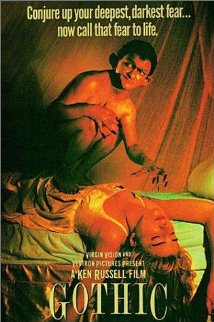
GothicThe Lady and Her Monsters reminded me of Gothic. A friend of mine in seminary showed me this “shocking” movie by Ken Russell just after it was released on VHS (I always was fond of ancient history). To my young eyes this was a challenging film, but it rated higher in moodiness than scariness. Roseanne Montillo’s book brought the movie to mind because, it turns out, several of the incidents in the movie were based on fact. Perhaps I need to take a step back because Gothic never made it big, and many may not realize that the movie is about the legendary night Mary Godwin (soon to be Shelley) came up with the idea for Frankenstein. In an early nineteenth-century walk of fame, Percy Shelley, Mary Godwin, Lord Byron, and John Polidori decided to write scary stories, as a kind of contest. Only two ever made it to print, Polidori’s The Vampyre, which inspired Bram Stoker’s Dracula many decades later, and Mary Shelley’s Frankenstein. The movie, with Ken Russell’s famous flamboyance, traced an unlikely story of the friends conjuring a ghost and then banishing it once again before the stormy night is over.

Ken Russell had the reputation for being obsessed with the church and sexuality. These interests are certainly well represented in Gothic, where Percy Shelley, famously an atheist and believer in the supernatural, struggles to make sense of it all. Polidori, Byron’s personal physician, is presented as a Catholic who admits, when each has to confess his or her deepest fears, that God terrifies him. The friends (perhaps in an unwitting prelude to a television series by that name) explore sexuality and the supernatural through the long night. Waking nightmares meet them at every turn. They even have a skull of “the black monk,” a character attested in all sincerity, at one time, at the most gothic seminary in the Wisconsin woods.

“He who fights with monsters,” Friedrich Nietzsche opined, “might take care lest he thereby become a monster. And if you gaze long enough into an abyss, the abyss gazes also into you.” That which we worship is that which we fear. Certainly the Christianity of the Middle Ages had as much of Hell as of Heaven in it. Bursting out into the light of rationalism, it seems, did not banish the darkness after all. We still have many questions left unanswered, and many intelligent people have begun to question whether any one paradigm fits all of the evidence. I suspect not. Human experience goes in multiple directions at once. We have ladies, we have monsters, we have scientists, we have God. And on rainy nights we have movies that make us see that we have combined them all into a tale often repeated but never fully understood.