Heat Wave

Kim Stanley Robinson’s The Ministry for the Future wasn’t my favorite book read the first half of this year, but reading the headlines about India’s heatwave took me back to it.  That’s precisely the way the book starts out—with an intense, deadly heat wave in India.  As a nation lacking infrastructure in relation to the size of its population, and lying near the equator, India is particularly vulnerable to global warming.  We all are.  As the planet heats up and weather becomes more erratic and extreme, food shortages will appear.  At the moment we’re concerned because Covid and Putin-War have driven inflation to incredible highs.  A trip to the grocery store or gas station is like a horror film.  Meanwhile the planet’s heating up and Republicans are pushing for four more years of Trump environmental degradation.  Can we please open a window here?

Global warming has been challenged by many because of their religious conviction that the world ought to end.  Apocalypse is probably the Bible’s most dangerous teaching.  Speaking only for myself, I didn’t know there was an Indian heatwave until headlines took a break from Putin-War and America’s mass shooting crisis.  And oh, India’s sweltering under temperatures over 110 degrees.  People are dying.  Birds are falling from the sky in mid-flight.  We had a couple days in the 90s around here before the end of May.  Those were some uncomfortable times.  Meanwhile in India it was twenty degrees hotter.

The human ability to ignore life-threatening problems we create for ourselves in service of our theology is remarkable.  Even as experts declare religion is no longer important, it’s slowing killing us.  We focus our resources on making money, as if money will do us any good when we’re the lobsters in the pot.  As a species we’re amazingly capable.  Billionaires can afford their own private spaceships—something most nations in the world can’t spare cash to buy—and we have proven ourselves endlessly inventive.  When it comes to the basics—the need to believe, for instance—we turn a blind eye and pretend it’ll just go away.  Religion scorned is a very dangerous thing.  I once heard a talk by a scientist presenting a rosy technological future.  I raised my hand and asked about religious objections and he mused, “I hadn’t even thought about religion.”  His future was progressive and optimistic.  Robinson’s is quite a bit less so, although it ends by suggesting we might manage to pull through, with only millions of deaths.  As Donovan says, “It’s time to ask yourself what you believe.”

Future Ministry

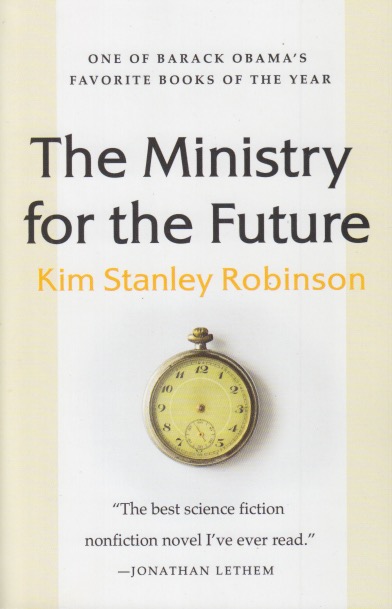
I’ve been on the Green Committee at work almost since I started the job.  Occasionally for Earth Day we’ll have a book discussion.  Usually it revolves around nonfiction books that my press publishes.  This year they selected Kim Stanley Robinson’s The Ministry for the Future.  It’s an environmentalism tale of what global warming may well be like and the political machinations it might take (and the millions of deaths along the way) before we stop burning carbon.  It’s a long and detailed and political story.  Robinson is known as an intellectual science fiction writer and there are sci-fi elements to the book, but its style is realist and its outlook, while ultimately hopeful, is staid.  Even when humans start to move in the right direction.  It’s also a very long book.

Reading it got me to thinking again of a somewhat bewildering truth: environmentalism books tend not to sell overly well and sustained reading, even by supporters, is difficult.  Many of us know that we’re beyond the tipping point for environmental disaster.  The Trump years assured us that it is coming.  One of the elements Robinson makes clear is just how politically entrenched it is.  Perhaps that’s one of the reasons for the despair.  The vast majority of people in the world want a more environmentally conscious government, but plutocracy tends to bring narcissists to the top and the needs of all others are less important.  In Robinson’s version of the story, targeted violence is the only thing that works.  Near the end of the story an interesting idea is raised: the Ministry of the Future (which is a government ministry, not the church kind) concludes a new religion is needed.

The masses of people, you see, are followers.  Religious leaders reinforce the idea that God told their founders—and by extension their followers—the only truth.  Their jobs (and ministries are jobs) include reinforcing those ideas to people who’ve been raised or converted to that particular brand of religion.  A number of New Religious Movements, and even a couple of prescient ancient religions, have been purposely constructed.  The trick is to get followers to accept that the religion is legitimate.  Most western religions around today have been based on the idea that humans can do whatever they want with the planet—even destroy it to force God to return.  I kind of like Robinson’s idea better.  Perhaps that’s why religions form around movies like Avatar.  Not a bad thought, when your job has you reading a sci-fi novel.  A religion saving the earth feels like a novel idea.