Kings and Gods

Kong has never been my favorite monster.  Perhaps because it is more of a sad story than a scary one, and in movies of gigantic animals, there always seem to be scaling problems.  The monsters are only reacting to the circumstances in which they find themselves and humans prove to be the real problem.  In ways nearly impossible to conceive, less than a century ago films like the original King Kong shocked and stunned audiences.  Humans are such visual creatures and no similar spectacle had been seen before.  I recently watched the 1976 reboot for the first time.  I’d seen clips, of course, and kids in junior high were talking about it back when it came out.  For me it was more like “if you know the story already, why see another attempt to tell it?”

Visually, there is a lot of nice cinematography in the film.  We’re all used to CGI so the animatronic Kong isn’t really believable, but nevertheless, our emotions map onto his with the prolonged shots of the gorilla’s facial expressions.  That part was effectively done.  Much of the rest of the movie left too many questions for belief to be suspended.  The heartlessness of corporations was too real and perhaps the scariest part of the movie.  Watching any movie with explosions on the twin towers brings back a kind of post-traumatic 9-11 reaction.  Prolonged, nearly Russian-length, death scenes personally don’t do it for me.

The reason I was watching, however, was for the religious aspect.  This is underplayed, but the islanders clearly worship Kong and consider him a god.  (I did wonder what he ate since no giant fruits were shown, but the immense snake tells us not all was revealed.)  In one reflective moment on the oil tanker back home, Jack Prescott says that they’ve taken the islanders’ god and their society will fall apart.  Western enterprising does have much blood of this kind on its hands.  And no matter how it’s dressed up King Kong always appears to be a racist story.  Some critics say the 1976 version isn’t horror, but instead a kind of bizarre love story.  While I don’t think much thought went into the implications—it seems the movie was a showcase of state-of-the-art animation for the period (otherwise the long scenes of Kong changing faces and blowing on Dwan make little sense)—that accidentally play into tropes of gods falling in love with women.  Maybe there’s a reason I haven’t watched any of the other reboots.

Silverbacks

kong33promo

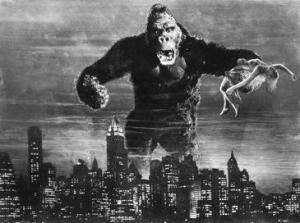
It’s been decades since I’ve seen the original King Kong. A none-too-subtle racist and sexist flick it may be, but it stands as one of the original “horror” films of the early thirties and it has had a profound influence on movies ever since. King Kong wasn’t very nice to Fay Wray, and had to be euthanized by biplane, if I recall correctly. I work one block from the Empire State Building, and sometimes I subtly glance up, looking for the giant ape. There are more fearful sorts in New York these days. I can see Trump Tower, for instance, from the pantry at work where I keep my lunch. But I digress. For its day, King Kong was a violent movie. Like many films, however, it is also a parable.

Recent studies have shown that some 98 percent of mass murderers are male. Men deal out, by far, more than their share of death to others. Some have suggested that when women experience failure they look internally, blaming themselves. Men, on the other hand, go postal. They seek someone else to blame. In our culture—maybe in all “western” cultures—man are acculturated to think of themselves in terms of success. Quite often this means business success—affluence and its discontents. Do you have more money than your neighbors? Good for you! You have succeeded, and, for some warped perspectives, God has blessed you. In reality, the system we’ve constructed has set many people up for failure. This is no excuse, but men who have no other way of measuring self-worth may find comfort in firearms. After all, it’s society that should take the blame. Right?

Gun lobbies claim that collecting firearms is a harmless hobby. Like collecting stamps, only a little louder. A bit of psychology might go a long way here. Might we not stop and think what happens when you give arsonists matches to play with? I suppose if we took away these toys, boys would use baseball bats, or rocks, to take out their aggression. I can’t help but wonder, however, if the problem might not be the system that measures a man by his money. Could there be a better way? There have been those throughout history who’ve made such a claim. They often die violent deaths. Once King Kong has begun his ascent with lust and violence in his eyes, we should all cast a wary eye on the Empire State Building and wonder what it all means.


Scary Pictures

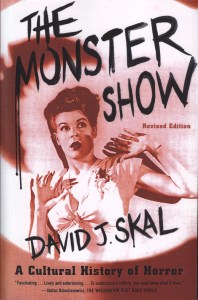
monstershowThroughout its history, until quite recently, one of the most serious natural enemies to the horror movie was the religious establishment. At times this antagonism seems well placed as horror films often take theological concepts and stand them on their heads. Within the last few years, however, thinkers of religious thoughts have come to an uneasy accord with some horror movies as vehicles for the kind of thinking promoted by traditional religions. The first half of this dynamic appears clearly in David J. Skal’s The Monster Show. Written before any kind of detente had been reached, his book chronicles skirmishes between the Production Code, religious groups, and even women’s collectives, against what was considered indecent and degrading. We have come to realize, however, that we are the monsters. We are the degraded. And seeing these films can lead to a strange sort of solidarity.

Most classic monsters, after all, have their origins in religions. Even the most recent of the lasting undead—Frankenstein’s monster and zombies—have origins in religious thought. Mary Shelley’s novel was subtitled The New Prometheus, a reference that anyone in the early nineteenth century would have understood. Zombies, on the other hand, are a product of vodou. Religion can’t get along very well without its monsters, and despite their less-than-stellar looks, their screen appeal is undeniable. Maybe it’s just we don’t like our dirty liturgical laundry being hung out where anyone might see it.

Skal’s treatment doesn’t stop at the cinema. He has a chapter on modern vampires, and Stephen King has earned his own chapter (or at least most of one) as the poet laureate of the novelistic form of the genre. More often than religion, Skal traces what’s happening in the monster world to the larger social issues of the day. Quite rightly so, as scary movies go nowhere without a receptive viewership. Looking around these days it’s easy to be scared. Even what was once a grand occasion of debate over higher principles as we ponder our next leader has become a farce in one of the parties that could make its own horror movie. Hitler, it is said, was a huge fan of King Kong. Large apes manhandling women never seem to go out of style. Some call it horror. Others try to get away with saying it’s politics. While the daily commute grows more and more dangerous, and the rhetoric grows even worse, is it any wonder we like to dim down the lights and watch monsters that we know really can’t get us at all?


The Weather in Kansas

In a move that threatens intellectual whiplash, the Kansas State Board of Education has backed the Next Generation Science Standards. For a state historically at war with evolution, adopting a curriculum that (rightly) presents evolution and global warming as facts, there is cause for hope. As an average citizen sometimes just struggling to get by, I watch in stunned horror as our elected officials try to repeal Obamacare without touching their own health plans paid for by yours truly (and mine truly). I see them vote themselves pay raises while pension plans and salaries of ordinary citizens are frozen. I know where the buck actually does stop. So it is strangely encouraging to see a state that has declared war on science beginning to realize that yes, the truth does have consequences.

Science does not necessarily have all the answers, but it is the best that we know. The empirical method works, and our healthcare, transportation, and communication have all benefited enormously by it. Our way of life has grown easier because of our application of evolution and its ways to our understanding of microbes and the ways to hold off their attacks. Science has been warning us since I was a high schooler, over three decades ago, that our industrialization has been causing grave changes to our ecosystem. Unfortunately, those with money to make from it can simply afford to move to higher ground. Kansas is among the Great Plains states. It is wise to recognize that global warming threatens those who live close to the earth most of all.

The intolerance to science is not simply a religious reaction, as some would characterize it. Religion may be used in the interest of business. And any savvy entrepreneur knows, and exploits that fact. It matters not a jot or tittle if you evolved from a common ancestor with the apes, as long as you can climb, like King Kong, to the highest towers and look down on all the rest of humanity. The water from melting ice caps may be rising below, but the Great Ape need not worry. Until it becomes clear that without the little guys down below, even the top monkey is nobody.

NotInKansas