
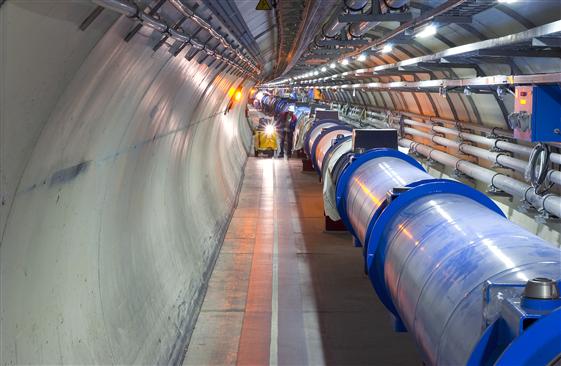
I’m sorry, I didn’t mean to be rude but I just had to laugh. A friend sent me an article from Science Alert titled “A Physicist Just Explained Why the Large Hadron Collider Disproves the Existence of Ghosts.” Intrigued, I read, “there’s no room in the Standard Model of Physics for a substance or medium that can carry on our information after death, and yet go undetected in the Large Hadron Collider.” One of the reasons, I believe, science has trouble among hoi polloi is such arrogant statements as this. I don’t know about ghosts, and for a very good reason. There is no experimental way to test for that which doesn’t exist in the material world. The LHC may tell us all we can know about the world that we perceive (although I doubt it) but it can’t tell us about that for which there is no measure (e.g., consciousness). I don’t mean to get all complex here, but let’s stop and think about this for a moment.
What we know of the universe is what we can perceive and extrapolate from that perception by reason. We, however, don’t perceive everything. Our five senses evolved for one purpose and one purpose only—to survive in this particular environment. That’s a trait, hate to admit it as much as we might, that we share with other animals. It helps to be able to see, hear, touch, taste, and smell things clearly. These traits give us valuable information about the world around us—is that plant poisonous? Is this heat going to kill me? Should I avoid approaching that large, angry-looking bear? Things like that. What our senses don’t tell us is the aspects we didn’t evolve to perceive. We understand everything about nothing. Put another way there is nothing that we understand completely. Entire books can be written about the concept of zero and that’s just an abstract. We only experience a small piece of this universe.
That’s the problem with being in the backwater of the galaxy. I grew up in a backwater so I know what I’m talking about. Things might be different if we lived near the galactic hub, where beings with different senses may well exist. We know, for example, that even on our planet some animals perceive magnetic fields. Who knows what kinds of abilities might have evolved on worlds that posed different challenges to survival than our own? Who are we to say that here in our basement on earth we have a machine that can uncover every possible permutation of anything in the known universe? I don’t know about ghosts, but, I suspect, they’re laughing too.
 Steve A. Wiggins