From Solid to Gas

“Ignorance of the law is no excuse.” I couldn’t believe that the woman at the police station actually used that phrase on me. The only time I’d ever heard it uttered before was on Gilligan’s Island. After all, we were talking about a parking ticket. I’d arrived in Boston, after driving through four states, with a massive headache. I was moving into an apartment in Winthrop, and all the cars along the street were lined up with their left tires along the curb. I simply did what everyone else had done and went to bed to sleep off my debilitating pain. In the morning I had a ticket under my windshield wiper. I explained that I’d just moved to town from another state, I was a student, and that all the other cars were parked the same way. Then she said it.

IMG_2625Ignorance, it seems to me, is the only response in the face of laws far more complicated than they need to be. I always thought, for example, that it was against the law for churches to meet in public schools. I’m no lawyer and what with voucher programs and other legislation that has been approved by the Reagan-Bush empire, I’m just not sure any more. So when I drove past the local middle school I was surprised to see banners all over the place proclaiming Liquid Church was meeting there. Liquid Church? They have a slick website (advertised on the banners) and they had guys directing traffic in the local school lot, which was frighteningly full. When had this happened? When had the school which had refused to allow a robotics league, approved the meeting of an evangelical church in the building? I can’t guess about the legality.

One of New Jersey’s fastest growing churches, according to its website, Liquid Church is flashy and trendy. This is God for the twenty-teens. Like businesses these days, it has “core values” as well as beliefs. Those values? Grace wins. Truth is relevant. Church is fun. The beliefs are pretty basic evangelical standards. But what is it doing in my local school? Having attended churches where anything fun smacked of Satan, perhaps I’m just a little bit jealous. Maybe as a guy who tries always to obey the rules, who doesn’t speed, and who actually follows traffic conventions in parking lots, I’m just a little confused. I thought there used to be a wall here. Now there seems to be nothing but rules anyone is free to concoct. I miss Gilligan’s Island.

Suit Yourself

I guess I’m going to have to sue myself. In this litigious society I have few options left. Instead of understanding and forgiveness (some of the positive motivations that religions have encouraged) our culture is controlled by those parsing out the finest particles of the law, seeking violations, and making somebody else pay for their mistakes. Money makes everything better. It is like the new God. I have to sue someone for this coffee I spilled on myself.

You see, I’m an early riser. I’m not really a coffee addict—I have a cup first thing in the morning, something I’ve been doing since college, and that’s generally it. Still, that first jolt is helpful in the waking process. I shlep around in my Edinburgh University sweatshirt for a pajama top. I like to be reminded of my post-graduate days in Scotland, and I appreciate the irony that my PhD never got me anything but this comfy shirt. This morning, laptop humming on my, well, lap, I baubled my coffee and spilled it all down my Edinburgh sweatshirt. It seared my skin, but I couldn’t jump up because of the laptop and any sudden moves would only slosh more of the hot liquid onto my burning chest. My mind immediately went to Liebeck v. McDonald’s, where the fast food giant was sued for selling hot coffee. I don’t know about you, but I’d almost rather suffer a burn than to drink tepid coffee. But somebody has to be sued, right? The question is: whom? Mr. Coffee for making my morning cup so hot? JSW for making my Edinburgh sweatshirt so absorbent? The unnamed pottery house in England that made the mug that wobbled in my sleepy fingers? Or maybe God for making the morning so early? If there’s anyone to blame, it’s me. Oops—I’ve admitted culpability, so I’ll have to sue myself.

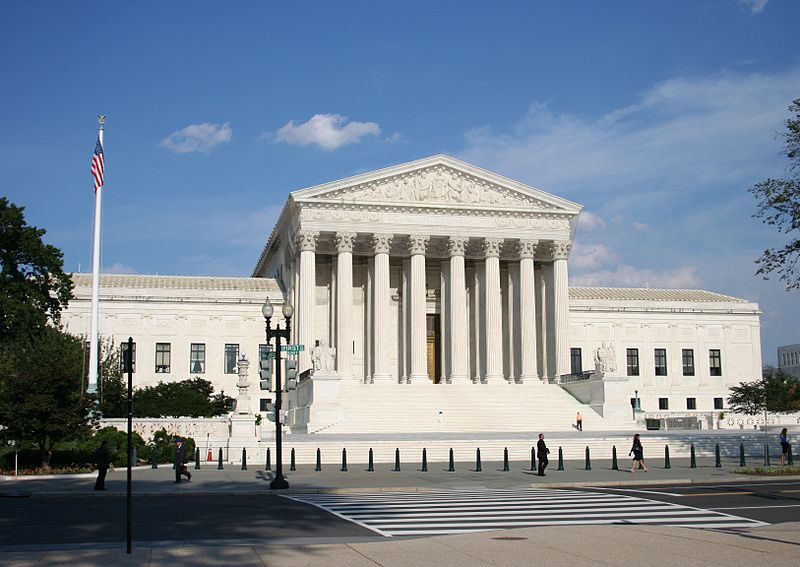
800px-SCOTUSbuilding_1st_Street_SE

For a society in love with the Bible, we’re far bigger on lawyers than forgiveness. Of course, the Bible is a pretty legalistic book. You can’t get very far in the Pentateuch without figuring that out. Only with the Bible it often isn’t a matter of suing; the stakes are considerably higher. Disrespecting parents can get you the death penalty, and mixing plant and animal fibers can get you expelled. Thumbing through my concordance I don’t see anything about coffee. I do see that I might be unclean for a day, but that’s okay because the Sabbath’s nigh. In any case, I’m too busy dreaming about what I’m going to do with all of that money.


Faith on Trial

Great white throne of judgment?

I just had a brush with the law. I was recently called up for jury duty for what looked like a very interesting case, but I was dismissed before it got started. When I left the courthouse, I felt as if I was being watched. I was trembling. The reason, I suppose, began with a simple ticket. As a teen I was reluctant to drive. Those who’ve had the annoyance of riding with me know that I rigidly adhere to speed limits and traffic laws. At a momentary lapse some years ago, I was cited for speeding in a rural setting and my sense of justice was shaken. I may have been going too fast, but it is not a habit nor a common occurrence. This happened within a year of being dismissed from a long-term job because the politics of the institution at which I’d faithfully worked for over a dozen years had changed. My faith in the system had been badly shaken. The ticket, issued on a road with very little traffic and for an offense that endangered nobody, only exacerbated the sense of something awry on a cosmic level.

This story has a point. Being raised in a religion with a punishing God who spent most of his time seeking out secret sins and infractions had molded me into what I supposed was a model citizen. I read the Bible daily, attended church every week, avoided all the common sins that others seemed to enjoy with no repercussions. Nevertheless, the God I knew was angry. That anger was directed toward me. Like Michael Pedersen Kierkegaard, I was surprised when things seemed to work out so that I had a secure job in the midst of a recession. Although my thought had evolved considerably, the angry God was still stalking me; I have no doubt that he will be until my dying day. What we teach our children about religion will stay with them for a lifetime. When that job ended, sending me in a career spiral that has now lasted five years, I could feel those punitive eyes staring me down. Now if I see a police car in my rearview mirror, my pulse rate quickens and I break out in a sweat. Like God, they are seeking any little infraction to exploit.

Ironically, the jury assembly room in our county seat is in an old church. As I sat, waiting for my number to be called, I looked at the stained glass windows of Jesus, angels and saints. My first thought was how such a sight might be experienced by someone from a different faith background: what does our public space say about justice? Would a Hindu or Muslim find this welcoming, contemplating the seriousness of the juror’s role? It is a beautiful and comfortable waiting area nevertheless. As I found myself in the rarefied atmosphere of a courtroom with a judge, attorney, and many other jurors, I again felt the eyes of judgment upon me. I’d just exited a building formerly inhabited by an angry God–losing a building surely can’t put someone in a good mood, can it? Had I not been dismissed, I would have watched the drama of justice unfold. And it would have been myself that was sitting at the table of the defendant in a world where no one can ever live up to the standards set by a wrathful God.