Uncial Nuncio?

I recently wanted to make a donation online.  As usual in these litigious times, there was a disclaimer that I had to read.  Since this was a respectable organization I decided I’d better do it if I was claiming I had.  Of course it was long and boring—lawyers talk to each other like academics do—but what struck me along about clause 6 is how these agreements suddenly go into ALL CAPS.  That seems to imply—but I’m no lawyer—that the rest of the agreement is less important.  Were it ever to come to court, would the judge say “Well, this part is clearly shouting, so you should’ve paid attention to it.”  Do lawyers need to resort to using all caps to make their point?  When do emojis start entering contracts?

When I was little I considered being a lawyer.  I’ve got a good head for rules and a fair reasoning ability.  My mother told me I was too honest to be a lawyer, and that dream died on the cutting-room floor.  Well, not exactly died.  I still think about it.  Never seriously enough to consider law school, but I am still legally minded.  Those sections of the Bible that have rules and regulations made sense to me.  You may not like them, but it’s best to have it in black-and-white.  These are the laws by which you live.  The rest is interpretation.  You might expect the ten commandments to be in all caps, but they’re not.  Perhaps they’ve been a bit crowded by the other stuff I’ve been cramming into my head over the years, but rules are rules, are they not?

Isn’t it somewhat disturbing that legal process resorts to shouting for the part they really want to apply?  We all know, at some level, that even contracts are negotiable.  Even after being signed.  It comes down to whether the party of the first part really believes a violation is worth suing the party of the second part.  In other words, it comes down to a cost-benefit analysis.  Contracts, after all, are promises on paper.  Not everyone keeps their promises.  And what does it say about us that we expect the party of the second part to do a, b, and c.  OH YES, AND X, Y, AND Z?  Something secret is being said here, and it’s something only a lawyer would understand.  Or maybe those who regularly issue contracts.

Photo credit: US Army, via Wikimedia Commons

Fundamental Law

Last year I posted a piece on Fundamentalist Church of Jesus Christ of Latter-Day Saints fugitive Lyle Jeffs. The occasion for my venturing into this sect was that Jeffs’ lawyer, after Jeffs had escaped house arrest claimed the Rapture was responsible for his disappearance. Now that an unraptured Jeffs has been recaptured, I begin to wonder about the special immunity of lawyers. Surely Jeffs’ attorney knew that his client hadn’t been spirited to heaven in the fictional escapade we all know as the Rapture. Indeed, all criminal lawyers—or at least most—know the facts behind a case before they step into the courtroom. While their witnesses are guilty of perjury if they lie under oath, lawyers, through careful wording, are permitted to insinuate the opposite of the truth with no hint of wrong-doing. It’s just their job.

Legalism and religion go hand-in-hand. After an interesting preamble, the Bible begins by laying down the Torah. Among its stipulations is not bearing false witness. But then, that was before the modern legal system. Religions tend to serve as moral compasses—and that’s the phrase that’s frequently used. A compass helps to find direction, ensures that we go the right way. What exactly the right way is can be a matter of debate, however. It all depends on where it is we want to go. When religious law, such as polygamy among Fundamentalist Latter-Day Saints, and civil law (generally recognizing one spouse at a time) clash, lawyers debate with the comfort of knowing they need not be accountable for the truth.

I’m no legal expert—in fact, I wouldn’t even have known about this had not a friend sent me the piece by Ruth Graham on Slate—but the question does trouble me. Religion is often all about laws. Specialists in Islam are called jurists, and in Judaism rabbis know the Torah inside out. Religious laws sometimes—often, actually—conflicts with the laws of the land. Believers either accommodate the differences or get into trouble in the secular courts. It’s headline news when religious law becomes civil law in this modern day and age. Isn’t there something cynical, however, when a lawyer pleads the Rapture as probable cause for a disappearance? Knowing the law, they need not reveal the truth they know. And yet, if you personally implicate any wrongdoing in another you can be sued for liable or slander. Lyle Jeffs wasn’t in heaven. He was living out of his car, keeping off the grid. Of course, following religious law can be like that some times.


Spare Change

The vernal equinox snuck up on me this year, and I learned that it can also be what those in medieval Europe used to call a “dismal day.” The sun was out and the temperature was unseasonably warm, but beginning with breakfast and all the way until bed-time, things just didn’t go according to plan. My mother had been admitted to the hospital, and I live some 600 miles away. When I called to see how she was doing, I spoke with a bureaucratic nurse who could neither “confirm or deny” that she was even there. I wasn’t aware that my mother had connections with the military, government, or covert operations. When I said I was just looking for my mother I got read the riot act including—this is the truth—having the Hippocratic Oath cited at me. I think, in all honesty, it might be spelled Hypocritic. Don’t get me wrong—I think it is important to protect people’s rights, and I sure the duty sergeant—excuse me, nurse, was only worried about lawyers and lawsuits. We have constructed a country so insidious that a boy can’t talk to his own mother. Eventually she put my call through to the patient’s ward where one of the patients answered the phone and went to find my mother for me. We call it civilization.

I’m not the most technical of guys. Think about it—I majored in very dead languages. When my wife surprised me with an iPhone for Christmas, my brother-in-law kindly agreed to get in on the surprise and took care of the details. We went into the Verizon store after the holiday and switched the phone (with the phone number I’ve had for years) into my name. Nearly four months later, when I tried to change some plan details, both he and I had to call Verizon several times to get the mess straightened out. One of the communications giants seems to have made itself so technical that it can no longer understand a simple request. When the Verizon representative asked if I understood the user agreement I said yes. Have you ever read one? No one without a law degree could possibly understand. Even Moses didn’t have a cell phone. I had to spend an entire evening getting my own phone back under my own name. Our society has taken what should have been a two-minute phone-call and made a mini-series of it.

So, is it because the vernal equinox is so early this year that my world went haywire for a day? We live in a society where it is nearly impossible to prove you are who you say you are. And children are not allowed to speak to their own mother. Lawyers have taken the law meant to shield us and made a bludgeon of it. Communications experts obfuscate. It may seem random, but these two phenomena have the very same evil as their root. They are twin trunks springing from greed. The nurse can’t put me through because a lawyer may sue. My phone number can be reassigned to my name, with added costs, approved by lawyers that only corporate giants can afford. Human need has been reduced to terms of cash. The trees are budding. The air is warmer. Flowers are in bloom. But it certainly doesn’t feel like spring to me. That chill you feel is cold, hard cash. We are all just spare change.

The weight of a human soul, legally.


Cross Swords

Occasionally the symbol of the Prince of Peace is used as a weapon. A current case playing out in New Jersey revolves around a Livingston man and his convictions. Originally erected for Lent, the homeowner in question placed a wooden cross within a municipal right-of-way zone where signs and potential distractions to drivers are prohibited. When informed of the violation the owner removed the original cross and placed a larger one just within the right-of-way zone. When asked to remove it he contacted the Alliance Defense Fund—a group of Christian lawyers (which sounds apocryphal to me) who advocate the spread of the Gospel. This bizarre case is now being cited as a test of a land-use law that protects religious expression. A few inches would have resolved this entire mess. Had the homeowner placed his second cross beyond the restricted zone, no fuss would have been made.

I don’t really feel safe in a world where bands of renegade Christian lawyers rove about seeking to support the violation of public safety ordinances. Instead of friendly persuasion the cross is here used as a cudgel. Perhaps wearing one’s religion on one’s sleeve ought to be accompanied with a measuring tape. Certainly there are those impressed by the masculine chest-thrusting implied in defying laws to assert one’s particular take on religion. Pushing such issues to the point of public funds being spent to enforce a law throws the action into sharp relief.

Some varieties of Christianity (and other religions too, I’m sure) thrive on the fiction of persecution. Is the quality of life of the homeowner affected deleteriously by not being allowed to place a cross in a no-sign zone? Is it not rather an attempt to set, in H. Richard Niebuhr’s phrasing, Christ against culture? What friends (besides lawyers) does it win to the cause? Having gone through a phase myself where PDR (Public Display of Religion) was considered the only way to be authentic about belief, I think I might understand the original intent of the homeowner. A clergyman, however, long ago set me straight with a frank discussion of subtlety. What I came to realize is that shoving only leads to shoving back. Perhaps moving the cross six inches would be the equivalent of turning the other cheek? But when the other cheek is turned, lawyers don’t get paid.


I Can’t Ear You

I bought a box of Q-tips in the store the other day. I noticed that the package shows humans using the cotton swabs in a variety of ways: around the eyes, nose, eyebrows, even on a computer keyboard. Everywhere but an ear. The suggestive shape of the Q-tip, as well as the received wisdom of everything from the South African name “ear buds” to Mad magazine, indicates that they were invented for ears. We all share that somewhat unsavory habit of forming earwax, and doctors warn that using cotton swabs may impact the matter and lead to complications of hearing. Q-tips (originally “Baby Gays” – check out the Q-tips website) are no longer for ears. In the back of my mind I supposed that it was because of lawyers. All it takes is one litigious sophomore and companies run to their attorneys to show that the faulty application wasn’t their suggestion.

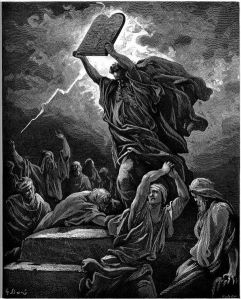
Laws run our lives. One of the most famous, but by no means the first, law-givers was Moses. I’m pretty sure Moses didn’t say anything about what to stick in your ears, but he did lay down the laws that Neo-Cons still argue should govern our lives just like the Quran governs the laws of Iran. The laws of the Torah, however, were only meant for the Israelites. Nevertheless, laws have become means of growing wealthy. If we can prove on a technicality that my dumb mistake was somebody else’s fault, why not have that person (or better yet, company) sued to within a millimeter of their lives claiming “damages”? The law has become a means to protect the special interests of those in power. As someone who has tried scrupulously to keep the law my entire life, I sometimes find that old Moses seems to have turned against me.

Laws are meant to protect the rights of people. When did laws shift to becoming instruments of entrapment and means of income? Just before leaving Wisconsin I was driving my family home from a movie. We were talking and laughing when I came to a speed-trap area of my local town where the speed limit drops from 45 to 25 m.p.h. within a matter of inches. Religiously I always complied. Today, in the spirit of the moment, I neglected my usual caution and was pulled over. A policeman young enough to be my son lectured me on unsafe driving (I began driving when he was still wearing diapers, and I had never been given a ticket before because I am not a speeder) before issuing me a citation. My wife couldn’t believe it – she knows that I never speed. One of my last memories of Wisconsin is being unfairly targeted by a law devised to bring money to the local police force. It has nothing to do with safety, since there were no houses or buildings for several hundred yards yet after the slow-down zone. Has the law come to free us or oppress us? Lawyers watch our backs, and law-makers watch their wallets. I want to ask Moses, but I’m afraid I won’t hear him. I seem to have a cotton swab stuck in my ear.

Lead us not into temptation...