
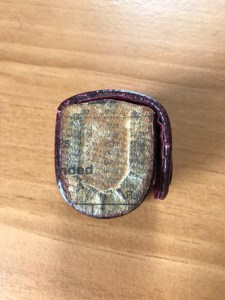
It’s an occupational hazard for the vegan Bible editor. Leather. Leather Bibles, although expensive, are popular. If you want free fetishistic deliveries of colored leather to arrive at your door, well, it’s part of a Bible editor’s life. Morally I’m opposed to leather and I eagerly await the day when cactus leather is considered a suitable alternative. Leather began being used in bookbinding early on, when books were treasured possessions. It was readily available because animal slaughter was a part of everyday life. It’s also extremely durable. These days it’s just a status symbol. When Bibles are produced there’s generally a market for whatever translation in leather. In my time I’ve seen some well enough used to perhaps justify such extravagance, but not very often. Usually it’s merely for show.
There’s an entire vocabulary associated with leather bookbinding. Tooling, or engraving the smooth leather to look like something else, embossing, or pressing a design in the leather, gilding, or the use of gold paint on leather, and dentelle, or having a border run around the outside edge. All of these were (and still are) signs of the artistry of the binder. The practice dates back to before the nineteenth century when books were bound by booksellers, not publishers. Perhaps this is why we shouldn’t judge a book by its cover. In any case, apart from tradition there’s no need to kill animals to bind books any more. Law books and Bibles are the major purveyors of leather binding. It continues simply because it continues.
One term used for traditions unwilling to change is “hidebound.” While this seems originally to have referred to emaciated cattle, it has come to be associated with codified, as in leather books. Pigskin, or other cheaper hides, are often used. Or “bonded leather,” which is as much plastic (if not more) than actual leather. The Bible isn’t a terribly animal-friendly book. Dogs are unclean and cats aren’t mentioned at all (except the large, wild kinds). Yes, there are shepherds—both good and bad—but sheep were kept to be exploited. And perhaps turned into leather. There’s something strangely symbolic about this. And not in a propitious way. Where does obeying the rules get you? Sheep are praised for their docility, their willingness to be thoughtlessly exploited, slaughtered, skinned, and eaten. To do the job, a Bible editor must learn about leather. Perhaps its a profession best left to carnivores.

 Steve A. Wiggins