Whole Books

One of the many peculiarities of my thought process is that I’ve tried to discuss only “whole pieces” on this blog.  In other words, as a “consumer” of media, my self-imposed limit has been discussing only whole books rather than a single short story.  Or the entire run of a television series rather than an individual episode.  The startling contradiction occurred to me that my latest book is an extended study of a single short story.  You see, Washington Irving was no novelist.  As America’s first famous writer, his fiction came in the form of short stories—sketches, he called them—and so to write a book on Sleepy Hollow meant focusing on a short story.  I love to read short stories.  I’ve always waited to talk about them here after finishing the book I found them in.  Maybe it’s time to discuss stories, or individual episodes here as well.
“The Legend of Sleepy Hollow,” many people are surprised to learn, is not a novel.  It’s often presented that way in telinematic adaptations.  The story, published as part of a collection of stories in 1820, is only 12,000 words in length.  Now, if you don’t work in publishing that figure may mean nothing to you.  There is no scientific way to parse these things but short stories tend to run from a few hundred words to about 15,000.  The next major category, the novella, is generally said to start at about 17,500.  You’ll notice there’s a gap there, between the two.  This is the strange territory sometimes called the “novelette.”  That’s because many modern fiction publishers cut the short story off at 7,500 words, and that leaves a gap of a literal myriad of words.  7,501 to 17,500 is the novelette, according to some.  And for the sake of completion, the novella tops out at 40,000 words so anything longer is a novel.

Irving wrote before these fine distinctions existed.  He wrote and people read.  Poe fell into a similar category.  He was known to have written only one novel,  The Narrative of Arthur Gordon Pym of Nantucket, but some of his short stories are long.  “The Unparalleled Adventure of One Hans Pfaall” stops just shy of 19,000 words, a novelette in today’s nomenclature.  My own fiction writing has been shaped by the fact that many magazines (even online, non-paying) top stories out at 5,000 words.  Some even at 3,000.  If you’ve ever tried to get a novella published, you’ll know why you shouldn’t even try.  All of which is to say maybe it’s time I start giving myself a break and talk about short stories.  Or an interesting episode.  If I can wrap my brain around it.

Knickerbocker

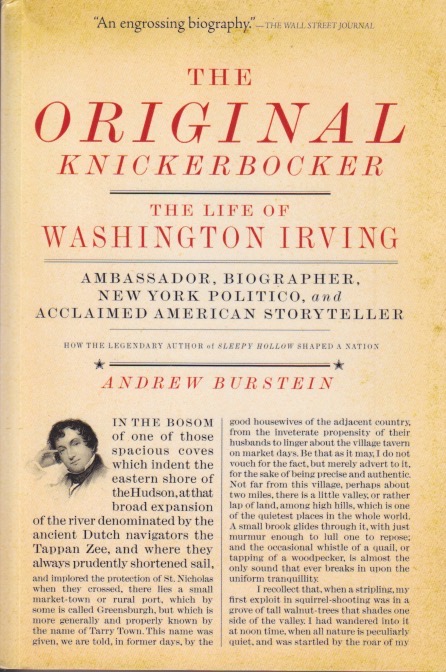
Washington Irving is one of those people with an outsized influence on American history who nevertheless has become ignored.  He met nearly every US president from Jefferson through Franklin Pierce, and what’s more, most of them knew who he was.  Sometimes decried as a less-than-original writing talent, Irving nevertheless led a remarkable life and through it all, treated others with respect and gentility.  He’s also a bit of a mystery.  All of this is captured quite well in Andrew Burstein’s biography, The Original Knickerbocker.  Burstein does go off on some diversions from time to time, but most of them are quite interesting.  One of the facts that astounded me was just how many early American political leaders were writers.

I don’t mean wealthy individuals hiring ghost writers to praise them in their “autobiographies,” but actual writers.  Fiction and all.  These were, pardon the period phrase, “men of letters.”  Writing was a way of not only influencing people, but of improving one’s mind.  Some of these individuals became presidents, others cabinet ministers, or foreign diplomats.  Once his literary star ascended, Irving could get struggling writers a government post by a letter sent to the chief executive.  It was a different day than that in which we live.

In my mind, Irving also stands out in that his fame came early and his later writings, while perhaps selling better, never eclipsed his early fame.  And honestly, never reached his earlier shine.  It began with his satirical History of New York.  This book established him as a wit and a gifted writer.  Since his family ran a secure business, Irving was able to travel without working for several years and didn’t produce his next book for another decade.  The Sketch Book of Geoffrey Crayon, Gent. may not be known to many today, but two of its sketches are still told and retold.  One is “Rip Van Winkle” and the other is “The Legend of Sleepy Hollow.”  This book also helped to establish the American celebration of Christmas, something begun in his History.  Although he would write many more books, he’s still best remembered for two short stories from his second.

Burstein takes his cues in this biography from “Rip Van Winkle.”  This particular story is kind of a parable of Irving’s life.  Irving couldn’t know this, of course, having published the story when he was about 36.  His subsequent books sold well enough, and apart from a stint as American minister to Spain, he was able to make his living through his pen.  There’s quite a lot in Burstein’s treatment that I’ll come back to, I’m sure.  But for the moment, it left me feeling as if I’d met a great, if struggling, writer in person.


Some High School

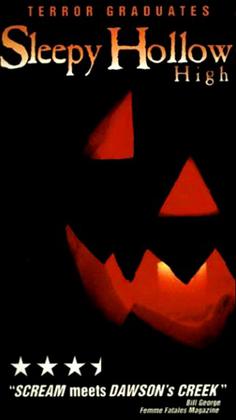
I have a soft spot for bad horror.  And Sleepy Hollow High isn’t exactly good horror.  It’s not horrible horror either.  It follows the story of five teenage delinquents at Sleepy Hollow High School.  Threatened with expulsion, their only choice is to do community service.  In this case that means picking up trash in the eerily secluded town park.  I won’t give away the one big spoiler, but it’s fair to say not is all that it seems.  It’s very low budget (paid for by credit cards and estimated to be $16,500) shows in several places, but it does keep you watching.  And wondering, to an extent.  It claims that the legend of Sleepy Hollow is true, but not exactly in the way you might think.  (Sorry for being cryptic—I don’t want to give too much away.)

One of the reasons I appreciate efforts like this is that I know what it’s like to be possessed by a story you want to tell but being unable to find a publisher—or in this case, a distributor/studio—who’s willing to take a chance on you.  The movie is largely the effort of Kevin Summerfield and Chris Arth.  They are listed as co-directors and co-producers, and each has credited roles beyond that.  Neither one is famous, and yet they made the film anyway.  It’s the same impetus behind self-publishing, I suspect.  The problem with the latter is that anyone can do it, and it often shows.  Most of us don’t have access to proper movie equipment, props, and actors willing to work for free.  Heck, I don’t even know most of my neighbors.

Movies like this stand a chance of becoming cult favorites.  I have no idea how that happens or who makes the call on it.  Low budget (often), cult films catch the imagination of a certain kind of fan and eventually generates some buzz of its own.  Wikipedia articles will appear about some of the people involved because those who watch grow curious.  Our highly developed publicity systems make decisions on who or what gets exposure.  That doesn’t mean the rest of us can’t get a small dose of attention now and again, but those who’ve made it have had some help.  Sleepy Hollow High was perhaps able to cash in a bit on the previous year’s Tim Burton effort, Sleepy Hollow.  But there are horror movies—and stories—out there that nobody knows about.  And which might, if discovered, have their fifteen minutes.


Horseman Horror

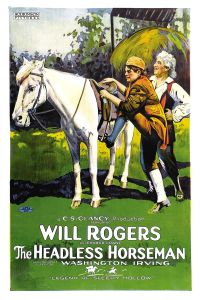
Yesterday was distinctly autumnal around here.  Cloudy and cool, the overcast was definitely moody although the equinox is still a couple weeks away.  Still, the mood was right for the Legend of Sleepy Hollow.  The earliest full cinematic adaptation of Washington Irving’s story is the 1922 silent feature The Headless Horseman, starring none other than Will Rogers.  Now, Irving’s story is fairly brief, and to get nearly a full seventy-five minutes out of it, the tale lends itself to some padding.  The film makes a great deal of Ichabod Crane knowing Cotton Mather’s A History of Witch-Craft, and even being accused of being in league with the Devil that leads to a  disturbing scene where he’s nearly tarred and feathered.  In reality Mather’s book was Wonders of the Invisible World, but the point of the film is better made with the fictional title.

Having watched Tim Burton’s 1999 version—Sleepy Hollow—many times, I was taken by the introduction of the Bible into the story.  The groundwork, however, was laid by Edward D. Venturini’s version.  True to the story, Ichabod teaches Psalmody in his role as schoolmaster.  Venturini’s film has a contrived scene in the church on Sunday that includes a lengthy sermon with everyone—even the usher—falling asleep.  The episode, which is lacking in Irving’s original rendition, introduces the Bible into the narrative.  The connection is thin, but nevertheless present.  Burton picked up on the religious element and built it firmly into the plot as Ichabod Crane’s backstory as a skeptic, raised by “a Bible-black tyrant.”

As someone interested in the integration of religion and horror, early examples, despite the comic aspect of Venturini’s version, are often instructive.  The comedic spirit is actually in the original; Irving’s tale gives a caricature description of Crane that gives the lie to the handsome protagonists beginning with Jeff Goldblum on through Johnny Depp and Tim Mison.  Will Rogers plays the homely image to its hilt, and although lighthearted, the movie has some classic horror elements.  To arouse his dozing parishioners, the minister yells “Fire!” When they awake asking where, he states “In Hell,” which sleeping churchgoers can expect.  Although the eponymous headless horseman is shown to be Brom Bones, a remarkably effective early scene presents a skeletal, ghostly rider that haunts at least the imagination.  The sun is out this morning, and the brooding skies of yesterday have passed.  They will be back, however, as the season for ghost tales is only just beginning.


The Lure of Lore

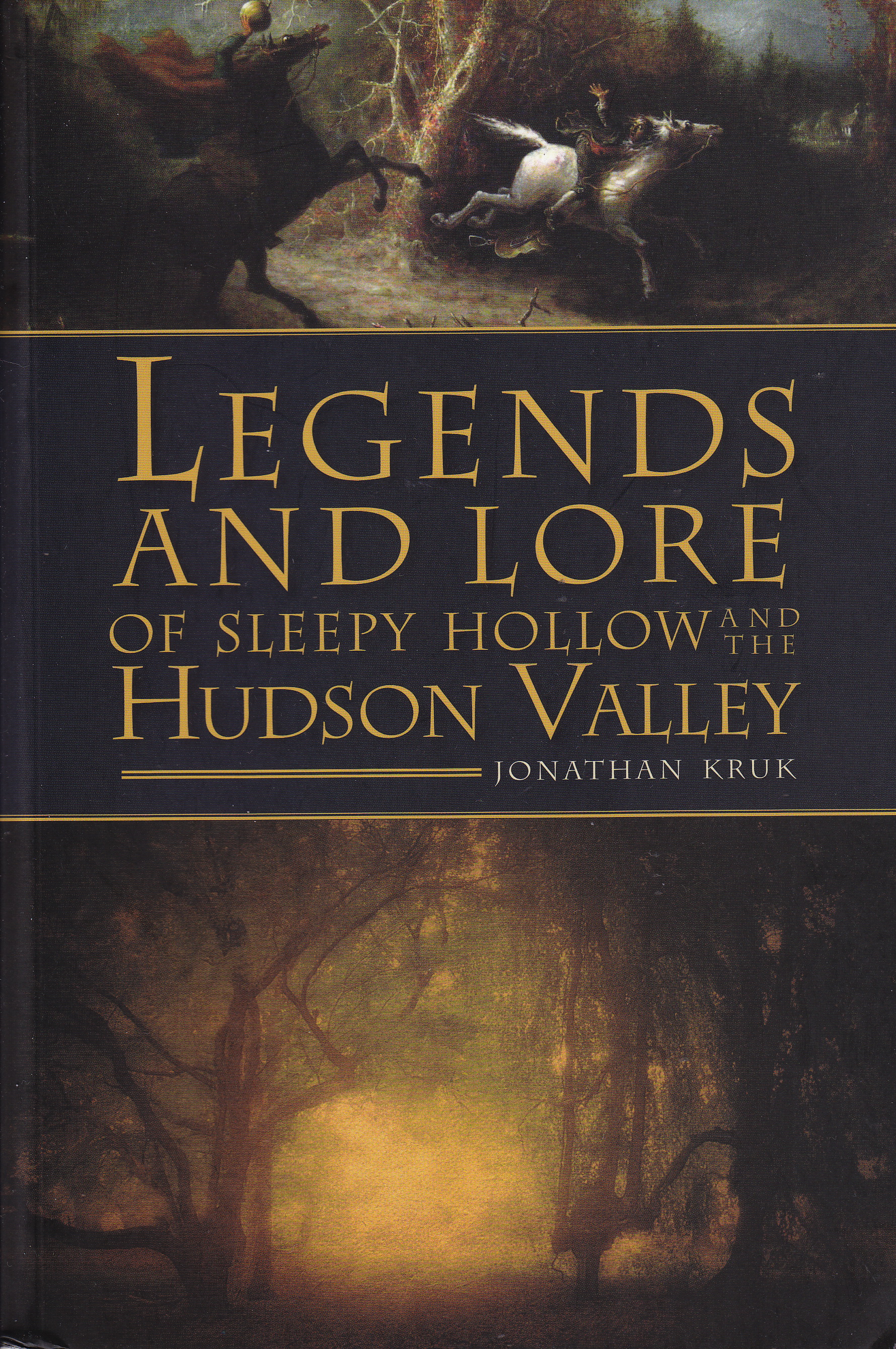
SleepyHollowOne of my doctoral advisers, Nick Wyatt, has become a friend over the years. I’m sure he would agree that he is often called a maverick, but in the best possible way. He is one of the brightest people I’ve ever known. When it was time for his Festschrift to appear, I had been unceremoniously tipped out of academia and left to my own devices. Being his first doctoral student, I had to contribute a piece, and so I settled on one I had written about an Edinburgh ghost story that seems to have roots in ancient Sumer.  Nick is the kind of scholar who can appreciate such ventures. This paper came to mind while reading Legends and Lore of Sleepy Hollow and the Hudson Valley by Jonathan Kruk.  Kruk labels himself a storyteller, and that was a venerable role in ancient times.  In fact it was a priestly one.  Kruk draws out the many tales of headless horsemen and other spirits mentioned in Washington Irving’s “Legend of Sleepy Hollow.” Nothing is proven here, but that’s not the point.

Headless ghosts were a staple of nineteenth-century lore not only in the Hudson Valley, but also in Scotland and Germany, as well as in many other locations.  How a spirit became decapitated is generally part of the draw to such ghoulish stories, and Kruk convincingly points to the tradition of the Wild Hunt as an element in Ichabod Crane’s famous ride.  The point is that stories often contain a truth that facts can’t match.  Case in point: the legend of Sleepy Hollow is alive and well. There have been periods, and will likely be more periods, when interest wanes, but we keep coming back to the story because it teaches us something about ourselves.  Empiricism is all fine and good until you find yourself facing a headless phantom on a nighttime highway.  Experience all of a sudden takes the wheel.

What does this have to do with Professor Wyatt?  My Festschrift article was reviewed, at a much earlier stage, by the journal Folklore.  I received a very sniffy rejection letter, citing, among other scholarly infractions, that I had referred to a popular publication (say it isn’t so!) as a source of the Edinburgh ghost story text. Where else was I to find it?  What scholar would bother to replicate an obviously—let’s just say it—uneducated tale?  Isn’t it beneath scholarly dignity? The stories we tell, I’ve always believed, make us who we are. It may be that materialists will have the last laugh.  When they are carted to the graveyard, however, I can guarantee that there will those among the common mourners who will be able to make a believable tale that their lives meant something after all.


North Tarrytown

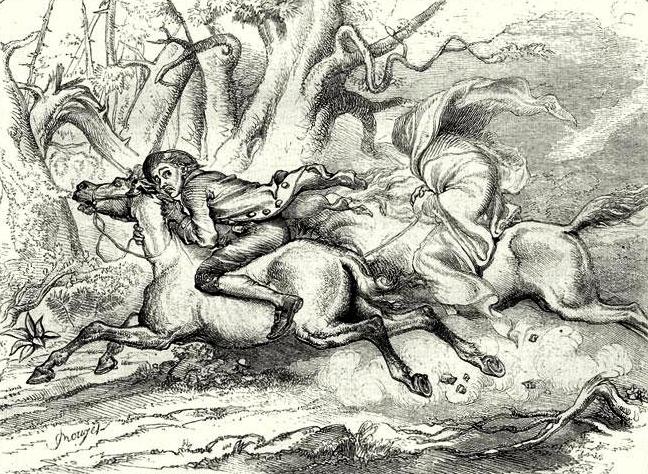
Ichabod Crane has undergone many incarnations since Washington Irving conjured him. Not very sympathetically described in the original “Legend of Sleepy Hollow,” he was gangly and somewhat clumsy and full of self-importance. The story of which he is forever a part, however, has become iconic of American myth-making. A deep symbolism runs through the story of the headless horseman, and for those who’ve actually been to Tarrytown, the modern incarnation of Sleepy Hollow, there may be a disconnect between the urbanity of a town so near to New York City and a rustic school teacher in a rural setting. Still, there seems to be quite a bit of buzz about the current television series “Sleepy Hollow” that I decided to see for myself what was happening. The conceit of Ichabod Crane reawakening, in a kind of Rip Van Winkle twist, in the present day is engaging. He is now a professor at Oxford University turned patriot to the American cause, which brings him to the point of actually beheading the horseman in the first place. But this literate, witty, and moody retelling involves more than Irving. The Bible is pretty much central to the series, at least as far as I’ve seen.

The headless horseman is none other than Death, the final of the four horsemen of the apocalypse, according to holy writ. Although the characters all refer to the Apocalypse as “Revelations,” something that causes premature baldness in biblical scholars, the program places the town of Sleepy Hollow at the crux of the oncoming end of the world, with the other three horsemen to be summoned along the way (Pestilence or Conquest, War, and Famine, for those who are keeping score). Also, witches, hearkening back to Salem, have a prominent place in the narrative, and the forces of rational law seem to be at their collective wits’ end to make any sense of religion breaking into a secular world. Without the Bible’s final book, Sleepy Hollow would have no legs (as well as no head).

Ichabods_chase_crop

In Tim Burton’s Sleepy Hollow, Ichabod Crane came through as a detective plotting science against superstition. At the end, however, even the most rational had to admit there was more going on than the science of the day could explain. That is part of the appeal of the Sleepy Hollow legend. No matter how strong the light we shed on them may be, our psyches reach out for the immaterial, the ghostly, the supernatural. We like to believe in sacred books and spells to protect from evil. Even the Twilight Zone episode “The Jungle” plays on how in even the most advanced cultures we still build skyscrapers with no thirteenth floor, as if our towers represent an unknown hubris for which we may be held accountable. Irrational? Perhaps. But Sleepy Hollow is not so somnolent these days when the Bible once again takes center stage and hoofbeats are heard once again in the night.