
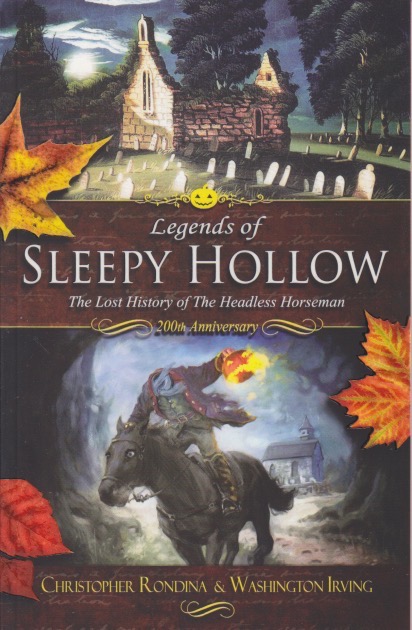
One thing I quickly learned when beginning work on Sleepy Hollow as American Myth was that the story hadn’t really been studied too much by those with academic training. There are some exceptions, of course. Another thing I swiftly picked up is that many people who wanted to write on the legend chose the method of publishing the public domain story with a variety of annotations, essays, and other additions, to make a salable book. Often these are self-published and not always immediately obvious to the researcher as to whether they contain anything important or not. I had not run across Christopher Rondina’s Legends of Sleepy Hollow: The Lost History of the Headless Horseman until well after my manuscript was submitted. I found it in the bibliography of a ghost-hunter version of Sleepy Hollow that wasn’t even published by the time I was going into production. (It doesn’t even have an ISBN.)
I do have to say that Rondina’s variety of this composite genre isn’t bad. He includes Washington Irving’s story and expands it with an introduction, and brief chapters considering any historical background that there may be. He also adds a chapter on modern media of the story that includes one television adaption that I failed to find for my book. Interestingly, after I’d written the manuscript I discovered Joe Nazare’s similarly annotated version, also with a number of the media I’d analyzed in it. I’d actually corresponded with Nazare earlier, having discovered his website. Not wanting to discuss what my book was about until after I sent it in (others have more time to write, perhaps, than I do) I didn’t mention our common interest and didn’t discover his annotated version until it was too late to include as a conversation partner.
Self-publication has perhaps become inevitable since standard publishing is difficult to break into. And the internet gives anyone the ability to self-publish without too much effort. It does, however, make doing research a bit more difficult. I determined early on that I could not review every annotated version of Irving’s story. I selected a few of the most promising and moved on. Both Rondina and Nazare had interesting things to say about the tale, and it’s a pity that they weren’t discoverable until after the fact, at least to me. I like to give credit where credit is due, but any ideas that seem similar to these two sources in my book will have to stand as examples of convergent thinking on the part of fans of the “Legend of Sleepy Hollow.” I know there are many other fans out there and I hope they find the resources they need to understand the story just a bit better.

 Steve A. Wiggins