On Campus

It’s still the pandemic and I don’t get out much.  It seems prudent and only a little paranoid.  I had the opportunity to meet someone from Lehigh University recently.  The interesting thing is, I’ve become shy about going onto college campuses unless invited.  I can still usually pass for a professor (the beard and glasses help, along with a natural disheveledness) and I behave well in public.  Still, universities are all about belonging.  If you’re an alum you can come in.  You’ve paid a lot of money, and, the thinking goes, hopefully you’ll pay more.  Of course you’re welcome!  The last time I visited Boston University I remember thinking how small it was compared to my younger memories of wider corridors and more welcoming faculty.  Many ways exist for measuring how we grow.

When offered the chance for a quick stroll around Lehigh I had to say yes.  Like Syracuse University, it’s set on a hill.  From downtown south-side Bethlehem you need to walk up.  Even growing up in Pennsylvania I didn’t hear much about Lehigh.  The western part is dominated by the University of Pittsburgh and the eastern by Penn.  In the middle there’s Penn State.  There are actually many colleges in the commonwealth, about 140 if you separate out branch campuses.  Still, I was struck by the classic feel to Lehigh’s campus.  As you come down the hill it grows more modern, but I always like the older buildings.  Something about their solidity is comforting.  How’ve I been here nearly four years and not found it?

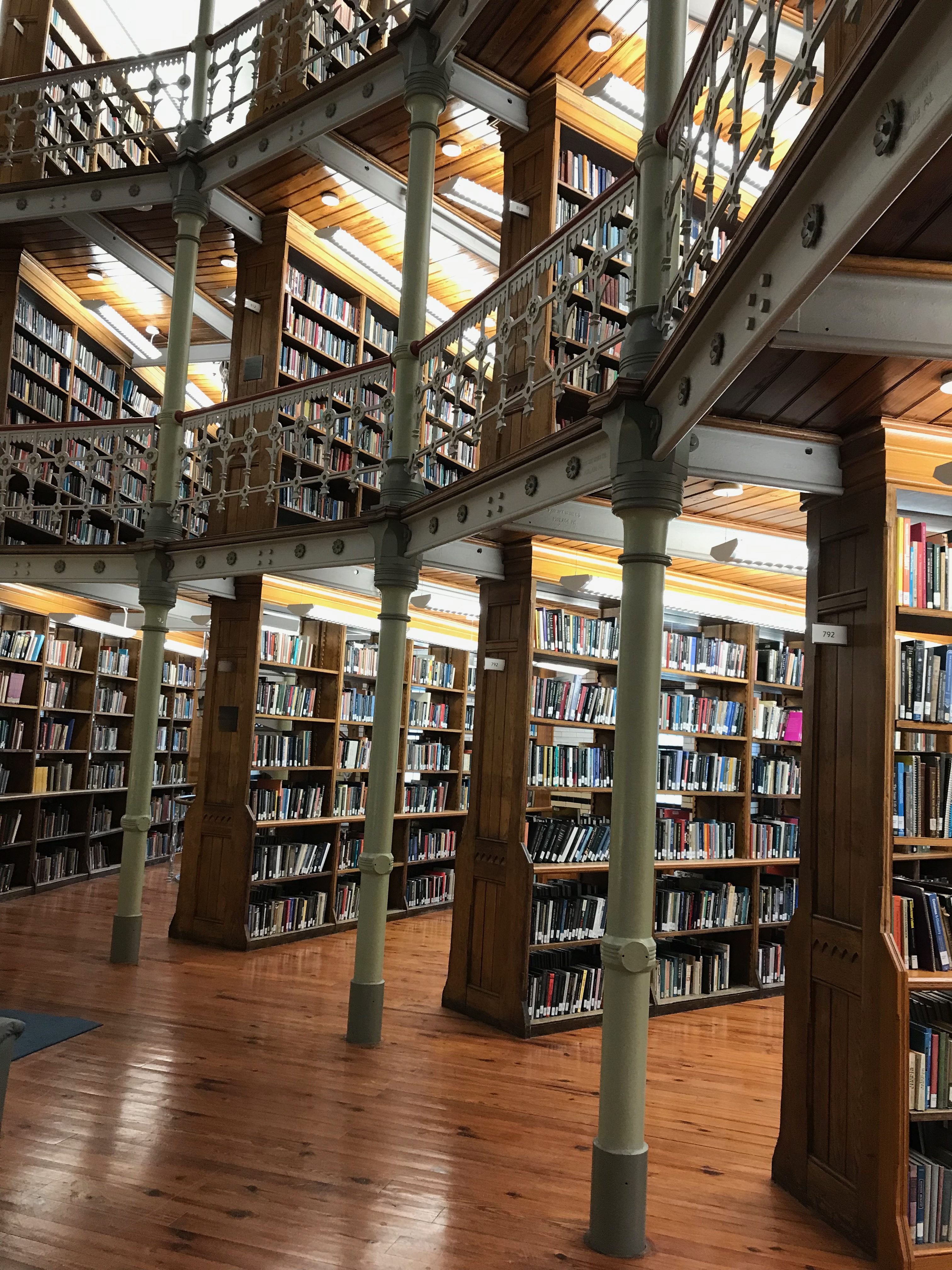
My host pointed out one of the libraries and suggested I stop in before leaving campus.  I had a mask and a minute so I did just that.  There’s a danger to stopping into libraries.  It’s too easy to fall in love in them.  I could see myself whiling away the hours there.  I spent plenty of hours in my own undergrad library, even though it wasn’t nearly so nice.  The only bad thing about visiting campuses is that I eventually have to face the exile from them I feel each and every day.  Many people can’t wait to graduate and get away.  Some of the rest of us never want to leave.  I suppose it’s an artificial environment, but if a small segment of the population can make it work, I wonder why we can’t get more of the world to emulate it.  I may not get out much, but I like to make those rare trips worth the effort.

Horror Homeroom

With a happy coincidence I discovered a website called Horror Homeroom.  Featuring articles and podcasts and reviews on horror films, I felt its siren call.  Then I learned it is run by a professor at nearby Lehigh University, making it even closer than I initially supposed.  I wanted to be part of the conversation.  You see, after years and years of being a Bible scholar and having to fight to find any kind of interest whatsoever in what I had to say, I’ve found the horror community extremely welcoming.  Perhaps because we all know at some level that horror is considered transgressive—it isn’t unusual to find critics who still claim it’s debased—we find each other.  There’s an aesthetic to horror, and it isn’t about gore and violence.  Horror, when done well, is an excellent marker of what it means to be human.

Life always ends in death.  Many people spend as much time as possible trying to avoid thinking about it.  There is, however, great creativity in facing squarely what you cannot change.  Well, that’s a good sounding excuse anyway.  All of this is by way of announcing my guest blog post on Horror Homeroom.  A few weeks back I was quite taken with The Curse of La Llorona.  Not that it was a great movie, but it had a way of coming back to haunt me.  Part of it has to do with the poorly understood way that local customs blend with imperialistic religions.  Faith is a local phenomenon.  Once you switch off the televangelist, you’ll begin sharing beliefs of your neighbors.  There’s no such thing as a pure religion.  Pure religion is one of the most dangerous myths there is.

Those of us who study religion professionally have been taught to call the blending of religions “syncretism.”  I’ve stopped using that word for it because it assumes that there are pure forms of religion.  Religion always takes on an individual element.  We make it our own when it gets translated into our personal gray matter.  The idea that there is a pure form of any religion requires an arbiter of greater rank than any here on earth.  You can always say “but I think it means…”  Horror, I suspect, latched onto this truth long ago.  Without some hint of doubt about your own individualized belief system, it’s difficult to be afraid.  Horror need not be about blood and gore.  Often it isn’t.  Often it’s a matter of asking yourself what you believe.  And once you answer it, opening yourself to asking questions.