Long Tail

There’s a truism in academic publishing (how many of these are actually falsisms!) that a book reaches its sales potential in three years.  After that, the received wisdom says, a sale here or there may occur, but the book has reached the end of its commercial life.  One of the problems with this is that sometimes a topic will experience a resurgence, or, perhaps, pick up for the first time.  Some publishers raise their back list prices every year, making those late sales nearly impossible.  McFarland, however, seems to understand that if you lower prices after the front list sales, a book may live on.  I received a royalty statement for Holy Horror this week.  I’m used to sales being low but I was surprised to see that the lifetime total is now up to 246 copies. Still no bestseller, but more than it was six months ago.  Many of those sales have been in the past year, six years after publication.  I was chuffed.

Academic publishers who price books at around $100 and keep them at that level are killing those books.  Nightmares with the Bible is so priced (and the publisher has no taste for paperbacks), meaning that it has sold less than 100 copies.  Surprised?  I’m not.  Academic pricing models are terribly outdated but the extra revenue from hardcovers priced beyond the reach of the interested reader is just too enticing to leave behind.  Libraries are the main market, in their mind.  Libraries, however, are in the crosshairs.  The Make America Dumb Again crowd is even slashing our copyright library—the Library of Congress—where a copy of each book published in America is kept.  Who else will be left to buy expensive books?

Speaking of libraries, I have an embarrassing confession to make.  I’ve seen (but not been in) the largest library in the United Kingdom, the Bodleian.  The Bodleian is the main library of Oxford University.  I’ve been to Oxford a few times but I don’t know the city well.  The embarrassing confession is that I realized I’d seen the Bodleian only by reading a novel that stated Blackwells, the bookstore, is just across the street.  I know right where Blackwells is, of course, and have been there a time or two.  There’s a kind of irony in that I learned a truth about the world by reading a novel about a place I’d been.  I spend more time in bookstores than libraries these days, but since I make purchases I like to think I’m supporting the growth of knowledge, in my own small way.  And I write books, which, pleasingly, still sell a few copies in a year even when they’re old.
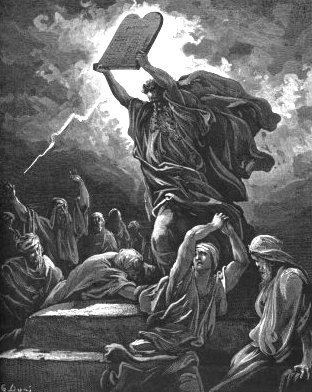

Go Down, Moses

For a time, I tried to write down family tradition. My family was somewhat unusual in that regard. Family saying came generally from my maternal grandparents—my father wasn’t around for my childhood years—and since my grandparents died when I was relatively young, I didn’t hear much of their wisdom firsthand. Still, my mother told me various things her parents used to say and I tried to keep a record. Kind of like I wanted to be an anthropologist for raw folk sayings among the, non-elites. One thing my grandmother used to say, so I was told, was “Where was Moses when the lights went out?” I was always intrigued by this since I supposed it had something to do with Moses the miracle-worker. I guess I imagined Moses waving his rod and the lights coming back on. That single question is all I ever heard of this particular family treasure. I forgot about it until recently, though the miracle of the world-wide web, I learned that the query comes from a song.

Moses gets down

Moses gets down

The song, it turns out, exists in multiple versions. The Library of Congress has a recording dating to 1901 available on the web. According to this version, written by Harry von Tilzer, Moses was not “the” Moses, but a preacher condemning gambling. Also, “lights” is rendered in the singular. So much for the canonicity of family tradition. Duke University library has an undated, but clearly old, version of another song by the same title. This one does reference the biblical Moses, also the name of the song’s narrator. A child afraid in bed at night falls in love with and marries his nurse girl who used to ask him the question “Where was Moses when the light went out?” as he was falling asleep.

Yet another version, dating from 1965, has the question “Where was Moses when the lights (plural) went out?” followed by the answer, “He’s in the dark.” With all of this instant information from the internet, I’m still not certain what was being conveyed by my grandmother with this cryptic question. My mother said she used to say it when someone walked into the room too late to help with something, a kind of sarcastic “Where were you when I needed you?” What is clear is that the song was about as old as my grandmother and she found it somehow appropriate in an unconventional situation. I have to wonder how much of sacred tradition, including the Bible, might have come from misunderstood original instruction. We will, of course, never know. I don’t know what the original lyrics were, but I have learned that even family wisdom has a backstory, like any Scripture, for those who look hard enough.