
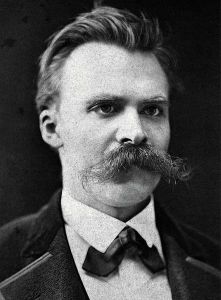
 Yesterday was the anniversary of the death of God. The Time magazine cover, the first to be text only, asking “Is God Dead?” was one of the iconic images of the 1960s. Fifty years ago yesterday, the media ventured out onto a limb that hasn’t snapped but hasn’t exactly bloomed either. Maybe it’s because the idea wasn’t original. Philosopher Friedrich Nietzsche had suggested that God is dead in 1882, nearly a century before Time. A friend in seminary reported seeing graffiti that read “‘God is dead’—Nietzsche; ‘Nietzsche is dead’—God.” Although we laughed over it, this waggish statement contained a profound truth. The concept of God has proven remarkably resilient. Indeed, it may be part of what makes us human.
The media, nothing if not endlessly self-referential, responded. In fact, an article by Lily Rothman on time.com, is a Time story about a Time story. An endless regression of unbelief. Roth mentions theologians in her column— theologians still, and perhaps always have, debate the question of God’s existence. The ultimate untestable hypothesis, God, in that sense, is an easy target. The media reach readerships of which the rest of us only dream. I didn’t see the Time cover as a child (we did not subscribe), but it made its way into Rosemary’s Baby as a statement of the Zeitgeist more effective that a declarative sentence. It is a question that haunts. Miracles, according to the Bible, used to be large and spectacular. Today they don’t happen at all. What went wrong?
Rothman’s story begins with a seminary professor being fired. William Hamilton, at the then Colgate Rochester Divinity School, was dismissed over the question of God’s existence. Seminaries have been particularly sensitive to questions of God’s continuing presence. We sometimes forget, however, that magazines exist to make money. The same is true of some theologians. If you wanted to get noticed when the Vietnam War claimed so many headlines, you needed to say something striking. As the article points out, the question of God’s death seems a lot less radical today. Living through this campaigning season running up to the Republican National Convention it might be less difficult to disbelieve. I wonder what Nietzsche would’ve said.
 Steve A. Wiggins