Hallowed Halls

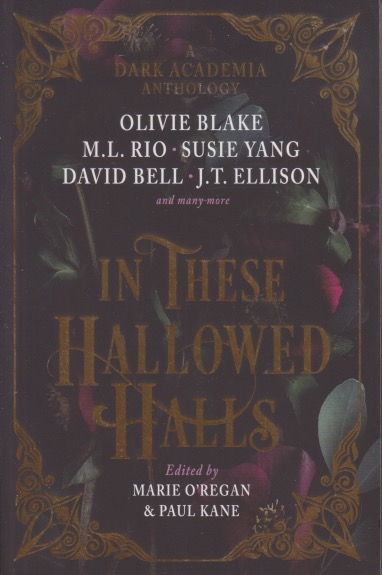
Every time I read a short story collection I tell myself I should do so more often.  Knowing that you’re only committing yourself for maybe thirty or forty minutes at a time is one way to incorporate more reading into a life that’s incredibly busy.  I read In These Hallowed Halls, edited by Marie O’Regan and Paul Kane, because, as its subtitle declares, it’s A Dark Academia Anthology.  As with nonfiction anthologies, it is a mixed bag.  The stories are all well written and all were enjoyable to read.  They also display some of the breadth of dark academia.  Most of the stories are literary (as a genre), others dip into science fiction and horror.  Dark academia doesn’t specify whether a book (or story) will be speculative or not.  As someone who writes short fiction, it seems that some of my tales might wag that way.

In any case, discussing a collection is tricky because there is such variety.  Some of the stories stayed with me beyond reading the next, which could be quite different.  Others I have to go back to remind myself what happened.  These days it can take several weeks to finish a book and a lot can happen in real life in that time span.  The stories that stay with me the most have obsessive narrators, or characters who are obsessed.  This kind of story, I know from experience, is difficult to get published.  Many of us who write, I suspect, do get obsessed.  An idea latches on and won’t let go.  Of course, most of us also have jobs that force the jaws open and drop us down in the world of the ordinary again.

Another thread that runs through many of these stories is how students struggle for money.  That’s true to life.  Thinking back to both college and seminary, there were times in both settings that I was working two part-time jobs as well as being a full-time student.  And living like, well, a student.  That experience, except for the truly privileged, is fairly common and our writers here recognize, and perhaps remember, that.  The other unavoidable theme when writing about young people in college is, shall we say, hooking up.  For many of us, college is that period in life when, thinking of our futures, and following our hormones, we start looking for love.  (I know, high schoolers do that too, but college has a way of focusing your energies.)  All of that swirling around the darkness that sometimes falls over our tender years makes this dark academia collection worth reading cover to cover.
Discovering Witches

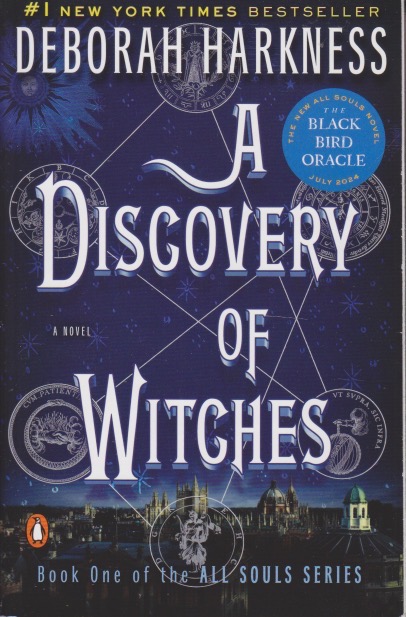
On a number of best of dark academia novel lists, A Discovery of Witches was a book I knew I had to read.  Frightened by the size of the tome, I put it off.  Although it says it on the cover (by which I don’t buy a book) that it’s part of a trilogy, I was hoping it’d be self-contained.  Of course, it ends without resolving what happens to the main characters, more or less coercing the reader into the remaining two volumes.  Now, this is not unique.  Many authors do it.  Publishers especially like books with series potential—assured sales.  My eight novels (none published) are stand-alone.  One is over 200,000 words, but the rest are reasonably svelte.  Big books take a large commitment of time and, well, at my age you have to make some choices.  This one took me nearly a solid month of daily reading, sometimes multiple hours at a stretch, to finish.  I have some decisions to make.

Set initially in Oxford, this world created by Deborah Harkness contains three kinds of humanoid creatures besides humans: witches, vampires, and daemons.  The daemons aren’t really defined, but they don’t seem to be the kind that possess girls like Regan McNeil.  The witches seem pretty traditional and the protagonist/narrator is one.  The vampires are quite different than the Hollywood version, as well as the traditional sort.  Vampires can be out in the sunlight, they aren’t affected by crucifixes, and, indeed, can be quite religious and Christian.  They can eat things other than than blood.  The protagonist, Diana Bishop, is a witch who doesn’t use her powers.  A professor, she’s doing research at Oxford where she meets, and eventually falls in love with Matthew Clairmont, a vampire.  An ancient pact between witches, vampires, and daemons forbids them from consorting closely, and herein lies the tale.

The dark academia aspect comes in a couple of guises.  One is that much of the first part of the novel takes place at Oxford University, and even in the Bodleian Library.  Also, vampires seem to be quite compatible with dark academia as a whole.  The dark aspect comes not only from the creatures, but their situation.  There is ancient animosity and tension that results in murders.  The novel ends with a war starting and Diana and Matthew taking a risky journey.  I may be content to let this state of affairs stand.  From the look of things, the sequel is also a long book and I am content to let my imagination fill in the blanks.  I’m glad to have read it, but I’m going to look for a novel with a little less time-commitment next.


Hop In

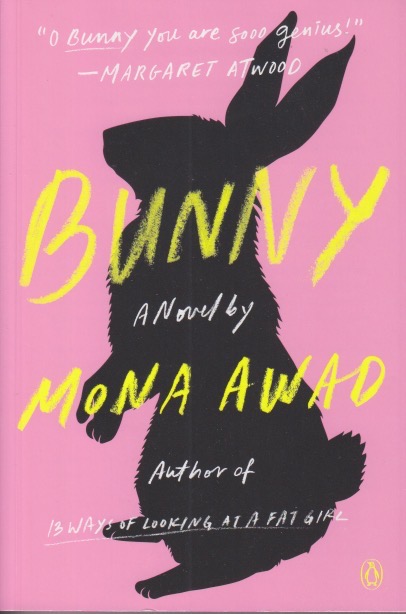
Especially the first part, of Mona Awad’s Bunny, is so well written I almost laid down my pen for good.  I really enjoyed this one.  Once the story gets deeper, into the second and third parts, questions begin to arise as to what’s going on.  One reason for this is the story becomes speculative in nature and Awad’s not about to give away what’s “really happening.”  Set among a set of five graduate students at the prestigious Warren University (the name is a hat-tip), the novel is often considered dark academia.  It starts out pretty light, and although Awad maintains her deft hand, it grows progressively darker as the tale goes on.  Samantha Heather Mackey is enrolled in the writing program with a cohort of four “perfect” women—the kind many guys go for.  Sam’s an outsider, though, writing dark and troubled stories while her classmates garner the professor’s praise.

The “perfect” women call each other “Bunny” and they eventually invite Sam into their clique.  This annoys Sam’s best friend and sometimes roommate, a local artist who isn’t a student.  But Sam is caught.  She learns that the Bunnies actually transform rabbits into their ideal boyfriends.  They haven’t got the process down pat, though, and the resultant hybrids often have various deformities.  Sam is the only one who can’t do this transformation.  Until she does.  But it doesn’t turn out like anyone expects.  I’d better draw my plot summation to a close there, otherwise I might hop into spoiler territory.  I wouldn’t want to do that because I recommend reading this one for yourself.  Awad’s writing is beautiful and compelling.  I did wonder if I’d interpreted everything correctly when I finally put the book down.

Dark academia comes in a rainbow of colors.  Here, although comi-tragic, there’s something seriously wrong at Warren University.  There are plenty of books and classes, as well as intrigues among ingenues.  And also some serious reflection on expectations and how they affect relationships.  Friendship and what it really means.  Loneliness, and how it creeps into the lives of creative people.  It’s also a story about writing and learning to write.  As noted above, it succeeds wildly in this.  There are definitely horror vibes about the tale, but it’s so well told that you might lose track of the fact that they’re there.  When Margaret Atwood praises a book, it’s worth paying attention.  While not dark and dreary, Bunny shows the sub-genre off as one of great potential.  It’s worth twitching your nose over.


A Different Lord

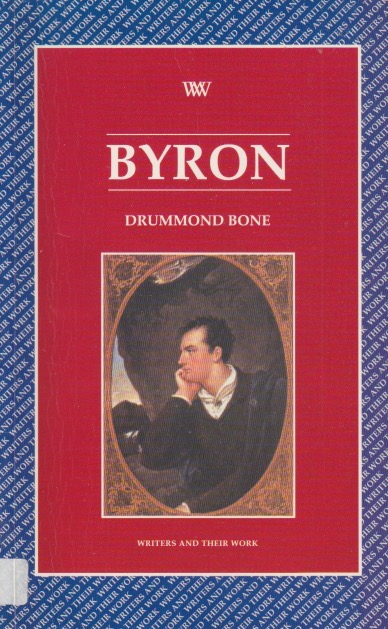
I just wanted to learn the basic outline of Lord Byron’s life without having to commit to the hundreds of pages most of his biographies boast.  Something brief, but authoritative.  Something for which I could be sure the author was vetted.  I hadn’t read any of the Writers and their Works series before.  It gets good reviews and here was the story of Byron in less than 100 pages!  I was excited to get started.  Then I discovered this is mostly about his poems rather than his life.  It contains 21 pages of biography and 60 of poetic analysis.  I really should’ve checked more reviews.  I’m not really into poetic analysis.  I know that those of us who create tend to think of our creations as extensions of ourselves.  I’ve made 3-D art (kind of like sculpture), I’ve drawn, I’ve painted, I’ve written.  These are parts of me that exist in the world.  But really, I just wanted to know what Byron’s life was like.

Actually, I did learn the answers to some of my questions.  Although a “lord,” he didn’t inherit much wealth.  Indeed, the opposite.  His eventual wealth came from his poetry.  This is nearly an impossible dream these days, of course.  His fame brought the spotlight onto his personal life and politics.  A man who easily “fell in love”—he was a Romantic, after all—he had affairs and his politics weren’t those of the majority.  He left England at the advice of a friend, never to return.  He was friends with Percy Shelley, which is common knowledge.  As he made a home, actually several homes, in Europe, he continued to earn good money for his poems.  He was famous and feared, it seems.  Although the book doesn’t describe it, he gave the world its Byronic hero.

I haven’t read much of Byron’s poetry.  That style of writing has never appealed to me.  The poetic life, however, is of endless interest.  Shelley drowned on a boat trip home after visiting him in Italy, and Byron was present at the cremation.  (And I got yelled at in the New York Public Library for trying to snap a picture of the fragments of Shelley’s skull that were on a special display.  Byron had been there in person, of course.)  A few short years later Byron also died while helping to plan and finance the Greek war for independence.  Still, there is more I’d like to know.  But probably not enough to read a biography of several hundred pages, though.


Poe Day

Perhaps best known for his rabidly racist The Birth of a Nation, D. W. Griffith was nevertheless influential in early filmmaking.  I’m fascinated by how literature made its way to celluloid, particularly in the early days.  It was thus that I discovered Griffith’s Edgar Allen [sic] Poe, a silent film from 1909.  A dramatized version of Poe’s writing of “The Raven,” this seven-minute movie opens with Virginia Poe—the “Lenore” of the poem—in the process of dying at the Poe’s hovel.  Not able to keep warm or to find nourishment, she languishes on a cot until Poe arrives home and covers her with his coat.  At that moment a raven appears on the bust of Pallas above the chamber door, leading Poe to write the poem in a white heat.  He knows it’s a masterpiece and leaves Virginia promising success.

In a scene only too familiar to any writer, Poe takes the poem to the publishers, three of whom simply dismiss him, the third laughing at his work.  This particular scene rings so true.  A fourth editor buys it from him on the spot.  This is, in fact, how publishing works.  I’ve had 33 short stories either published or accepted for publication.  By far the majority of them were rejected multiple times.  One of them, previously turned down by six editors, ended up winning a prize.  So it goes.  You’ll never find an editor who “gets” you every time.  Even those who like your work may eventually start sending you elsewhere.  I often wonder how many writers of what would be classics died unpublished because of some editor’s choice.  But back to Poe.

Screenshot: public domain,

Newly paid for his work, he buys food and a blanket and returns home jubilant.  Of course, it is only to find Virginia dead.  Poe’s life did have its share of intense drama.  His death remains mysterious all these years later, and Virginia’s death was a severe blow to him.  “The Raven” was published in 1845 and Virginia died two years later, with Poe himself passing yet two years beyond that.  This film, which I learned about from Jonathan Elmer’s In Poe’s Wake, was made sixty years after Poe’s death.  He’d already become an icon by then, instantly recognizable in pancake makeup.  But even now, more than a century later, publishing is still a matter of the same process.  One of my own novels has been declined over 100 times, despite having once been under contract.  I do know the feeling of being rejected by publishers, even as I participate in a ritual as old as writing for publication.  Happy birthday, Mr. Poe.


Oblong Box

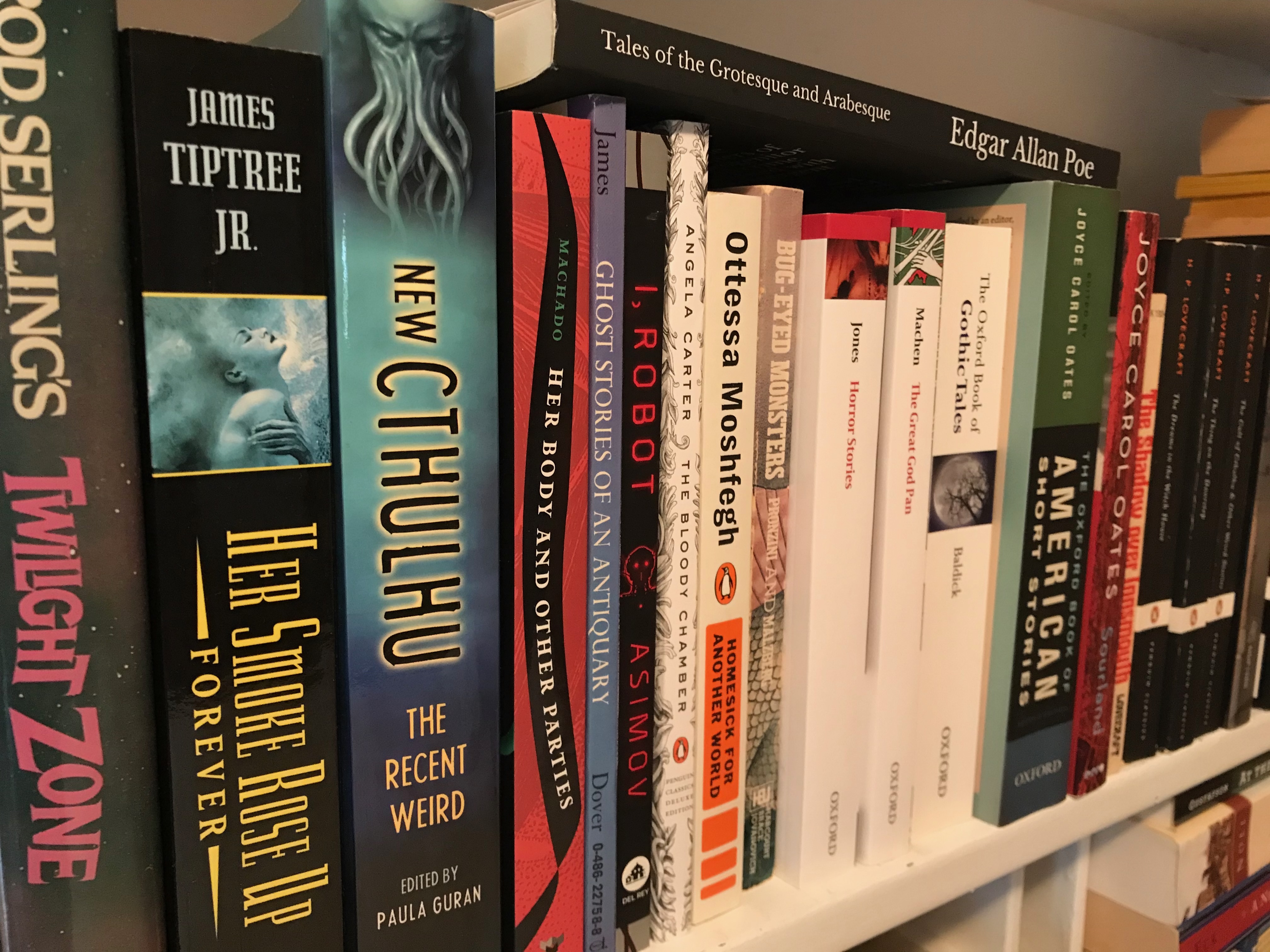
When Borders was closing—a sad day in the annals of American readers—things were marked down.  On one venture to a remaining store somewhere in New Jersey, where the checkout line snaked like one of those around a Times Square theater before the doors open, I picked up Edgar Allan Poe Complete Tales and Poems.  Poe has, of course, been in the public domain for many decades so anybody can publish his works.  I did attempt to sit down and read through this behemoth that contains 73 short stories, but stumbled at “Hans Pfaall,” the first.  This story is really a novelette, in today’s measure, coming in at nearly 19,000 words.  (It took Tales of the Grotesque and Arabesque to get me through it.)  So I’ve been content to dip into it now and again to read one of Poe’s stories.  In print. When the mood hits.

I read “The Oblong Box” in preparation for watching the movie.  I had never encountered this story before, and I prefer to read the base before attempting the latter adaptations (particularly by AIP).  The problem with reading Poe from this remove—in the light of his reputation—is that even the title tells us the box is a coffin.  How it is to be used in Poe’s tale may be unknown at first.  Here Poe divides his characteristic obsessiveness between the narrator and Mr. Wyatt, his temperamental artist friend who is newly married.  Wyatt, the owner of said oblong box, takes it on a voyage by boat from Charleston to New York.  The narrator obsesses over what might be in the box, being kept in a cramped stateroom rather than in the hold.  A storm leads to a shipwreck and rather than be rescued, Wyatt binds himself to the box and leaps into the ocean.  I won’t put the reveal here, but you get the idea. Today the title gives away Poe’s original twist.

There are still many of Poe’s stories that I haven’t read.  I’ve had enough of a head start, however, that I may eventually make it through those he published.  I’m aware that some of them may be funny, and some are tales of ratiocination.  Some may be completely unexpected.  Like many writers, Poe’s reputation is based on certain of his most well-known tales.  But also like most writers, his interest ranged fairly widely.  And he had that sense of “what if” that tends to drive those of us who write in a similar vein.  But these days we know that if we see an oblong box we’ll already have a pretty good idea of what’s inside.

Photo by Tom Oates, 2013; This file is licensed under the Creative Commons Attribution 3.0 Unported license. Attribution: Nabokov at English Wikipedia

Short Story

I often reflect on how little I know.  No matter how much I read there is more to be read.  Works worthy of time but sacrificed to circumstance.  I was recently reading a short story by Poe that I’d never read before.  As others have noted, Poe was a prolific author of a great deal of forms—poems, a novel, letters, a scientific treatise, literary criticism, and, of course, his stories.  I came to know his stories through cheap collections available in my small town, mostly not along the lines of those Poe himself selected.  Indeed, editions of his own chosen works, such as Tales of the Grotesque and Arabesque, before the advent of internet-based publishing, were difficult to come by.  Original editions cost many thousands of dollars.  Poe isn’t alone in this category—short stories are an unusual genre.

I know from personal experience that finding a publisher for a collection of such stories is nearly as difficult as finding a publisher for poetry.  Publishers are looking for money, of course, and like Poe, all writers produce stories that interest some but not others.  The novel is safer, and even today’s amazing writers have to find success as novelists before publishers will offer volumes of their short stories.  Tis a pity, really.  I have many volumes of short stories on my shelves, including some of Poe’s, but for some reason publishers tend to cram such volumes so full that they become unwieldy.  Intimidating almost.  It leads to that feeling of existential dread that I felt approaching War and Peace—would I indeed survive to finish it?  (I did, but that is such a Poe-like question I had to employ it.)

The short story is an important literary form that is singularly difficult to publish.  I have managed to find homes for about thirty such pieces, but many more have failed to move even just  the internet critics.  Those that have been published have brought no income at all.  In Poe’s day, an author attempting to make a living could not afford to give away their life’s blood.  Indeed, Poe’s older contemporary Washington Irving struggled with pirated copies of his works being sold overseas (he spent a great deal of time in Europe).  Like Poe, Irving excelled in the short story, or sketch.  We’re often at the mercy of editors who select the stories for us, making them available.  I suspect there’s much that we miss by not stepping outside their personal tastes regarding what to include.  Or, just as importantly, exclude.  Some day, perhaps, I will have read all of Poe’s short stories.  Until then, I’ll find them when necessary.


Poe’s Novel

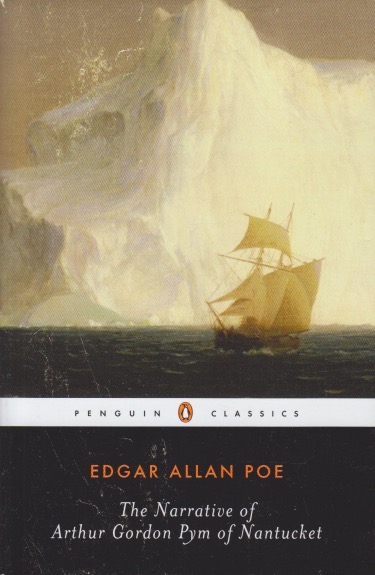
Certain authors, some great among them, excel at short stories.  I know from personal experience that trying to publish a book of such stories is a very hard sell.  For a writer like Edgar Allan Poe, who was trying to live on his words, it often led to periods of poverty.  Thinking of him as a short-story author, I had never read his only novel, The Narrative of Arthur Gordon Pym of Nantucket.  Hailed by fellow brief-tale writer Jorge Luis Borges as Poe’s best, I figured I’d better give it a try.  I’m glad I did.  I had, however, no idea what to expect.  Those who write on Poe seldom pay it much mind.  He was famous for his poems and stories, and this gothic, sea-faring novel was, according to the introduction, suggested to him by those who felt his making a living as a writer might improve if he used long form.

Concerning the edition: the novel is in the public domain.  Penguin Classics, however, often contain nice introductions.  Indeed, the intro by Richard Kopley in this edition is excellent.  A few of his observations stood out to me—this novel was, in some measure, about Poe’s family.  Both the protagonist and the author have five-syllable names with the same cadence, ending on a three-letter surname beginning with P.  Also, as both the introduction and notes make clear, Poe was deeply steeped in the Bible.  You seldom read about Poe and religion.  Writers from America’s first generation, however, were uniquely brewed in it.  I’d never considered that about Poe before.  There are many editions of Pym available, but I recommend this one because of its introduction.

The story ends without resolution, just so you know.  Pym, talked into an adventure by a somewhat devil-may-care friend, goes out on the ocean on a boat after a night of drinking.  And herein hangs the tale.  Well, actually, the friend convinces the young man with a taste for the sea to stow away on a whaler that his father captains.  A mutiny, however, leaves Pym “buried alive” onboard.  A shipwreck leads to near starvation and a boon companion survivor.  Picked up by an explorer headed south, they discover a surprisingly temperate Antarctic circle where a native tribe turns treacherous because of their fear of the color white.  It does seem that there’s a race narrative taking place here too.  I enjoyed the story although the chapters about longitude and latitude don’t quite rise to the level of Melville’s maritime writing.  It’s a tale worth the read, however, but find one with a good introduction and it will be smoother sailing.


Morte d’Author

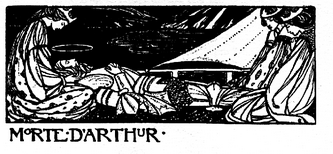
I recently learned of Roland Barthes’ essay, “The Death of the Author.”  Originally written in French, Wikipedia warns it’s not to be confused with Le Morte d’Arthur.  Or is it?  Barthes’ idea is that to truly appreciate a piece of literature you must dissociate it from its author.  I’m of conflicted feelings about this.  To truly understand an author you should read everything they’ve written.  Perhaps that’s a task best left up to biographers and historians.  I have trouble, especially when an author’s name is well known, and perhaps the very reason I purchased a book, of leaving the author out of the equation.  On the other hand, sometimes I’ll read literature merely for the experience, and the author is often someone I know nothing about.  If the book moves me, however, the first thing I start to research is the author.

Said author may not give the ultimate meaning to the story, but I believe it’s a more subtle  interaction than “La mort de l’auteur” might suggest.  It’s not unusual to enter into parasocial  relationships with an author.  In fact, I suspect it’s quite common.  After reading a Neil Gaiman novel I sometimes think we’d recognize each other across a crowded room.  Compelling writing will do that to you.  And from a writer’s perspective, what you write does contain part of you.  Captured in literary form.  As much as—no, more than a photograph does.  An author does not determine the final meaning of what s/he writes, but they mean something by writing it in the first place.

When writing fiction I often find myself exploring themes that require other stories I’ve written to give them fuller texture.  Perhaps this is why finding publishers is so difficult.  I’ve had people tell me that they understand my nonfiction better after they get to know me.  There’s a natural progression here, in this age of endemic loneliness: a story, blog post, or book catches your attention.  You want to know more and what do you do?  Await the death of the author or reach out to the writer?  I’ve done both, and I generally find that reaching out to an author can be satisfying.  It depends, of course.  Some don’t like to be disturbed by those they don’t know, their parasocial paramours.  Of course, there is a way to get to know an author, even remotely.  Read what they write.  It won’t give you the whole story, of course, but the more of their work you read the better you’ll get to know them.  Thus I’m conflicted about “La mort de l’auteur.”

Image credit: Florence Harrison, public domain via Wikimedia Commons

Tracing Writers

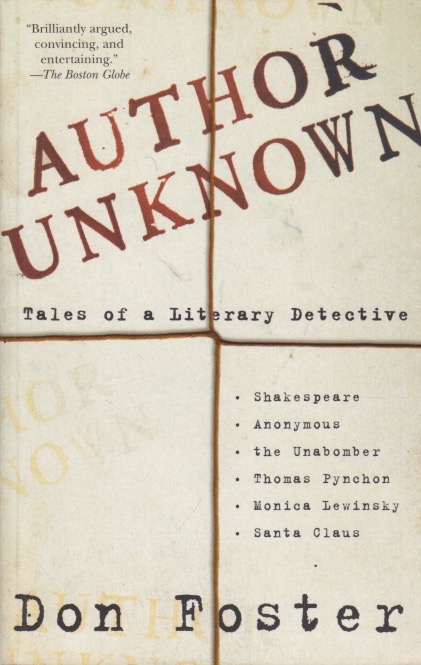
Ratiocination.  Detection.  There’s something compelling about that clear, crystalline logic that leads to solid conclusions.  I was floored by Don Foster’s Author Unknown: Tales of a Literary Detective.  I found the book by following up a reference to “A Visit from St. Nicholas,” aka “’Twas the Night before Christmas.”  Like most Americans I credited the poem to Clement Clarke Moore, but he did not, in fact, write it.  If you trust anyone with literary detection, it should be Don Foster.  Although this cleverly written book is not an apologia for the author’s personal accomplishments, it nevertheless builds trust in his methods and his sense.  It begins as he discovers an unacknowledged text was written by Shakespeare.  The evidence is carefully laid out, and is convincing.  Then others began to ask him to “prove” who wrote other pieces.  It’s quite a ride.

While Foster takes great care not to claim the ideas as his own, he’s nevertheless drawn into the case of the Unabomber, and Monica Lewinsky, and Thomas Pynchon.  His methods of ratiocination demonstrate repeatedly what he explains in his excellent introduction—our writing is every bit as indicative as our DNA.  With an adequate writing sample size, a piece with an unknown or disputed author can, with a great degree of probability, be attributed to the correct author.  You don’t even need to know of the cases to find the outcomes fascinating.  And those who disagree, being human, are simply not convinced by his conclusions.  They’ve already made up their minds.  In this regard the case of Wanda Tinasky (I’d never heard of her) is utterly compelling.

The Santa Claus chapter, the final one in the book, is a real pay-off.  Henry Livingston Jr., of Poughkeepsie, wrote the famous poem that defined Santa Claus as we know him.  Considering Christmas’ importance in our capitalistic society, this attribution is an important one.  Clement Clarke Moore was a very wealthy professor of Bible at the newly formed General Seminary.  Foster demonstrates probable cause in his claiming, and keeping alive, the mythology that he wrote the famous poem.  The way that this chapter is laid out and presented is especially witty.  Those interested in getting at the truth behind who wrote what will find this a page-turner.  Although he wasn’t seeking out the attention that came (most of us, as academics, are surprised when anyone show any interest at all in what we write) Foster has given the world a real gift in this book.  It reminded me once again why research is the most intriguing thing on earth.  And learning can be like reading a good mystery.


Ninth Day of

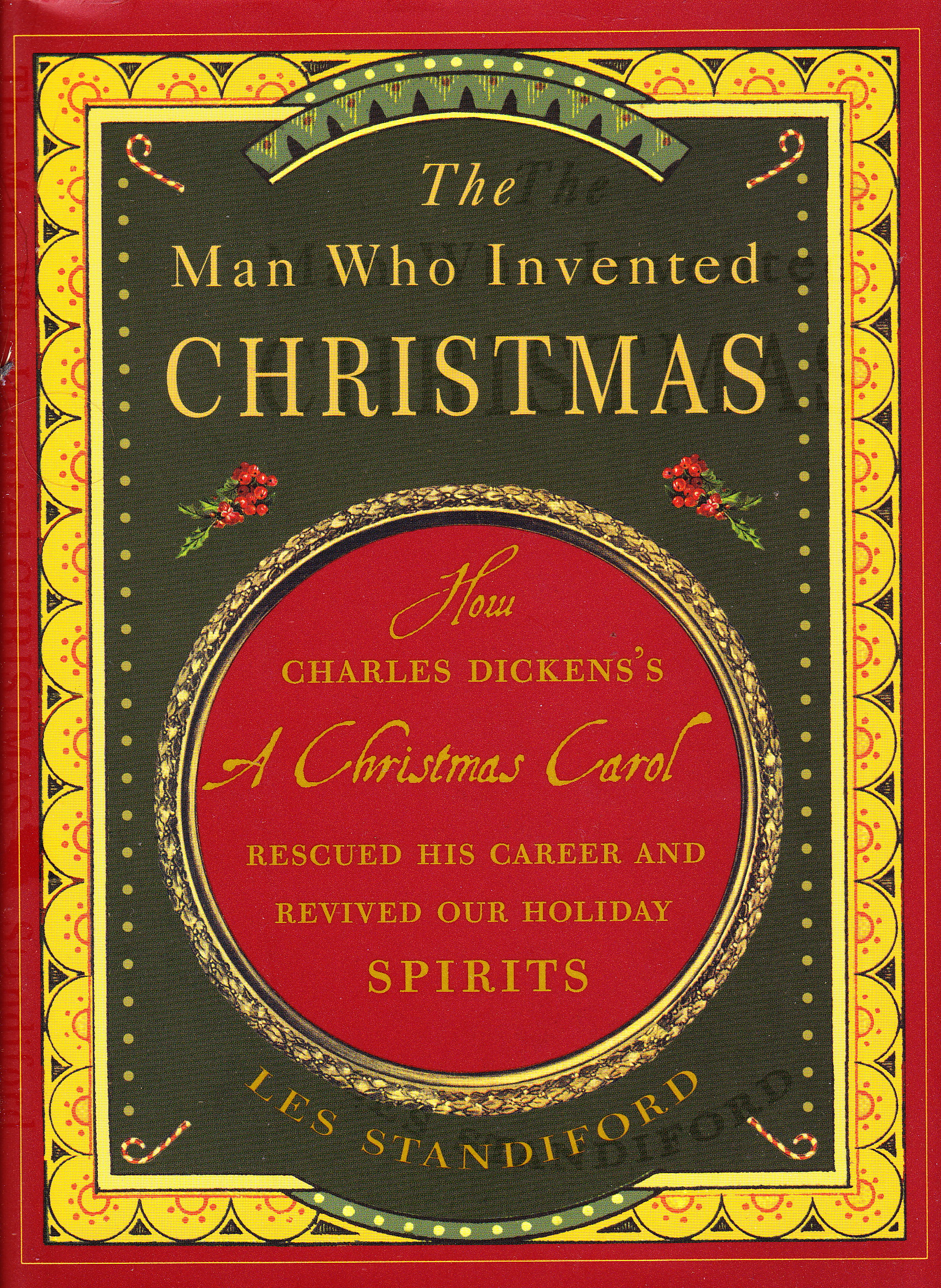
I read Les Standiford’s The Man Who Invented Christmas back in 2017 and learned a lot from it then.  Some of what I read on the bus, however, has faded a bit with time and I was curious to read it again in the light of the reading I’ve done about Washington Irving.  Irving was a bit older than Charles Dickens and had, it seems, given Dickens the idea of writing, first, a sketch book (Sketches by Boz), and second, writing about Christmas.  From what I’ve read about Irving, he had a cautious liking of Dickens but wasn’t terribly impressed.  Standiford does note that it was Irving who suggested an American tour to Dickens (it didn’t turn out well) but he (Standiford) indicates that Irving was a staunch fan of his English colleague.  Were I able to spare the time, I would follow footnotes and read letters to see if I could get to the heart of the matter.  Of course, I’ve become much more interested in the history of modern literature in recent years.

It would be difficult to overestimate the influence of Dickens in English literature.  As Standiford points out, he helped to invent novel publication as we know it.  Although he took up the gauntlet of international copyright (something Irving had earlier understood as important), he became internationally famous partially through pirated works.  We still use the phrase “What the Dickens” to express surprise. (It turns out that the expression predates Charles—now that’s influence!)  As Standiford notes, however, we’ve passed the era when a single author can have such great influence.  Dickens was a singular talent and read by vast numbers of his compatriots and also grew a respectable readership in the United States.  He also had a great deal of influence on how we celebrate Christmas.  I was this time looking for Irving lurking in the shadows.  And I found him.  Dickens was an enthusiastic fan of Irving.

Standiford brings Irving into the discussion often, but also perpetuates the association of “It was a dark and stormy night” with Edward Bulwer-Lytton (who did use it) without mentioning that the phrase originated with Washington Irving.  One gets the sense that Irving was completely eclipsed by the work of his young fan, Charles Dickens.  Standiford mentions Irving quite a lot in this little book, but it’s about Dickens and not his American colleague, of course.  And Standiford also notes that crediting Dickens with the “invention” of Christmas is overstatement.  The story is nevertheless fascinating.  To me this second reading underscored the importance of Irving for the Christmas holidays, and also how terribly difficult it is to make a living as a writer.  I’m glad I came back to it, even when life otherwise threatens to be too busy for re-readings.


Author! Author!

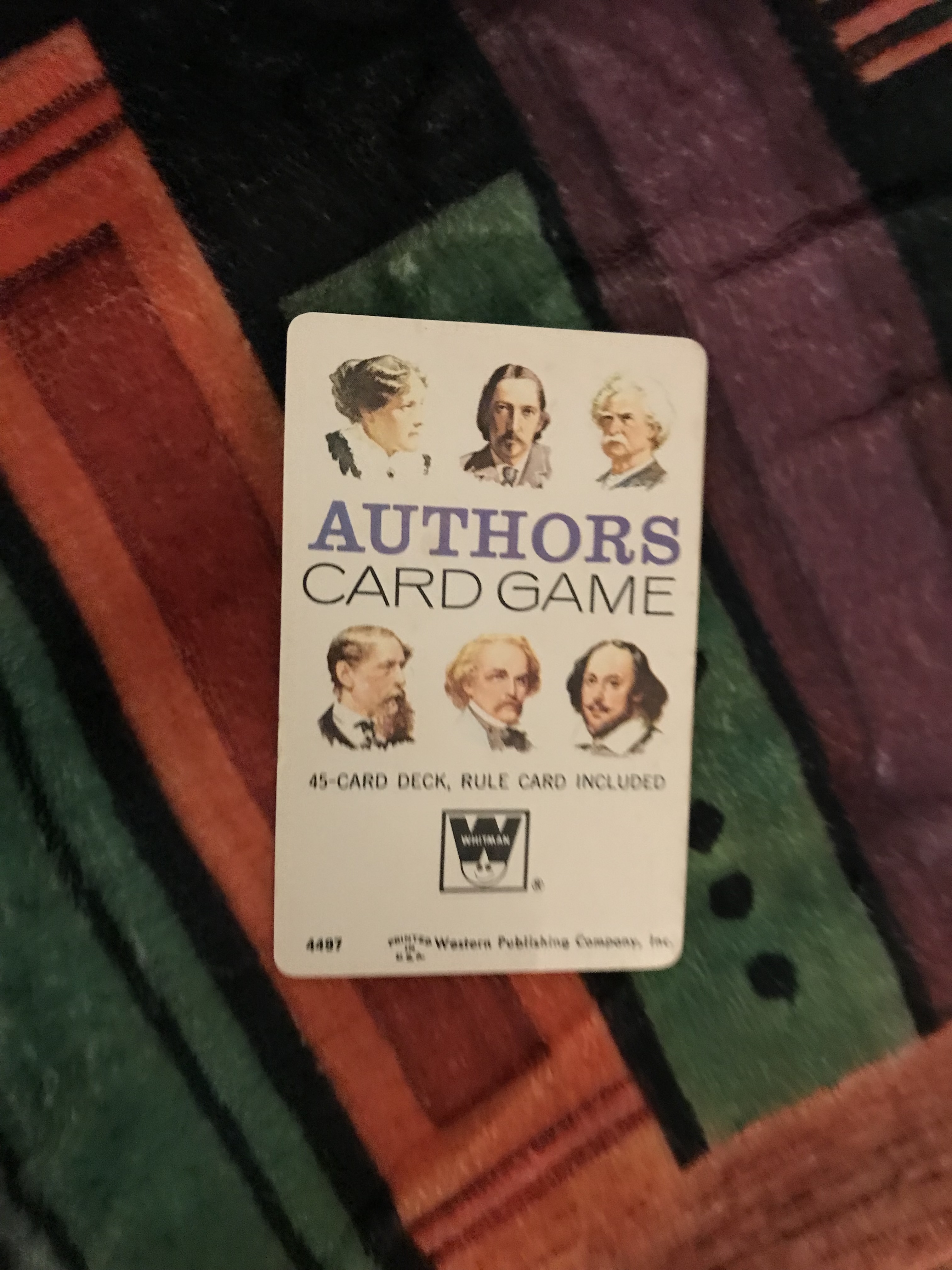
It happened in Salem.  In 1861.  The classic American card game, Authors, was published.  G. M. Whipple and A. A. Smith devised the game, which has remained available ever since then.  It’s one of the few games I remember having as a kid.  We, of course, had the Bible Authors game as well, which I’m kind of nostalgic for, but not enough to see if it’s on eBay.  The object of Authors, an early form of “Go Fish,” is to collect sets of four cards for each author.  Each card lists a different work.  Poets are represented by poems, of course, but prose authors mostly by books.  I have to confess to having eBayed this some time back and having beetlebrowed my family into playing it with me.  I noticed, however, a few curious omissions.

Edgar Allan Poe isn’t among their number.  Neither is Herman Melville.  Rather strangely, they included Shakespeare—centuries earlier than the others—and Alfred, Lord Tennyson.  The only female is Louisa May Alcott when there were perfectly acceptable Brontës in the room, as well as Jane Austin.  The game reflects its time.  A couple years back I was in Michaels—you know, the arts and crafts supplies store.  In fact, Michaels is one of those places for family outings, for families like mine.  (We tend to be creative types.)  While I’ve never been into scrapbooking, I walked down that aisle and found a set of stickers labeled “Literature.”  Two authors were represented: Shakespeare and Poe.  People smarter than me have argued that worldwide Poe is probably the best recognized American author.  I think it’s safe to say Shakespeare occupies a similar role in Britain.

Poe had fallen afoul of many in America because of an intentionally damning obituary by Rufus Wilmot Griswold, whom Poe had named his literary executor.  If it weren’t for Poe nobody would likely know Griswold’s name today.  In 1861, when Whipple and Smith were inventing their game, Poe wasn’t really considered worthy of emulation, largely because of Griswold.  He wasn’t the kind of guy you’d want your kids to be too curious about as you tried to teach them about literature.  Authors has gone through over 300 editions over the years.  I’ve never seen any of them (apart from Bible Authors) other than the Whitman edition from my childhood.  Each time I pick it up, smell the cards (go ahead—try smelling your Kindle), and thumb through the authors I feel like I’m missing something.  Go fish.


Twain Shall Meet

On a slightly hazy fall day, when the autumnal colors were alive, we stopped in Elmira.  To understand the significance of this stop, I should explain that from the time my daughter could appreciate it (and probably even before) we used to make fall literary trips.  We would take a long weekend and drive to where a famous author had lived.  Laura Ingalls Wilder in Pepin, Wisconsin, or Mark Twain in Hannibal, Missouri.  When we moved east we visited Edna St Vincent Millay at Austerlitz, New York, and Washington Irving in Sleepy Hollow.  More recently, in the spring, we went to see Rod Serling in Interlaken, New York.  So it was that we stopped in Elmira, New York, where Mark Twain rests.  I had always assumed Samuel Clemens was buried in Missouri, but his most productive literary period was his time in upstate New York, and it is here he remains.

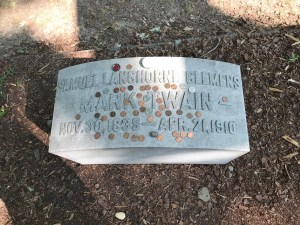
His tombstone was covered with pennies and a few higher denomination coins, a rock or two, and a guitar pick.  People want to show their respects to the writers who’ve meant something to them.  I find this a moving tribute.  I suspect it happens at the tombstones of many famous people, but in Highgate Cemetery in London we found Douglas Adam’s small plot filled with pens stuck in the ground as mementos.  I travel through the world lightly, seldom carrying anything extra with me.  Somehow I never stop to think to bring a memory to the cemetery.  Fortuitously I had found a penny on the ground the morning we left for Elmira and I placed it among the others on Twain’s marker.  

What would make the appropriate calling card to leave?  I often wonder that.  If I had such a token, I suspect I would feel the need to revisit the various cemeteries of years past to leave a sign of my respect.  There are lots of them.  Edgar Allan Poe in Baltimore.  George Orwell in Sutton Courtenay.  H. P. Lovecraft in Providence.  Is there anything that ties them all together?  Pens seem an obvious choice, but stones are far more traditional (especially in Jewish settings).  The tradition is traced back to building cairns in biblical times, and the idea survives in that stones are more permanent than flowers and are a sign of respect.  Writers often have more elaborate items left, but it’s clear that they are removed from time to time by the grounds keepers.  Before I visit my next literary grave, I’ll give some thoughts to symbols and tokens and the importance of celebrating writing.