Paper Chase

Maybe you’ve done it too.  Kissed the posterior of technology.  Up until three years ago I didn’t pay bills online.  I waited for a bill, wrote a check, stamped an envelope, stuck it in the slot and forgot about it.  Then I started getting overdue notices.  My payments were failing to reach their recipients.  I switched to online payment—it seemed like the only option.  That has worked fine for two years but then something else started to happen: my email notices failed to show up.  I started to get overdue notices again.  I went to websites and enrolled in auto-pay for all my regular bills.  Then the emails began showing up stating accounts were overdue.  The actual websites said the bills had been paid.  There seems to be no pleasing the technological beast.

You see, I’m a simple man of pen and paper.  I don’t read ebooks unless I have to.  I don’t trust most of what I find on the internet.  Mine is the mindset of a working Post Office (or at least Pony Express), paper payment for which you receive a copy back.  Some solidity.  Live Science ran a teaser headline that the next solar storm could lead to an “internet apocalypse.”  All records wiped out.  With no shoebox full of receipts, how are you going to prove you’ve got the money you say you do?  (That could be a boon to braggarts such as Trump, but the rest of us will be waiting timidly for a letter from our banks.)  Technology seems to be chasing an invisible goal.  Doing it because we can without thinking of the consequences.  Shooting rockets into space with no certified astronauts on board—what could possibly go wrong?
Tech isn’t bad, of course.  It has preserved many of our jobs through a pandemic.  It makes it easy for forgetful guys like me to be able to find information quickly.  But functioning is only as good as the coding behind it, and it feels terribly vulnerable to me.  Coronal mass ejections, apart from sounding slightly dirty, are rare according to the story by Brandon Specktor, but they tend to happen every century or so.  A century ago a working landline telephone was a luxury.  The computer as we know it hadn’t been invented.  We were about to plunge into the madness of a second world war in which tech would be used to kill on a massive scale.  Now I guess we await the apocalypse.  The safe money says to have plenty of paper on hand.

Evolving beyond Fear

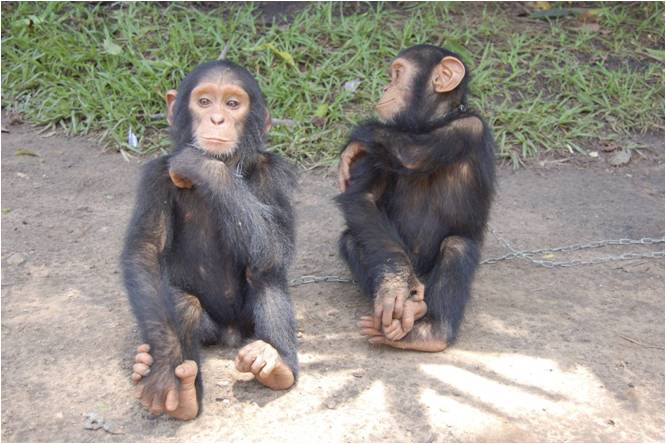
Live Science recently reported on a story that may shed light on human evolutionary behavior.  While my conclusions are speculative, they make sense, given the circumstances.  Titled “Albino chimp baby murdered by its elders days after rare sighting,” the story by Nicoletta Lanese describes how an albino chimp caused a fear reaction among its community shortly after it was born.  A few days later it was killed by the chimps.  Scientists must be careful not to attribute human motive to such attacks, and so they note that this particular community has a tendency toward infanticide, but that doesn’t explain the initial fear reaction.  An individual who was “different” appeared and the response was one of deadly violence.  We’re far from understanding human motivations, let alone those of animals, but it’s difficult not to see this as typical human behavior.

Photo credit: Afrika Expeditionary Force, via Wikimedia Commons

Just because a behavior has evolved doesn’t mean it’s inevitable.  We evolved out of our need for tree dwelling in order to open new potential habitats—an experiment that proved wildly successful.  Can we not evolve out of fear of those who are different?  That seems to be the idea behind recent diversity and inclusion initiatives.  There are those who still resist them, but examine their beliefs and you’ll soon find fear of those who differ.  This atavistic tendency is remarkably close to the chimp behavior in killing an albino.  If we are to remain civilized, we must name such fear for what it is and grow beyond it.  Conservatism is often based in fear.  Fear of change is natural enough, but had our ancestors given in to it we’d still be in the trees.

We need to admit that the lives of those different matter. How long will we allow difference be a reason to fear other human beings?  The story on Live Science is difficult to read.  The chimp behavior is so typically human that we can feel sympathy for the murdered infant and his mother.  Fear, if left unattended, can bring us to this.  The antidote is education.  The more we learn the better we can cope with fear, which is, after all, a natural and necessary response to an evolved world.  Our fear of being prey has caused us to drive extinct most of our natural predators.  The world is hardly a better place for it.  Might not weighing fears and thinking through reasonable solutions be a better coping technique?  Fear can revert a human back into an animal state.  Or it can drive us toward improvement.