Shipping Good News

Some say the infrastructure of this country is crumbling. It’s something I try not to think much about when I’m on the Helix or in the Lincoln Tunnel, but the concrete of those aging piers doesn’t look too healthy to me. So when I see a truck with a religious message, I guess I’m supposed to take comfort. On a recent drive along interstate 80, the great New York to San Francisco highway, we passed a Sam Kholi truck. You can tell a Sam Kholi truck because they declare “Jesus Christ is Lord, not a swear word” in bold letters on the side. The back has just the first part of the aphorism followed by “Almighty God the First and the Last.” A little research revealed that Sam Kholi is from Syria and now lives in San Diego. Many Americans, in these days of Trump, don’t realize that many “middle easterners” are indeed Christian. I got my start in publishing from a Syrian Christian. Prejudging is seldom a good idea.
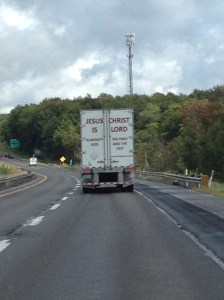
Sam Kholi is combining his faith with his practice—something that harkens back to more ancient forms of religion. Lived religion used to be the only kind of religion. Once it was systematized, it became an academic pursuit. Knowing precisely what you believed became more important than what you did with it. Today’s religion, at least in these hallowed states, seems to be purely a matter of what you believe. Whether you live morally, treat others justly, or even pay attention to what the Bible says about caring for those in need, none of this matters as long as you believe the right thing. The result is people suffer. No matter, orthodoxy is secure.

Since our actions are more vocal than our words, I’m amazed and perplexed by what many evangelicals say. They are the ones who claim for themselves the literal truth of Jesus’ words. How they can deny the rights and needs of others based on race, gender, or sexual orientation is a mystery given the many passages in the Bible concerning forgiveness and love. When it comes to religion as how you live, apparently it is one size fits all. Driving, it seems to me, is one of the places where lived religion is put to its harshest test. Religion is how we live with others, and driving is how we show what we really believe. It takes a tremendous amount of faith to paint your belief on the side of a truck.

Magic Bibles

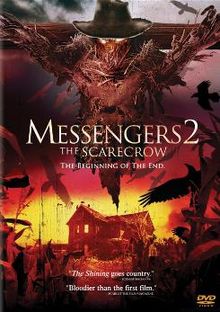
With autumn not far down the road, my mind turns to scary things. Actually, it is that way quite a bit of the time. Nevertheless, movies about farms are often the setting for the creepy—the sense of isolation, the sharp implements farmers use, the rustling of the drying crops in the wind. A couple years back I watched The Messengers. As a horror film it had a number of good scares, but the menace always seemed somewhat restrained. Nothing profound happens, and it is a film fairly easily forgotten. It was a rainy Saturday afternoon and The Messengers 2: the Scarecrow suggested itself to me. I began watching in an ambivalent mood, but when the first scene began with the protagonist (whose name I’ve forgotten) dropping his Bible on the porch chair as he loosens his tie to work on a derelict water pump, I was curious. When his wife arrives home and asks why he left church before it was over, my interest grew. This direct-to-video prequel turned out to be a cut-budget horror flick based squarely on a religious parable.

In a faustian moment of abandon, and at the advice of a jocular neighbor named Jude (Iscariot, anyone?), our hero erects a scarecrow to try to improve his lot (literally). To give credit where it is due, the scarecrow is distinctly disturbing. The scene of John (okay, I looked it up) nailing the scarecrow to the cross is clearly a crucifixion scene, and the blood that will later appear at the foot of the cross bears this out. Before he realizes that the scarecrow is evil, John hears ghostly children singing in his cornfield. The song is “Jesus Loves Me.” There is a strong fertility goddess theme running through the film and when Jude reveals that his wife has a magic book that explains all the benefits of the scarecrow, John decides to cut it down. The scarecrow, predictably, resurrects.

Meanwhile, John’s Christian family thinks he has gone insane. Or worse, backslidden. As he tries to explain to his wife what has happened, John shows her the magic book and she insists “It’s just your old Bible,” and it is. Heathenish occult instruction transubstantiates into Christian scripture. It is tough to tell one sacred writing from another. For cut-rate horror fodder, this is wonderful commentary on religious sensibilities. Although straight-to-video movies are not high art, and will never receive academy award nominations, they do reflect popular religious beliefs. Scholars are now in search of such beliefs in ancient societies since “official religion” almost never reflects what actual hoi polloi think. Lived religion seldom conforms to the intricacies envisioned by religious founders, and yet it is out there on the Internet for all to see. Maybe the messengers in this film are not the crows after all. The point of the parable? Stay true to your Christian upbringing or else the scarecrow will get you.