Google Me This

Technology frequently flummoxes me. Although I use it daily, it changes more swiftly than I can hope to. Working for a British company, for example, my computer seems to be a loyalist. It supposes that it is in the United Kingdom even as it sits on my desk in New York. I’m told this has something to do with a mystical key called an “IP address.” When I search Amazon, prices come up in pounds. When I google something, I’m told that European laws restrict certain searches. And, interestingly, I discover that Google’s icons of the day have a British theme.
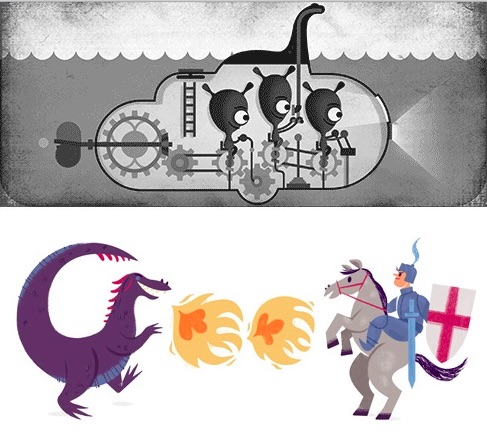
GoogleI’m assured Google is a fun place to work. One of those enlightened companies that believes reducing stress and increasing enjoyment of employees leads to good results. Were that all companies so enlightened. In any case, the famous Google logo is often decorated with a commemoration of the day. This past week, two such icons appeared on my UK searches. The first commemorated Nessie with something like the 81st year of her appearance. The icon puckishly showed Nessie to be a fake, a submarine actually piloted by aliens. Later that same week, on St. George’s Day, a dragon appeared on the icon. I began to wonder about this reptilian connection. If lake monsters are real, many make the claim that they must be plesiosaurs, their dinosaur cousins that most resemble them. St. George, clearly a character cut from the same cloth as Hadad, slays a dragon—an equally mysterious reptile.

We tend to associate dragons with evil, although in world mythology they appear equally as often as harbingers of good. Human interaction with reptiles has always been fraught. Somewhere along our evolutionary track we must’ve shared a common ancestor with them. Even today some responses, such as fight or flight, are referred to as those occurring in the “reptilian brain.” In Genesis 3 the serpent slithers in. According to Revelation, at the other end of the canon, the snake is still there at the end. It was only happenstance that Nessie and George’s unnamed monster appeared in the same week, I suppose. Nevertheless, there is a deep connection between them and us. We can’t seem to get away from them, even should we flee across the ocean.
Where? Wolves?

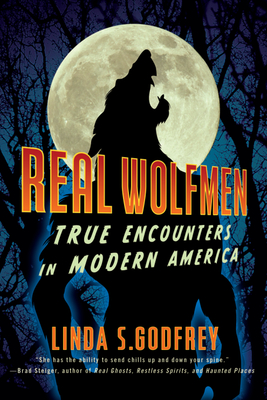
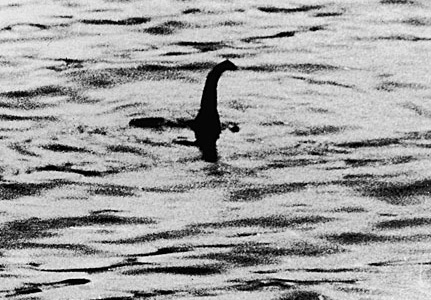
The problem with occasional phenomena is that they are seldom empirically verified. Try as we might, no one has managed to be in the exact place at the exact time on Loch Ness to capture definitive evidence that Nessie exists. Of course, it is very difficult to prove that something doesn’t exist. I have a creeping suspicion that not all of reality can be quantified. I’m very glad for the parts that can be, but a little mystery never hurt anyone. I’ve just finished reading Linda Godfrey’s Real Wolfmen: True Encounters in Modern America. There—I’ve already lost some of you! We all grow up to learn that there are no such things as werewolves and I’ve experienced many a peaceful night in that knowledge. Nevertheless, many people do report seeing upright wolf-like creatures, and many of the people interviewed by Godfrey appear to be entirely sincere. What makes this intriguing to me is that many of these episodes are reported in a circumscribed area (near which I used to live). While reports come from across the country, it is easier to dismiss one person who saw something odd once than it is to discount many people who see a similar thing over many years in the same general vicinity. That’s why I keep coming back to Godfrey’s books.

Being an open-minded writer, Godfrey also considers possible spiritual explanations for what people see. Shamanistic traditions, in this case particularly Native American ones, do not dismiss transformations from human to animal. It is difficult for most of us to accept that a person could bend the laws of physics and biology—for which we suffered through so many tests in our education—to mutate or mix human DNA into or with lupine stock. Indeed, it takes the faith of the world of religion to believe that. And yet, people see beasts.

We have been in the process of sealing the borders to our universe since the Enlightenment. The vaster our universe becomes the smaller the realm of possibilities grows. But we haven’t even explored all of our own little planet yet. The deep-sea trenches remain largely out of our reach, and the sheer volume of the oceans boggles the imagination. Even on land, we can’t watch every place all the time. The possibility of getting to somewhere truly remote is frequently an optimistic illusion. At times with my wife’s family I’ve ventured to places so far from civilization that freedom truly feels palpable. And as we hike down some neglected trail, talking to alert the grizzlies to our presence, nearly always we end up encountering others out here to escape from the likes of us. Yet a whole lot of the woods remain off-trail. It’s not a small world after all. And it’s October. Who’s to say there’s not the occasional werewolf out tonight?


Cryptid Be Thy Name

While poking around the internet last night to take my mind off the heat and humidity surrounding me, I stumbled across an article entitled “The Religious Struggle over Cryptozoology” on a site called Science and Religion Today. The piece was written by Joe Laycock, a doctoral candidate at one of my alma maters, Boston University. Having just finished Bruce Hood’s Supersense, there was a pleasing euphony in the coincidence. Cryptozoology is the study of unknown animals, and is not necessarily based on the supernatural (although it may fall within Hood’s definition of it). Laycock notes that two religious elements in society have latched onto this study: New Agers and Creationists. Creationists, it seems, see in certain cryptids, such as the Loch Ness Monster, hold-overs from the Mesolithic Era that prove the Mesolithic Era never existed. God can still make dinosaurs today, therefore the Bible (which doesn’t mention dinosaurs at all) must be true.

The draw of the unknown

One of the most welcome parts of Hood’s thesis was its consonance with Stephen Asma’s On Monsters, a book I’ve posted on before. Both authors explore how the human psyche reacts against what it perceives to be “strange mixes,” beings that cross-over between readily defined categories. Hood addresses this by tackling the concept of “essence” while Asma notes a dread accompanied by a sense of wonder. Hood demonstrates that from a scientific point of view, there is no such thing as the “essence” of a person, object, or living thing. Such ideas are the cling-ons from the era of souls and radically distinct species and genders. Closer observation has taught us that many such things are more of a continuum than a series of sharply defined types. Religions prefer to have fixed categories. Religious ethics often depend on them.

Laycock suggests that both New Ageism and Creationism “can be read as a religious response to the cultural authority of science.” Religions fear that which can be empirically demonstrated since it throws the god-of-the-gaps into the dryer and he comes out smaller each time. This is so, despite the fact that Creationists crave scientific respectability. While teaching my course on Myth and Mystery at the University of Wisconsin Oshkosh, I dwelt on cryptids for a few sessions. They are indeed often surrounded with a religious mystique. I wouldn’t necessarily dismiss the possibility of undiscovered species, many new ones are described by science every year. Nor would I say that they are supernatural. Nature has ways of surprising us still, and as Asma clearly demonstrates, we still have a need for monsters.