
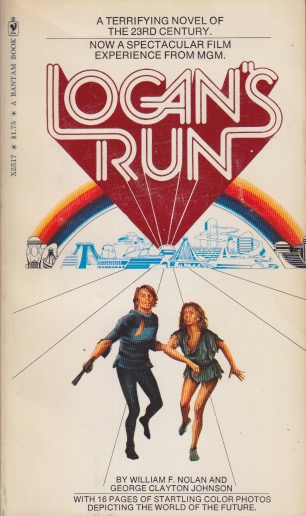
A couple of friends, both younger (ahem), liked my recent post on Logan’s Run. As did someone my post on Goodreads. I was pleased to see that. I was alive, but not yet literate, when the book was originally published. So, predictably, I sat down to watch the movie again. My wife had to work that weekend and I had last seen it in 2011. This time, the book fresh in my mind, I was able to notice just how much the movie diverges. For practical reasons, the movie has people live to 30 instead of 21. The issue was finding enough young actors (this was the seventies, after all) who could carry off the story. Michael York was over thirty, but he could pass. The book is a romp across the country, and it would be unbelievable in the film if Peter Ustinov were able to walk from Washington DC to Los Angeles.
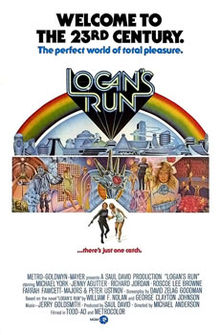
The movie has Logan dedicated to Jessica, but in the novel they have to grow to love each other. In the film, Logan is sent on a secret mission to find Sanctuary, which, it turns out, doesn’t exist. The novel has Ballard (transformed into “the old man” in cinematic form) disguised as Francis, Logan’s fellow Sandman, from pretty much the beginning. On the screen, Francis remains a dedicated Sandman to the end. Gone are the zoo animals in Washington, the hovercraft chases, and the little children who save Jessica’s life. Granted, a lot in the novel would be very difficult to transfer to celluloid, and changes had to be made. The whole episode of the religion of “Carrousel” isn’t in the book, but was added to give the movie coherence. I did find it odd that they included the scene with Box, which really doesn’t fit the film.
In any case, it warms my heart that some of my younger friends have fond memories of this movie. It’s definitely a period piece. Fitting for the seventies, there’s kind of an atheistic undertone to it. Sanctuary only exists in people’s minds. Nobody is “renewed” (born again). But not all is doom and gloom. The old man quotes from Old Possum’s Book of Practical Cats, by T. S. Eliot. (That fact is the only way that I could get my daughter to watch the film.) And it does have an optimistic ending. Logan and Jessica decide they want to stay together—marriage was ancient history in their world. And the young people, my greatest hope for the future, came to see the old man was fascinating. Something that gives this particular writer a true sense of hope.
 Steve A. Wiggins