
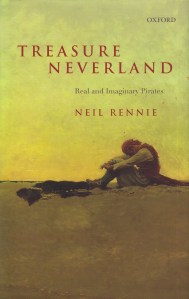
 It might seem superfluous to be reading about pirates when such serious issues face us these days, but my answer to most of life’s problems is to look at the history. Besides, like many people in the early new millennium I was swept into the swashbuckling romance of the purified pirate. I suspect, given the time period, that I hadn’t really thought of pirates for a couple of decades. I knew that in reality a pirate was simply a thief on the seas, a bloke on the water who had looking out for number one down to a capitalist science. I thought maybe Treasure Neverland: Real and Imaginary Pirates, by Neil Rennie, might say a bit about the most famous fictional pirates of the modern era, but alas (or “avast”?). For a book that says in its cover copy “the long dissolve from Captain Kidd to Johnny Depp,” it has only a single paragraph about the modern Hollywood pirate from the Caribbean. That’s not to say that the historical and fictional information aren’t interesting—I especially enjoyed the chapters on Long John Silver and Captain Hook, and women pirates—but the book wasn’t quite what I was expecting.
Rennie does a good job of exploding myths that mostly trace their origins to a bottleneck of historical sources on the subject. It’s good for academics to revisit the origins of ideas, I find. Beginning with the days of Henry Every, the early material is quite interesting. I had no idea that Madagascar was such a pirate haven, being mostly aware of the Caribbean variety. But there are also contemporary swashbucklers about.
Consider, for example, that our country seems to be run by pirates. Thieves are those who claim for themselves what they have no right to take. We have a president and cabinet who are pretty much all of that description. We also have majorities in both houses of congress who seem, on many issues, willing to climb aboard a stolen vessel. In Iceland they have the probity to call themselves “the Pirate Party.” At least you know what you’re getting when you cast your vote for those who say what their intentions are so obviously. Not that Trump didn’t make clear in his words and deeds of a lifetime that he would only look out for himself. People can’t be troubled to check the facts, though. It’s better just to let your anger drive you when you’re behind the curtain. Who looks at Wanted posters anymore? Of course, I would say that. I’m the kind of person who looks at history to solve problems.
 Steve A. Wiggins