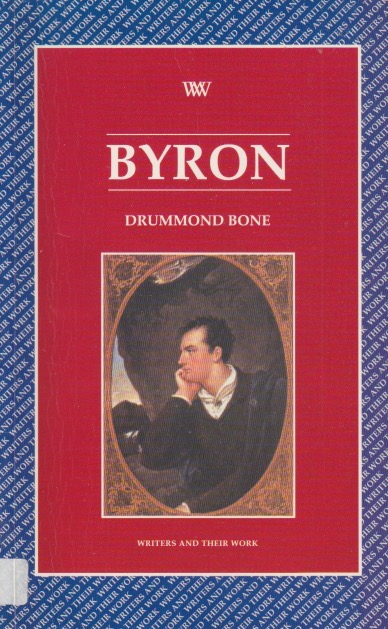
A Different Lord

I just wanted to learn the basic outline of Lord Byron’s life without having to commit to the hundreds of pages most of his biographies boast.  Something brief, but authoritative.  Something for which I could be sure the author was vetted.  I hadn’t read any of the Writers and their Works series before.  It gets good reviews and here was the story of Byron in less than 100 pages!  I was excited to get started.  Then I discovered this is mostly about his poems rather than his life.  It contains 21 pages of biography and 60 of poetic analysis.  I really should’ve checked more reviews.  I’m not really into poetic analysis.  I know that those of us who create tend to think of our creations as extensions of ourselves.  I’ve made 3-D art (kind of like sculpture), I’ve drawn, I’ve painted, I’ve written.  These are parts of me that exist in the world.  But really, I just wanted to know what Byron’s life was like.

Actually, I did learn the answers to some of my questions.  Although a “lord,” he didn’t inherit much wealth.  Indeed, the opposite.  His eventual wealth came from his poetry.  This is nearly an impossible dream these days, of course.  His fame brought the spotlight onto his personal life and politics.  A man who easily “fell in love”—he was a Romantic, after all—he had affairs and his politics weren’t those of the majority.  He left England at the advice of a friend, never to return.  He was friends with Percy Shelley, which is common knowledge.  As he made a home, actually several homes, in Europe, he continued to earn good money for his poems.  He was famous and feared, it seems.  Although the book doesn’t describe it, he gave the world its Byronic hero.

I haven’t read much of Byron’s poetry.  That style of writing has never appealed to me.  The poetic life, however, is of endless interest.  Shelley drowned on a boat trip home after visiting him in Italy, and Byron was present at the cremation.  (And I got yelled at in the New York Public Library for trying to snap a picture of the fragments of Shelley’s skull that were on a special display.  Byron had been there in person, of course.)  A few short years later Byron also died while helping to plan and finance the Greek war for independence.  Still, there is more I’d like to know.  But probably not enough to read a biography of several hundred pages, though.


Mad, Bad

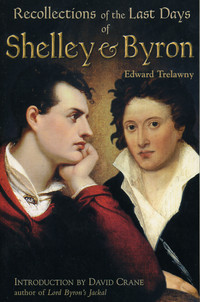
Although epic poetry holds an important place in literary history, I tend to read prose more.  Like most wordsmiths, I do write poetry—more like dabble in it.  Unlike my fiction writing, the poems aren’t intended for publication.  They are too deeply personal for that.  Still, my recent post about Gothic (the movie) had me thinking about Percy Shelley and Lord Byron.  They were known for their poetry, of course.  I can’t pretend to have read a ton of it, but their free-spirited personalities are intriguing.  Back in 2012 I read Edward Trelawny’s account of Shelley and Byron’s last days—neither lived more than six years after the summer when Frankenstein was born, both dying before forty.  I was recently reading about Byron in another context and was reminded (I’d read it before) that an acquaintance once described him as “mad, bad, and dangerous to know.”

Authors, I suspect, are often neurodiverse.  There’s a reason I think this.  The size of the population that reads for pleasure is depressingly small.  It stands to reason that writers are a subset of that small population.  The writers I know tend to have some quirks.  They function just fine in society, but they do seem to operate on a different level.  I’m naturally drawn to them.  I have been trying to get to know writers locally—there are quite a few here in the Lehigh Valley—and sometimes they will let you in.  Often not.  It’s tricky to befriend writers, in my experience.  I suspect I might be one myself.  In the published side of things, I’ve produced six non-fiction books, but I also publish short fiction (and have completed six unpublished novels).  Still, I’m not part of the “mad, bad, and dangerous to know” club yet.  If there is a club.

Over the years I’ve joined three different writing groups.  Their meetings are interesting since many of us are introverts.  One thing we all have in common is that we love to talk about writing.  Perhaps it’s because mainstream success is so difficult to come by.  Publishing houses have consolidated and the “Big Five” are responsible for by far the majority of books the reading public—that most rare group—buys.  One thing that’s true among the writers I know is that most would keep writing even if publication, or hope of publication, was off the table.  It is what we do.  For many years, perhaps too many, my writing was academic.  What nobody knew in my teaching days, however, was that I never stopped writing fiction.  It was there I put my thoughts that I’d classify as “mad, bad, and dangerous to know.”


Feeling Gothic

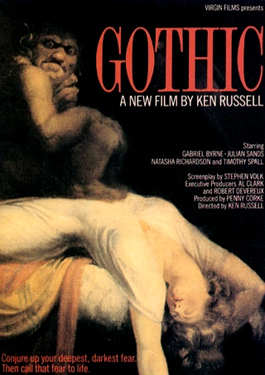
Gothic is an odd movie.  I first saw it while in seminary and have come back to it now and again.  I had been thinking of Frankenstein, so I decided to refresh my memory.  A pastiche of opium-fueled images and hedonism it nevertheless brings some religion into the horror.  In case you aren’t familiar with this Ken Russell piece, it’s a movie version of the stay of the Shelleys with Lord Byron, his physician John Polidori, and Mary’s stepsister Claire, in the summer of 1816.  During that visit, the basic ideas for Frankenstein emerged, and Polidori wrote an early vampire story that later inspired Dracula.  The religion comes in the form of Polidori’s Catholicism and his fear of condemnation for being a homosexual.  At one point, when the friends are about to read ghost stories, Percy Shelley says they’re more fun than any Bible.

Of course, in actual life Shelley and Byron were atheists, but the movie portrays the five raising some kind of entity during a seance.  They then spend the remainder of that stormy night trying to drive the entity back into their minds from the physical reality they gave it.  It’s a weird movie with lots of incongruous shots and some gross-out moments.  Ken Russell was known for his flamboyant style, and this movie is a good example of that.  It’s not great but it is moody and I come back to it when I want something, well, gothic.  The year 1816 was called “the year without a summer,” because of the volcanic winter caused by an eruption of Mount Tambora, and some have speculated that the bad weather of that year may have led to the creation of Frankenstein.

Every time I watch it, I wonder what the appeal is.  There’s a lot of God and Devil talk, and Byron was a fascinating character.  Julian Sands’ overacting in every scene makes me wonder what Shelley was like in real life.  I’ve occasionally read about his relationship with Byron and each seems to have had at least a supporting role in the iconic pair of monsters, Frankenstein and Dracula.  The two would be forever associated with the Universal release of movies named after them in 1931.  Gothic never made it big—I only found out about it because a seminary friend invited me over to watch it on VHS one weekend.  Still, it made enough of an impression to bring me back when the mood is right.  Even if it’s strange.


Summer of Frankenstein

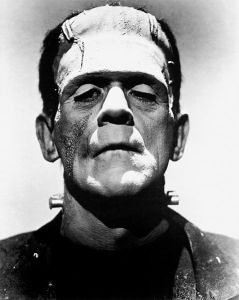
Two centuries can make an enormous difference. Just two-hundred years ago Napoleon’s defeat at Waterloo was merely one year in the past. North America and parts of Europe were experiencing “the year without a summer.” Perhaps due to that cool and rainy summer, when Mary Godwin and Percy Bysshe Shelley called on their friend Lord Byron, their thoughts turned to ghosts. According to the legend, together with Byron’s personal physician John Polidori, the friends spent a night writing scary stories. Polidori, although not widely remembered today, invented the vampire that would, in Bram Stoker’s hands, become the aristocratic Dracula, and eventually, with Anne Rice’s influence, Lestat, Louis, and Armand. Mary Godwin, soon to be Shelley, gave birth to perhaps the most successful of new monsters ever created—that of Victor Frankenstein’s construction. Many have claimed the monster’s pedigree to have been that of the golem, but Shelley’s creativity went beyond this forebear into the sympathetic misfit who, like all of us, never asked to be born. The two centuries since that summer have been haunted.

477px-Frankenstein's_monster_(Boris_Karloff)

Quite apart from the monster tale, Frankenstein is also about building that which we, in our hubris, can’t understand. Progress without forethought, as Epimetheus could never learn, housed immediate and very real dangers. The two centuries since Frankenstein have proven Mary Shelley a prophet. An early supporter of women’s equality, she profited from her novel, but never managed to thrive. Just six years later her famous future husband would die tragically in the Romantic genre of a shipwreck. Even with important friends, Mary found it difficult to capitalize on her success. The monster was real enough.

We’ve become accustomed to making things we can’t control. When’s the last time you were able to fix a car broken down by the road, apart from the occasional flat tire? Can you really stop your job from becoming completely different from what you signed up to do? What about when that bully wanders from the playground into the political field? Once you’ve figured out how to split an atom, you never forget. It may have been Napoleon still recently in the news, or the fact that 1816 failed to warm up like it was expected after the solstice. Perhaps it was the fact that Mary Godwin was a liberated woman in a world still utterly determined by men. We can’t know her intimate and ultimate reasons for creating a monster, but we do know that once the monster is unleashed we can never bind it again.


Shelley, Byron, Trelawny, and Ahab

“I took up the word [atheist], as a knight took up a gauntlet, in defiance of injustice. The delusions of Christianity are fatal to genius and originality: they limit thought.” The words come from Percy Bysshe Shelley, according to Edward Trelawny. After visiting the display Shelley’s Ghost at the New York Public Library last week, I was struck by how little I knew of Shelley. I’d read some of his poetry, and had watched the fictional movie Gothic (maybe more times than is really healthy) to get a sense of this candle in the wind, the Romantic poet who died in a shipwreck before reaching 30. Edward Trelawny’s reputation as an historian is somewhat suspect, but he did form friendships with Shelley and Lord Byron and arranged the disposal of their earthly remains. His book, Recollections of the Last Days of Shelley and Byron, while somewhat self-serving, weaves an intriguing account. Among the mementos in the library display are some fragments of Shelley’s skull, taken after his cremation by Trelawny. This erstwhile biographer did prove his mettle by reaching into the pyre and pulling out Shelley’s heart, according to his own account, that eventually returned to Mary Wollstonecraft Shelley, his widow.

Trelawny admired Shelley’s atheism, and even applauded Darwin’s Origin of Species when it appeared. The nineteenth century was setting the stage for a strange Frankenstein’s monster of political and religious backlash against the freedom of the Romantics. Not all of the Romantics, obviously, were atheists, but their works extolled the wonders of nature and a sense of liberty from tyranny that would define them as dreamers and idealists. Lord Byron comes across much less favorably in Trelawny’s account, although their friendship lasted through some difficult times. After the poet’s death, Trelawny claims to have examined his feet, discovering the cause of a lifelong limp. His psychologically astute conclusion is that Byron’s disagreeable personality traits arose from his lifelong anger and anxiety about his birth defect.

Being an ardent admirer of Herman Melville’s Moby-Dick, I have to admit that the elements of anger at the divine for a limp (Captain Ahab forcefully stomps into mind), and the emphasis on ships and shipwrecks (as in Shelley’s death) tie these three literary geniuses together into a knot of suffering and seeking. Religion had consoled many in the nineteenth century, just as it continues to do now in the twenty-first. Among many of those who have endured through their literary works, however, God had slowly disappeared. Not quite as dramatic of a demise as Shelley’s, nor as unforgettable as Captain Ahab’s, but one for which there will be few biographers.


Assyrian Dreamers

And the widows of Ashur are loud in their wail,
And the idols are broke in the temple of Baal;
And the might of the Gentile, unsmote by the sword,
Hath melted like snow in the glance of the Lord!

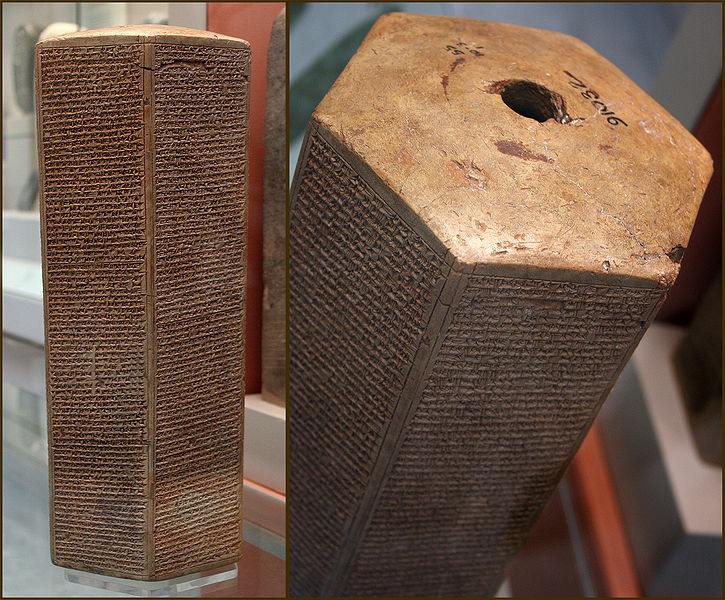
These lines from Lord Byron’s “The Destruction of Sennacherib” were recently quoted to me by one of my relatives who houses a tremendous store of memorized poetry. The poem is Byron’s vision of the siege of Jerusalem, a historical event that is now well understood because the actual annals of Sennacherib were discovered in 1830. The Akkadian version of Hezekiah’s revolt and the subsequent siege of Jerusalem in 701 BCE match the statement in 2 Kings 18 that declares Hezekiah bought off Sennacherib, thus sparing his kingdom. The biblical version then goes on to add the event eulogized by Lord Byron that an angel was sent after a prophecy of Isaiah and the Assyrian army fell decimated outside Jerusalem. The latter event is not historically accurate, but it is much more poetic. Who would write a poem about a king paying off his enemies?

Annals of Sennacherib

The Bible is comfortable with conflicting accounts of events, sometimes laying them side-by-side without comment, supposing that the reader is bright enough to see the obvious contradictions and draw the relevant conclusions. With the birth of Christian Fundamentalism in the 1920s, however, the myth of biblical inerrancy was born. In a world rendered in shades of gray, a distinct comfort lies in having answers in black and white. The Bible, considered the exact (if sometimes dodgy) words of God himself, could not be other than one hundred percent historically accurate. This version of history distorts what actually happened to what must have happened.

Lord Byron, notorious sinner that he was, seems to have been closer to the biblical spirit when he penned his famous poem. Glorying in the bravado of a warrior God who lays waste an entire army without lifting a sword or spear is fanciful, if breath-taking, poetic license.

For the Angel of Death spread his wings on the blast,
And breathed in the face of the foe as he pass’d,
And the eyes of the sleepers wax’d deadly and chill,
And their hearts but once heaved, and for ever grew still!

bears a grandeur lacking in “Hezekiah gave him all the silver which was found in the house of the LORD, and in the treasuries of the king’s house. At that time Hezekiah cut off the gold from the doors of the temple of the LORD, and from the doorposts which Hezekiah king of Judah had overlaid, and gave it to the king of Assyria.”