Colorful Space

Lovecraftian horror translates to film unevenly.  Even when it’s successful, as in Color Out of Space, it really isn’t that close to reading Lovecraft.  “The Colour Out of Space” is among my favorite Lovecraft stories.  To me, it feels perhaps his closest to Poe, and Poe is my personal muse.  I knew that it couldn’t be made cinematic without changing things a bit, and that it would be pretty gnarly.  I was correct on both counts.  In very broad brush strokes, the movie follows the story: a colorful meteorite on an isolated farm begins changing the crops and the people who live there.  Instead of crumbling, however, they are struck by the color and become other.  The mother and her youngest son, for example, are fused together creating one of the most cringe-worthy scenes I’ve watched in a long while.  The movie emphasizes family, even when things go horribly awry.

Defying Lovecraft’s well-known avoidance of focus on female characters, the movie’s focal point in Lavinia accords with Poe’s concern for threats against beautiful women.  She’s the teenage daughter of the family and the film opens with a scene where she uses Wicca to try to heal her mother of cancer.  The love between Nathan (Nicolas Cage) and his wife is movingly shown.  The movie was recommended to me during a conversation about Nicolas Cage in horror.  Maybe it’s because he’s in so many movies in total, I’d never really considered him a scream king, but he’s nailed the role quite capably, with the notable exception of The Wicker ManColor Out of Space is pretty extreme body horror but the movie is artistically done.  You almost don’t mind feeling violated in that way because of the visual appeal of the non-horror focused parts.

The acting is uniformly strong.  In a nod to Lovecraftian fans, Lavinia uses the Necronomicon as the basis for her Wiccan rites.  Some of the scenes seem to reference Evolution and others eXistenZ.  Transforming the action from Lovecraft’s setting in the early twentieth century to the early twenty-first is done pretty well.  The family is isolated when the meteorite prevents electronics, including cars, from working.  The movie does offer some alien creatures, unlike Lovecraft’s basic story.  And these creatures point to a planet with tentacly beings that naturally tie this story into the Cthulhu mythos.  Lovecraft’s own story doesn’t make this move, but of course, the Cthulhu mythos only really developed among his fans.  In all, Color Out of Space exceeded my expectations, even though it was a box office flop. 

Slimy Monsters

Stuart Gordon apparently had in mind to do an H. P. Lovecraft cycle, as Roger Corman did with Poe.  I first saw Dagon—clearly his best—and some time later picked up Re-AnimatorFrom Beyond was his second Lovecraft movie and it doesn’t have the visual appeal of Dagon, but it is certainly a passable gross-out for those who enjoy slimy monsters.  Gordon was pretty obviously of greater libido than Lovecraft ever was.  From Beyond puts sex in the spotlight’s periphery without making it absolutely central to the story.  A Dr. Pretorius has built a “resonator” that allows him to see extra-dimensional beings.  It does this by stimulating the pineal gland.  His assistant Dr. Tillinghast, is present when a creature from, well, beyond, kills Pretorius by wrenching off his head.  Tillinghast is suspected in his murder but is being held in an asylum rather than a traditional jail.

Dr. McMichaels, the love interest in the film, believes that Tillinghast is sane and that he actually did witness these beings from beyond.  As a scientist, she wants to see if the resonator really works.  It does, but in addition to providing the ability to experience the other realm, it also boosts the sex drive of those under its influence.  She decides, against the warning of Dr. Tillinghast, to try the resonator once more, but this time the other-dimensional Pretorius has become strong enough to prevent her from shutting the machine down.  Tillinghast is transformed into a modified human with an extension from his forehead and as she tries to explain what she witnessed, McMichaels is classified as insane.  She and Tillinghast escape the asylum and McMichaels manages to blow up the machine, ultimately going insane for real.

Lovecraft strenuously avoided sex in his written work, limiting the number of women characters who appear.  I suspect he would not have been pleased with this treatment of his story.  Gordon went on to make one more Lovecraft movie beyond Dagon, a television movie of Dreams in the Witch House (which I haven’t seen).  Of the three theatrical releases, I find Dagon the most convincing since the mood is serious and it seems to capture much of the feel of Lovecraft’s “Shadow over Innsmouth,” one of his best stories.  Lovecraft himself apparently didn’t care that much for that particular tale.  And he was critical of the conversion of stories into movies.  It’s a good thing that one doesn’t have to see eye-to-eye with Lovecraft to appreciate his works.  And some of them transfer to film reasonably well.  Especially if you’re in the mood for slimy monsters.


Lovecraftian Advice

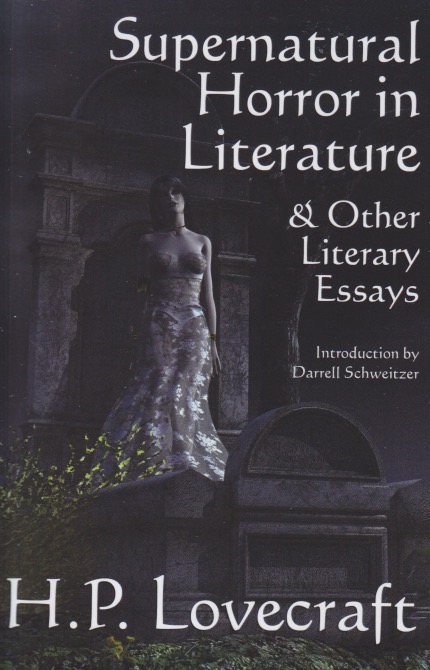
It seemed natural enough to follow up Stephen King’s On Writing with H. P. Lovecraft’s famous essay “Supernatural Horror in Literature.”  This piece, widely quoted, is available online but it is lengthy and I wanted the convenience of not reading it on a screen.  What can I say?  I like to turn pages.  I found a print copy, along with two other, shorter Lovecraft essays in Supernatural Horror in Literature & Other Literary Essays.  This was published by Wildside Press, which added a brief introduction by the speculative writer Darrell Schweitzer.  The text of the main essay was obviously computer-read—a couple reading errors remain—but it is clear enough to read.  Like Poe before him, and King following, Lovecraft put down some of his thoughts on the craft of writing.  Interestingly, Lovecraft is seldom considered as a producer of belles-lettres, but he is world famous as a horror writer now.

The essay itself is worth reading.  Mostly it is a summary of what Lovecraft felt was worthy weird fiction.  I tend to agree with much of what he says here, as would be evident were anyone to read my own fiction writing.  I can’t say that I learned this at Lovecraft’s knee.  I only discovered who he was when I was teaching at the University of Wisconsin Oshkosh.  I did not have literary friends growing up; my reading tastes were determined by myself, largely based on what was available at Goodwill any given week.  Nobody I knew read Lovecraft and although his books may have been in that bin, he wasn’t really someone I’d have known to keep an eye out for.  As a child I didn’t think of myself as a horror reader.  I liked monsters, and vampires were among the most immediately recognizable.  My brother, if I recall, got me started on Poe.

When I began writing fiction, probably around twelve or thirteen, it was weird fiction.  One of my other influences was Ray Bradbury.  I agree with Lovecraft that, to be interesting, fiction often requires a speculative element.  I do read realism, of course, but I really enjoy tales with a bit of supernatural.  It’s useful to read Lovecraft’s ideas about influential writers.  I’ve got my homework cut out for me.  I can certainly recommend this edition for anyone who wants to read this lengthy essay in print form.  The one thing that struck me as weird was the cover design.  It features a woman wearing a strapless dress in a cemetery.  Lovecraft famously didn’t really have women as one of his main themes, and his women characters are among his most inaccurately drawn.  Still, it’s best not to judge a book by its cover.


Suitable Genre

As I muse over genres, it seems that “low-budget Lovecraftian horror” might be an—ahem—suitable one.  This is perhaps because Lovecraft has trouble being taken seriously as a literary writer and his stories are so easily parodied.  I watched Suitable Flesh unaware that it was a Lovecraftian (low-budget) movie.  I’ve seen quite a few of these over the years and they can be pretty fun.  This one was somewhat enjoyable.  Based on Lovecraft’s “The Thing on the Doorstep,” it’s a body-swapping, possession fest that involves two psychiatrists who have been friends forever but who both become victim of a nameless possessing entity.  It took some adjusting to believe Heather Graham in her lead role here—she doesn’t strike me as the Lovecraftian type.  She does seem to enjoy her role, nevertheless.

Lovecraft famously didn’t write many women.  He was xenophobic and a racist.  He didn’t much enjoy being married.  Modern films (and even novels) based on his works tend to redress this situation, sometimes creating a little disconnect with the white-male Lovecraftian universe.  Still, the story is fun.  Dr. Elizabeth Derby (Graham’s character) encounters a young man whom she supposes is schizophrenic.  In actuality, his body is being taken over by an entity that had possessed his father.  While possessed, the patient begins an affair with Dr. Derby and that leads to her also being a target of possession.  Although not considered a comedy it does seem that part of the story has an inherent humor about it.  Some consider it camp.  Lovecraft’s mood is difficult to translate to film.

Although cinema existed during Lovecraft’s lifespan, his writing wasn’t influenced by the possibility of film conversion.  The monsters are too enormous and the concepts too broad.  The real fear here, apart from the gross-out effects, is that of losing your identity.  The whole centers around a psychiatric ward where the supernatural events aren’t really accepted by the science that reigns.  People end up dying because the supernatural is inadmissible.  In this aspect, it shares some of the overarching concepts of some great horror.  The Exorcist, for example, derives a great deal of its energy from the fact that modern people have great difficulty in accepting that a demon could actually exist and science doesn’t seem to be working.  There are plenty of other examples of this.  Lovecraft’s stories bring us close to this realm, although Lovecraft himself was an atheist.  Maybe that’s one of the reasons his works are difficult to translate to film.  Or maybe something larger is going on.


Squidish

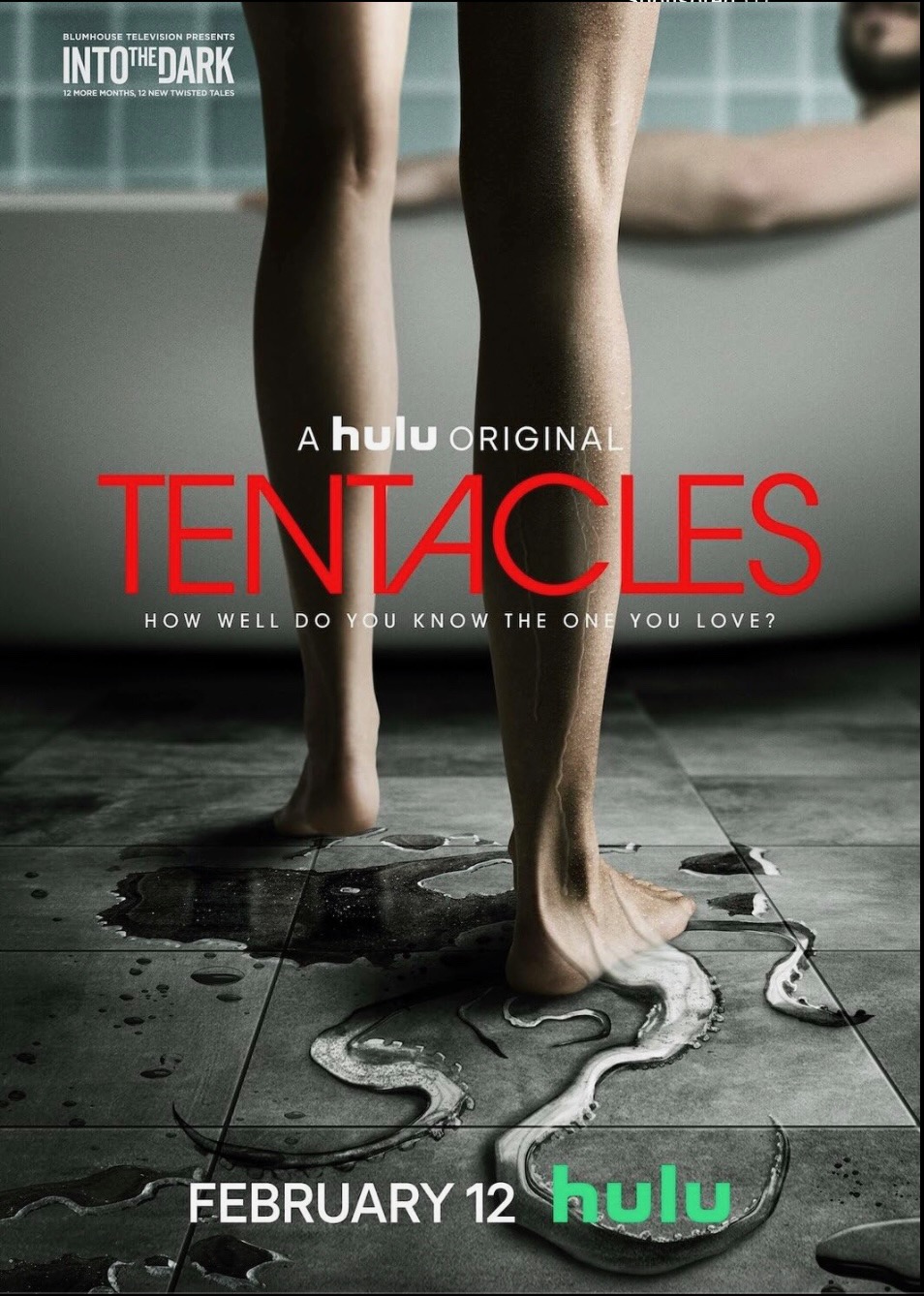
I was attracted to the Lovecraftian aspect of the title.  Of Tentacles, I mean.  I wasn’t aware that Into the Dark was a Hulu series of television shows based on holiday horror.  I watched Pure without realizing that.  Movies these days are complicated.  In any case, Tentacles caught my attention and although it isn’t a tier-one horror film, it’s fun in its own way.  Tara, a desperate young woman, is looking to buy a house.  She finds Sam, who’s trying to sell his parents’ place and seduces him into letting her renovate it.  The two fall in love and Tara reveals she’s being stalked by an ex.  Sam has, however, come down with an illness that doctors can’t identify.  Something is putting tentacles into his ears as he sleeps.  It doesn’t take long to figure out that Tara’s not what she claims to be.  She’s some kind of creature that originated in the ocean, but survives on land by taking part of her victims and slowly becoming their double.  The original, of course, must be disposed of.

This is a serviceable little movie.  The acting is good, particularly on Tara’s part.  There’s enough mystery and energy to keep viewers engaged, despite the commercials.  It also made me realize that Into the Dark might be worth exploring a little more intentionally.  When I went to my usual places to find out more about what I’d just watched, it was a little tricky.  To find the write-up on IMDb you needed to find the series title first so that you could click onto the individual episode.  This is so different than either the major studios or independent filmmakers.  Streaming services, however, have been offering some good home-grown horror.  I’ve seen some notable examples from Netflix, Amazon, and, of course, Hulu.

Anything with tentacles seems to have a tangible Lovecraft connection these days.  In large part it seems to be because of the internet success of Cthulhu.  Those who spend lots of time online know who the Old One is without having ever read H. P. or having watched horror.  He’s become the monster with tentacles, something my college sci-fi professor would doubtlessly have commented upon.  Lovecraft himself would have, I suspect, enjoyed the notoriety but would likely have felt some disappointment regarding the point he was trying to get across.  (That’s more evident in Older Gods.)  The vacuousness of being alone in a meaningless universe was more his aesthetic.  Still, it inspired some fun films for a sleepy weekend afternoon, and its tentacles keep on reaching.


Gods and Crafts

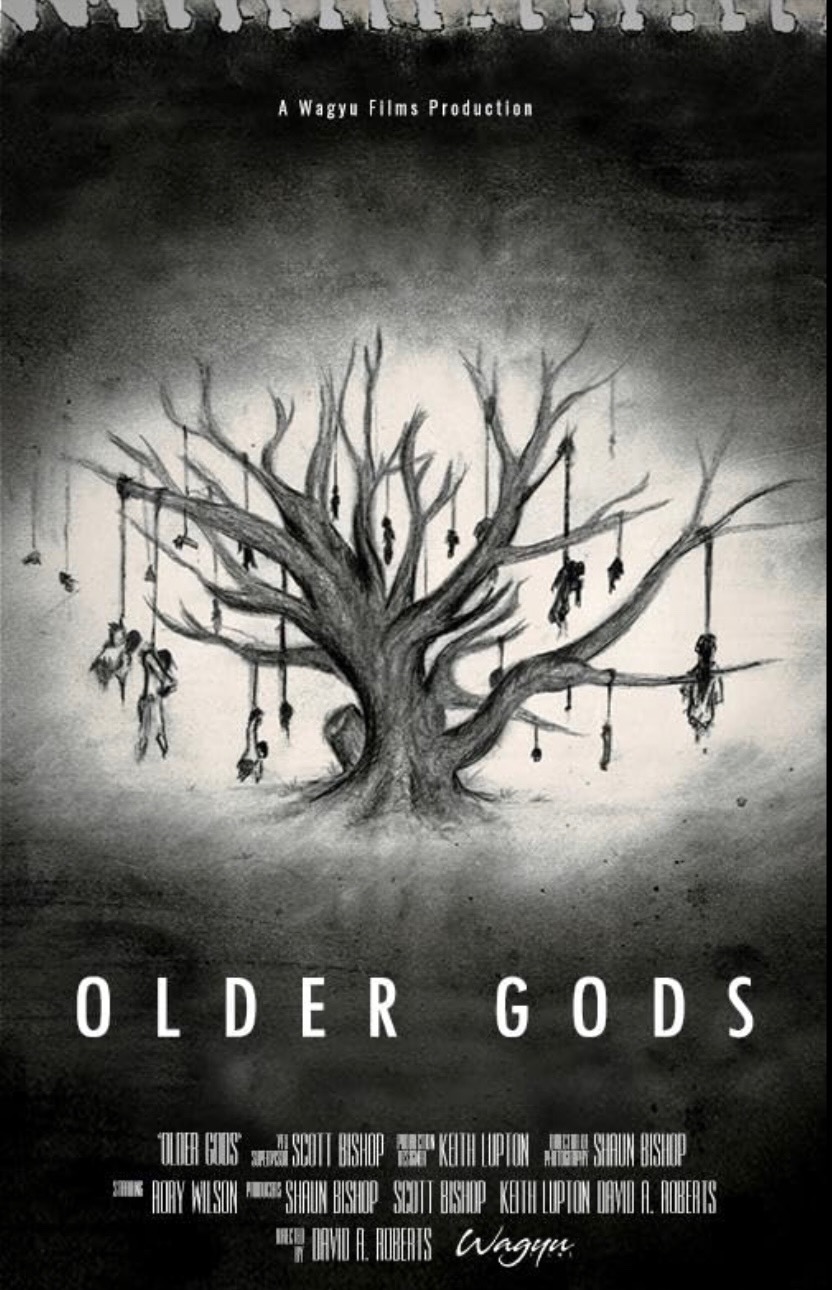
Those of us who write fiction, I suppose, often ponder what it would be like having a kind of writing named after us.  Knowing that’s not likely to happen we might cast an envious eye toward, say Lovecraftian horror, which has become a sub-genre in its own right.  When a friend pointed me to Older Gods, an independent Lovecraftian horror film shot in Wales, I was glad to see it already out on a free streaming site (with commercials, of course).  Winner of several accolades, the movie isn’t easily understood although the plot is fairly simple.  A man has gone to Wales to find answers regarding a lifelong friend’s suicide there.  A recorded message tries to explain what this friend had stumbled upon that led him to his extreme act.  A world-wide underground religion is attempting to awake one of the older gods to bring about the end of the world.

The problem is these devotees of the older gods—one deity in particular, called “The Origin”—hunt down anyone who learns about them.  They give them the choice to join or to have their families killed, followed by themselves.  If they do join, it hastens the end of the world.  In other words, the engine driving this movie is religion.  Shot with a very low budget over a very short span of time, it manages not to fall into the “bad movie” category, and actually edges into the “good” category.  The film crew, reportedly, numbered only seven (no extensive credit roll here), and the story is based on a premise introduced by H. P. Lovecraft.  The older gods, who care nothing for humans, are asleep beneath the sea, awaiting the signal to awake.

Since this movie was only recently released, not much in the way of online summaries is yet available.  The reason this might be important is that Lovecraftian narrators not infrequently go insane.  In other words, is our protagonist a reliable narrator or not?  Did he, like his deceased best friend, go insane?  This is never resolved.  Those devoted to the religion of the older gods are unrelenting.  Lovecraft, famously an atheist, knew the power of religious belief.  His nihilistic universe included a scary place for believers.  When these themes come together, with or without tentacles, we seem to be in territory named after its creator.  Older Gods is a slower paced, thoughtful film that leaves you unsettled.  And there’s no doubt regarding its true origin.


Haunted Pilgrim

No visit to Providence is complete without a tip of the hat to H. P. Lovecraft. As someone who dabbles in the noble art of writing, I have great appreciation for those who somehow made an impact (often only after they’ve died) on the literary world. I discovered Lovecraft only after I left Nashotah House, which was probably a good thing. Nevertheless, I have come to appreciate his breadth of vision, populating the earth with ancient gods who emphasize the powerful and heartless side of divinity. His vivid images of Cthulhu pervade popular culture to a level that few of the uninitiated would ever expect. And yet, deep in the depths he lurks. So when I was in Providence over the weekend for my niece’s graduation, I spent an afternoon seeking out some time with H. P.

Place inherently partakes of that we term holiness. Where something happened matters. There is no science to explain it, but it is something people know. It is for this reason that I try to visit the homes and resting places of classic writers. Over the years we’ve visited the haunts of Mark Twain, Laura Ingalls Wilder, Edna St Vincent Millay, Washington Irving, Edgar Allan Poe, and others, as well as H. P. Lovecraft. Simply standing in or near the places they once frequented provides a form of inspiration unavailable in any other way. So it was that I found myself at 598 Angell Street in Providence. It is a house still occupied, with no indication of who once called this building home. Lovecraft lived here from 1904 to 1924. If it weren’t for the Lovecraft walking tour I found on the Internet, I would have never known.

In many ways a provincial man, Lovecraft was born and also died in Providence. Apart from a stint in New York City, he spent his time in his hometown. I walked to 454 Angell Street, the address at which he was born. I knew the building had been razed in the 1960s, but I wanted to see what society deems more important than preserving those places that sequester the holy for haunted pilgrims. Although I couldn’t tell for sure, since house numbers change, I believe his birthplace is now the Starbucks that sits pleasantly in a small commercial district. I wonder how many of the thirsty realize where they’re sitting. Have they read any of Lovecraft’s stories? If so, are they uncomfortable sipping coffee in such a spot? Or perhaps it has become a kind of secular sacrament—a toast to all artists whose pasts have been obliterated.