
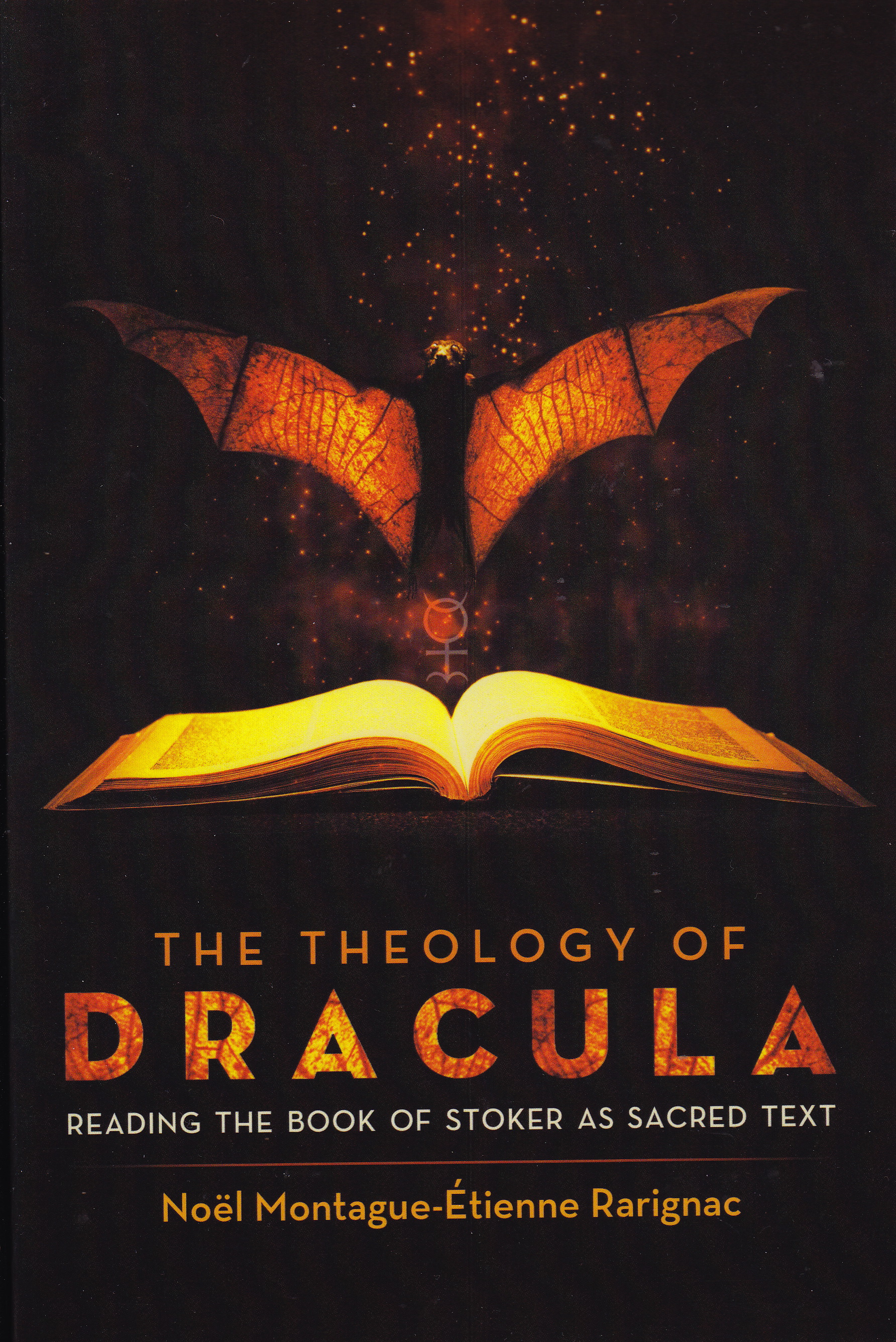
 Once vampires sink their fangs into you, it’s hard to shake them. I’m referring to an intellectual connection here, instead of a physical one. M. Jess Peacock’s book on theological vampires spurred me to read Noël Montague-Étienne Rarignac’s The Theology of Dracula: Reading the Book of Stoker as Sacred Text. It has been on my “to read” list for some time, and since I finished re-reading Dracula recently, I felt the canonical text was still fresh enough in my mind to take on an analysis. I have to confess that even though I grew up as a religious kid, and I loved monsters, I had no idea that the two were connected. Strangely, religion tended to elicit a fearful response while monsters gave me a kind of comfort. Of course, I always supposed that was normal. Then I learned that mature adults didn’t talk about, or even think about, monsters. I had to try to find solace in religion instead. Rarignac clearly figured out, however, that Dracula was a sacred text long before I came along.
What exactly does it mean to treat a book as a sacred text? Before anyone gets any funny notions, I need to say that Rarignac is not suggesting vampirism is, or should be a religion. That hasn’t prevented other people from seeing it that way, but that’s not what this book is about. It is about Bram Stoker’s Dracula. Devoting the kind of attention to detail that is often reserved for biblical texts, The Theology of Dracula examines the many religious traditions (not all of them Christian) that lie behind the novel. Stoker drew on many “pagan” traditions, including those of ancient Egypt and of Nordic mythology. Clearly Dracula responds to Christian symbols pretty violently, but he isn’t a classic Catholic. In fact, he seems to shy from Catholicism while admitting that its symbols work.
Rarignac, however, suggests more than this. He suggests that Dracula was written intended to be a sacred text. Not a Bible—we already have one of those, thank you—but a text that has its own mythology and symbols. Dracula‘s characters are not always what they seem. Careful scrutiny reveals that they often have celestial connections that tie them to ancient mythologies long forgotten by most modern people. We read the book expecting it to be about a vampire. Well, clearly it is. But not only a vampire. There is a much larger story at work in Dracula, and Rarignac has done an admirable job tracing its Vorlage (if I may step into jargon for a moment) and its wider context in the world of literary creations that specialize in our nightmares. There is much at which to marvel in this little book. I’m not convinced that Stoker intended his book to be read this way, but it is nonetheless a richer experience for it. Rarignac gives a simple monster tale real teeth.

 Steve A. Wiggins