Aging

M. Night Shyamalan’s horror is thoughtful.  Old is a little difficult to accept because it’s very difficult to keep artificially aging actors at a steady rate, either by make-up or substitution.  And it seems that the mysterious beach that ages people but also heals them should, in some way, make exploring its medical possibilities somewhat difficult.  Still, it is a noteworthy day-light horror offering that has an underlying ethical question.  I will need to include a spoiler to discuss that ethical issue, but before I get there, a vacation brochure.  Individuals, and families, are brought to a resort where everything’s perfect.  Then they are driven to a remote beach and discover that they really can’t leave.  And they age at a rapid rate.  (This may make you think of a Gilligan’s Island episode, but this one has no laughs.)  The aging is first noticed with the children and by the time the adults realize what is happening, it’s too late.
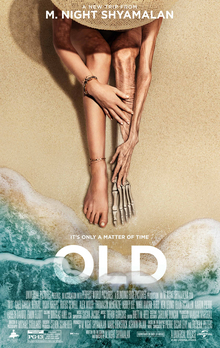
Here comes a spoiler.  Old was released during the pandemic’s second year, so I suspect it wasn’t widely seen.  If you’re still waiting, here’s your chance.  Ready?  Okay.  So, this island’s aging properties have been tapped by a pharmaceutical company to test new drugs on patients with various diseases.  Instead of waiting years for results, they can know in a day whether a treatment, unwittingly taken by the clients when they first arrived, worked.  If a “client” has no symptoms for a day, it is the equivalent of years.  The company, although it is responsible for the deaths of the people in the trial, give the results away, saving many lives for free.  Here is the ethical dilemma—do you save thousands, or millions, by having one person die to test the drug?  The real issue is that it’s done without consent.  Those aging have no idea they’re test subjects. 

Consent is an ideal, but in fact life happens to us and we seldom have the right of refusal.  Perhaps that’s the more insidious message here—giving consent furthers the illusion that we’re in charge of our lives.  I’m sure all of us can think of things that happened to us not because we chose them, but because we were at the right or wrong place at the wrong or right time.  When some such thing transpires, it often takes us considerable time to regain our balance, to feel like we’re “in control” again.  I chose to watch Old, perhaps when it wasn’t a good time to do so.  Or did I choose it?  And whose morals are these?

Breakage

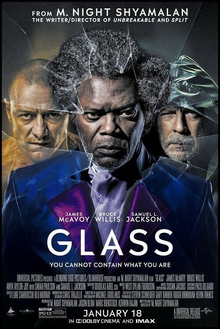
Glass makes me wonder; can any member of a trilogy really stand alone?  As someone who consumes fiction, the question always arises as to who really controls the meaning of individual units.  Scholars have given us reader-response theory that posits meaning rests with the reader (viewer, listener, etc.) rather than with the creator.  Being on an M. Night Shyamalan kick—I was brought in through his horror movies—I watched Unbreakable.  I vaguely knew it was a trilogy, but when I saw Split I was caught off guard.  Unbreakable was a super-hero movie.  Split was a horror film.  I knew Glass brought them together, but I wasn’t sure which way it would break.  It turns out the trilogy is a horror sandwich on super-hero bread.  It’s also surprisingly thoughtful.  And over two hours long.  There are horror elements, but it made me wonder since Split is horror, could it stand alone without the other two.

Having read about the development of this a little bit, Unbreakable could have stood alone.  It did for sixteen years.  Split could also, but for the reveal in the last few minutes.  And Glass manages to pull the whole thing off with a characteristic Shyamalan twist ending.  I’ve written about the other two movies in their own posts, but I really don’t want to give any spoilers for the last one.  I can say it ends with a message that is worthy of the Matrix.  It shows what movies can do.  Or at least it was taken that way by this viewer.

Given what movies are, and what they represent, I have to wonder if there’s not a good dose of racism in the criticism of Shyamalan’s work.  His movies are intriguing, without fail.  I haven’t seen all his films, but I have watched eleven of them now.  Some multiple times.  Here’s a guy with stories to tell.  I know, as a fiction writer who has trouble selling anyone on my vision, that a story can take over your life.  And you want to tell that story and see if it resonates with anyone else.  Those of us who make up tales generally recognize when something we write isn’t good.  My list of unfinished or unpursued stories dwarfs the stack of those I’ve had published, or tried to.  When you release a story out there in the world, you hope that others will get it.  I trust certain auteurs.  Even if not all of their films appeal to me, I like to think I see what they’re getting at.  This trilogy is well worth watching through to the end, even if it isn’t horror.


Not Just a Visit

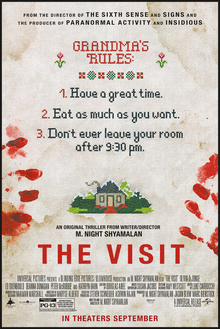
I’ve been on a bit of an M. Night Shyamalan kick lately.  When The Visit showed up on a streaming service I could access, and it was a rainy afternoon when yard work was impossible, I decided to give it a try.  I first became aware of Shyamalan as a horror auteur.  The Village was his first movie I saw, followed by Signs and The Sixth Sense.  (I knew about The Sixth Sense because of the press around the trailer accidentally being shown to underage audiences in theaters.)  I’ve seen some of his movies that aren’t that scary: The Happening, Unbreakable, The Lady in the Water, for example, and others that are.  Knock at the Cabin, Split, and now, The VisitThe Visit has a twist ending and I’m pretty sure that spoilers will make their way into paragraphs below, so if you’re holding off seeing it, you might want to wait before reading further.

The set-up is innocent enough.  A mother estranged from her parents is letting her two children, both minors, visit their grandparents while she takes a cruise with her new boyfriend.  (The children’s father had left.)  Becca, the daughter, plans to make a documentary of the trip.  The movie is found footage.  Sending the kids off by train, they make it to the grandparents’ house in Chester Springs, completely remote from wifi, to stay for a week.  Initially the stay goes great.  The grandparents, however, have some strange issues.  The grandmother’s sundowning disturbs the two kids, and the grandfather also displays elements of dementia.  As the week goes on, these things grow more intense.  Once the mother returns home, they Skype her (there is ethernet at the house) and when she sees the grandparents she realizes (spoiler follows!)

that the people watching her kids aren’t her parents.  They are a couple escaped from a mental institution.  Not only that, but they have also killed the actual grandparents and one of the visitors to the house.  The mother calls the police, but the insane couple makes their move to take care of the kids.  The youngsters are more resourceful than it seems, and are able to get out of the house just in time.  The police and their mother arrive, shuttling them to safety.  As with Split, the fear derives from a situation of mental illness.  There are some disturbing scenes in this film and it manages to bring in some legitimate scary stuff as well as a few effective jump-startles.  I guess I still see M. Night Shyamalan as a horror auteur.


Night Voices

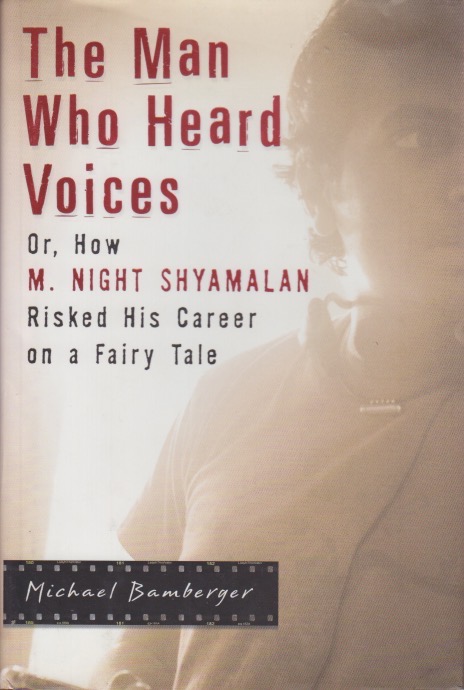
So this is really why I watched The Lady in the Water.  A friend had recommended The Man Who Heard Voices: Or, How M. Night Shyamalan Risked His Career on a Fairy Tale, by Michael Bamberger.  The book was published in 2006 and I found a “very good” used copy on sale for six bucks.  It’d been on my to read list for a year or two.  The book arrived and I discovered it was about a Shyamalan movie I’d never heard of.  I have friends who refuse to even mention his The Last Airbender.  (I’ve seen the original animated version and it’d be difficult to think a movie would improve on it.)  Indeed, The Lady in the Water was a box office disappointment, and The Happening (which I kind of like) and The Last Airbender were critically castrated.  M. Night Shyamalan’s name does draw crowds, but I prefer his horror to his fantasy, but that’s just me.

In any case, reading Bamberger’s book was like cinematography 101.  It’s a nonfiction account of how this movie was made, written by a sports writer also from the Philadelphia area.  He begins by narrating how he met Shyamalan at a party.  How that meeting led to the idea of writing a book about his movie-making process.  Lady in the Water isn’t Shyamalan’s best work, but this book goes through how terribly personal the project was to the writer-director.  It’s a gripping account, especially for those who try to create any form of art.  It also gave me a renewed respect for what Shyamalan tries to do with his movies.  Early career success made him rich, and then he was in a place to follow his dreams.  Or bedtime stories.  Of course, a book written nearly a two decades ago couldn’t project where Shyamalan would be today.

His career surged again, beginning with The Visit—definitely creepy—and has continued to ride fairly high.  Although I haven’t seen all his films, I was interested enough to read about his creative process.  Although The Village wasn’t as highly regarded as The Sixth Sense or Unbreakable, it’s still my favorite among his movies.  Part of that is because it was the first of his films I saw.  It was recommended to me by my brother, which also helped.  Mainly, that movie made me trust Shyamalan as a writer-director.  I’m not sad to have seen The Lady in the Water so that I could read a book about it.  The whole thing was a lesson in creativity.


Water Lady

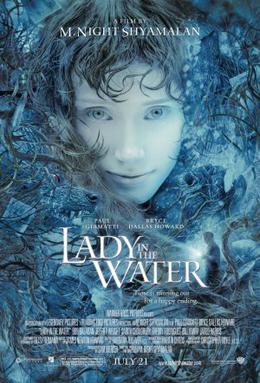
Being creative poses the very real threat of being misunderstood.  I can’t help but think that some of this was going on in M. Night Shyamalan’s The Lady in the Water.  Initially cudgeled by critics, it nevertheless seems to me that the perceived arrogance is overstated.  I generally like Shyamalan’s movies.  I think he does horror quite well, and I thought that maybe there’d be some horror elements here.  There were a few, but the story is kind of long and rambling, kind of like the stories I told my daughter at bedtime.  The movie begins by laying out a legend of a narf (water nymph) who will bring the world peace.  She is attacked by a scrunt, the monster in the film, but has to deliver a message to humans and has to be protected by the maintenance man at an apartment complex in Philadelphia.  And complex is right.

Since this isn’t a widely-known story, we have to be told, in pieces, by a number of the ensemble cast.  A lot of it is unbelievable, even for a fantasy movie.  At the same time, it contains a good message and I get the sense that this is why Shyamalan made it.  He does have an important role in his own movie (which is why it is said to be arrogant), but the style is reminiscent of his other movies.  The scrunt seems like a good idea for a monster and a couple of the attack scenes veer briefly into horror territory.  There’s even an element of Scream when Bob Balaban’s character explains (incorrectly) why he will survive an encounter with the scrunt.  The story has some likable elements but when so much of a fantasy world is being revealed piecemeal it’s sometimes hard to keep your focus.

Based on a bedtime story Shyamalan told his own children, it does resemble that genre of story.  Personal.  When my daughter was small, I made up nighttime stories for her pretty much on a daily basis.  They had a kind of rambling, plodding nature to them.  I made up creatures, as in this movie, and, as Balaban says, kept it family-friendly.  Classic stories do tend to follow a trajectory that is well known to literary scholars.  Something entirely new thrown into that area will sometimes emerge  beaten up.  It wasn’t a waste of time to watch The Lady in the Water.  Not one of Shyamalan’s best, it is nevertheless a film that makes you think a little while afterwards.  And that seems to be what it was intended to do.


Split Decision

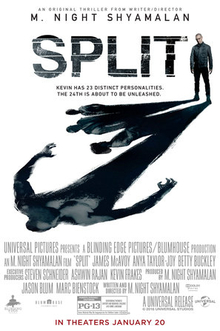
Sometimes advertising and packaging can make you ill-prepared for a movie.  I know that M. Night Shyamalan’s Unbreakable, Split, and Glass are considered a trilogy.  Without knowing the story, I saw the first film and discovered it was a superhero movie.  That’s fine, of course.  It’s not really horror much at all.  That’s maybe the reason Split caught me off guard.  It is brought into sequel territory right at the very end, but the story is tense and scary.  Kevin Crumb is a man with DID, dissociative identity disorder—what used to be called a split personality.  Quite apart from the inherently fascinating phenomenon (and the criticism the movie received for misrepresenting it), the idea that a person shifts and you don’t know who s/he is, is frightening.  A couple of those personalities have teamed up and become criminal.  Kevin abducts three teenage girls for a purpose that only becomes clear later.  Their efforts to escape create a great deal of the tension, and the quick shifting of identities that Kevin displays makes any kind of reasoning with him impossible.  

There are any number of avenues to discuss here.  One is that Kevin’s disorder stems from how his mother treated him as a child.  (Unintentionally I’ve been watching movies that trigger me that way lately.)  He developed personalities to protect himself from the pain and they continue to multiply.  Meanwhile, the kidnapped girls can’t figure out what’s going on but Casey (Anya Taylor-Joy—my first clue that this was horror instead of a superhero movie—)realizes that she has to treat the different identities in different ways.  Another avenue is to consider what “the beast” (one of the personalities) asserts: only those who’ve been broken are truly evolved.  Some children make it through difficult childhoods by becoming resilient while others don’t.  Casey, it turns out, also had an abusive relationship in her childhood.  Movies like this always make me reflect on how difficult being a good parent can be.

The person not in control of their own actions (ahem) is among the most frightening of human monsters.  Those with mental illness, however, seldom fall into this category.  I understand why mental health providers found this film problematic, but it showcases Shyamalan’s horror chops.  It was the scariest movie that I’ve seen in quite some time.  After I ejected the disc I felt bothered (and trapped) for quite a few minutes.  And I realized that if this is a trilogy then superhero and horror combined await in the third part.  We shall see.


Not Fragile

One of the problems with auteur theory is that you cast directors into an expected genre in your mind.  Or at least I do, and that is unfair to directors since they, like those of us who write, sometimes explore different genres.  My first exposure to M. Night Shyamalan was The Village.  Next was Signs.  And finally, The Sixth Sense.   (I was one of those creeped out by the “I see dead people” of the trailer for the latter, and it took several years for me to get over that.)  These were enough to solidify Shyamalan as a horror auteur in my mind.  I think the other films of his that I’ve watched, The Happening, Knock at the Cabin, have all been horror as well.  While some have classified it that way, many consider Unbreakable to be a thriller instead.  These two genres are very closely related, in any case, and I’d been wanting to see it.

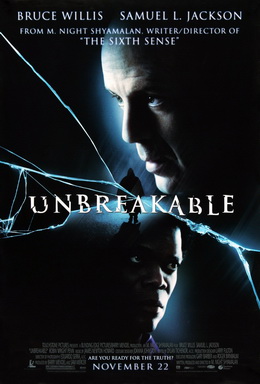
Unbreakable is a movie to get you thinking.  It’s old enough that I’m not going to worry about spoilers here, so be warned.  David Dunn, after surviving a train wreck that killed everyone else, runs into Elijah Price, an art dealer and comic book aficionado, who is, literally fragile.  A rare disease renders his bones weak and since his childhood love of comic books informed his outlook, he wants to find a hero.  Dunn seems to be the man.  Never sick in his life, he survived a car crash with no injuries and his only weakness seems to be water (he nearly drowned as a child).  Price tries to convince him that he is indeed a superhuman, but his partially estranged wife disagrees.  Their son, however, believes.  The twist ending has us realize that Price has been conducting terrorist activities in order to find a hero and he “confesses” once he’s certain Dunn is real.

There are definitely some very tense moments in the film.  There aren’t any monsters, and Shyamalan wanted this to be known as a comic book hero movie (which it is).  He has directed some others in this genre as well, none of which I’ve seen.  I watch hero movies now and again, but they often lack the depth of good horror.  Unbreakable, however, does have depth.  At least it makes you think.  Is the good of convincing a hero that he can help people worth the hundreds of deaths it took to find him?  Price’s motivation seems pure, but his methods are evil.  These kinds of dilemmas are inherently thought-provoking.  But I will still probably continue to think of Shyamalan as a horror director.  Maybe that’s just wishful thinking.


Watching Watching

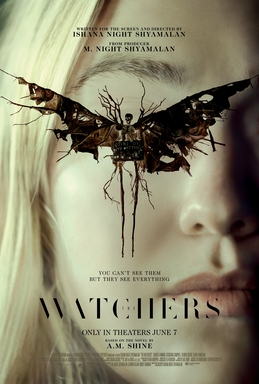
Dynasties exist in many professions.  Some of us grow up where there’s no succession, but for those who do the results can be good or bad.  I’m thinking in the case of Ishana Night Shyamalan it will be good.  I have not seen all of her father’s (M. Night Shyamalan) movies, but I have seen enough to know that he has considerable talent but also sometimes misses the mark.  That’s how I felt after watching The Watchers.  I didn’t know anything about it (including the director or producer) before watching it, but it only took a few minutes before I began thinking that it was like an M. Night Shyamalan movie.  Like his work, it is intelligent and intriguing.  And, in this case, slightly off the mark.  The story is a little too involved, and it may remind you, at points, of The Village (one of my “old movies” that I still go back to now and again).

Mina, an American living in Ireland (never explained), gets trapped in a forest from which no one ever escapes.  Now, this part was scary if you’ve ever been lost in the woods.  (I have been and it still terrifies me.)  These woods are inhabited by watchers—in lore known as fairies, among other things.  A professor had built an observation deck where he could observe them.  The only way a human can survive in the woods is to stay inside the shelter at night.  Mina’s car breaks down in the woods and she comes across three survivors.  They’ve been in the shelter for months and since it is in the middle of the woods, there’s no way to get out before sunset, when the watchers will kill you.  Now, were the premise of the film to have stopped there, it might well have been believable.  The story gets deeper (but I won’t give it away), straining credibility a bit.  There’s a little too much stuffed in.

Does it work as a gentle horror movie, in the Night Shyamalan vein?  Yes.  It satisfies an itch on a rainy or snowy weekend.  Too many unanswered questions remain.  The setting in Ireland makes sense, given the fey plot, but why is Mina American?  Why is her sister Lucy also in Ireland (or is that just a visit at the end)?  Why didn’t [redacted: spoiler] watch the video long ago and leave?  Other questions also haunt.  Why did the professor shoot twice?  And more.  Still, having a source of Night Shyamalan movies for more than one generation seems like a good thing to me.  And I really want to know where, exactly that forest is located in real life, with or without the fairies.


Cabin Stories

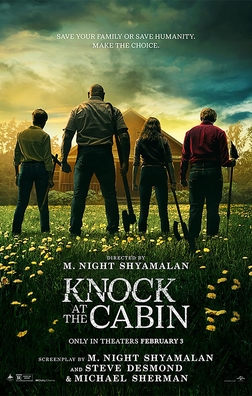
Almost always I come out on the same side of the debate.  The book is better than the movie.  The book allows things to be explained more fully and is the way the story is “supposed to go.”  Maybe it’s because I found the novel open-ended and I like closure, but M. Night Shyamalan’s Knock at the Cabin, in my humble opinion, is better than The Cabin at the End of the World by Paul Tremblay.  Now, the author’s title is better, but Shyamalan’s explanation is clearer.  In short, I think the movie works better.  If you’re not familiar with the story, four apocalypticists, responding to visions they’ve had, break into an isolated cabin occupied by a vacationing family of two daddies and an adopted daughter.  Shyamalan characteristically shifts the cabin’s location to Pennsylvania and, yes, before you think it’s all Philadelphia, there are some very isolated places in my home state.

These weaponized apocalypticists subdue the family and inform them that unless they decide which one will be sacrificed, and then carry out the deed, the world will end the next day.  The adult couple tries to explain rationally how crazy this all is.  How could four people be given this hidden knowledge and be tasked with saving the entire world?  It seems more likely that they’ve targeted a gay couple and are trying to break up their family.  One of the things the movie makes explicit that the book doesn’t is that the intruders are correct.  This is the end of the world.  In order to achieve this, Shyamalan had to rewrite the ending to remove the ambiguity.  For some of us, that really helps.

The movie, in a way that a brief blog post can’t replicate, includes quite a bit of dialogue about religion.  Religion and horror are often bedfellows, and this is one of those movies that relies on religion to fuel the fear.  Interestingly, the cabin invaders aren’t stereotypical conservative Christians.  In fact, they appear to be mostly secular everyday people who have come together around a vision that they all had in common.  In the novel there’s always some question whether this is an elaborate hoax whereas the movie makes it clear that the death of each individual apocalypticist unleashes a plague.  Indeed, they are, as the couple finally realizes, the four horsemen of the apocalypse.  Since I’m still here to tell you about it, the end of the world has obviously been avoided.  This movie is worth seeing, even if the novel has a better title.


Private Therapy

A friend recently introduced me to the YouTube channel, Cinema Therapy.  While I had some vague notions already that cinema therapy was “a thing,” I had never looked into it.  This was so, even while consciously knowing that I use movies that way.  Most of what I’ve seen on the YouTube channel has been about Disney/Pixar movies, especially those that tug at emotions.  These have never been my favorite movies since I have unresolved issues from childhood.  Still I learn a lot from watching their analyses.  It can still be difficult to watch these films, though.  As a family we recently rewatched Finding Nemo.  It struck me pretty hard how growing up without a father figure left me the anxious, quivering mess that I often am.  I prefer movies where I can find a father, no matter how odd the choices may be.

Photo by Denise Jans on Unsplash

In fact, in my own form of cinema therapy, I use horror films.  (Even the YouTube channel parses M. Night Shyamalan.)  Part of this is clearly because such movies take me back to my childhood.  I’m not sure why I found monsters so comforting, but I did.  We had no father and I latched onto the strong men—particularly if they didn’t smoke or drink—that dominated movies  (it was the sixties, after all).  Somehow I felt that this made the world seem alright.  Or a little less scary.   I didn’t understand the biology of parenthood, I just knew that I needed a man in the family.  One who would protect me and show me how to be a man.  Well, that never really happened.  My step-father was verbally abusive and I seemed to be his special target.  I watched horror and listened to Alice Cooper.

Sublimation, in psychology, is where you put difficult feelings aside, acting as if everything’s normal.  I did that for many, many years.  College, seminary, doctoral program, full-time professorate.  Then it all broke down.  After the tragedy at Nashotah House, I found myself watching horror movies again.  It took about a decade of doing that to realize that I could write books about the connection between religion and horror.  With three published (the third about to be, actually), I have a fourth nearly finished.  The writing is therapeutic as well.  I have to wonder, however, if these Pixar movies that are so painful for me to watch are really helping me.  I don’t always feel refreshed afterwards, as I do when I see a good horror movie.  (Bad films are their own kind of therapy.)  I’m an amateur psychologist (no license), with a most intractable client (myself).  My way of dealing with him is to watch horror and call it therapy.


A Tumble

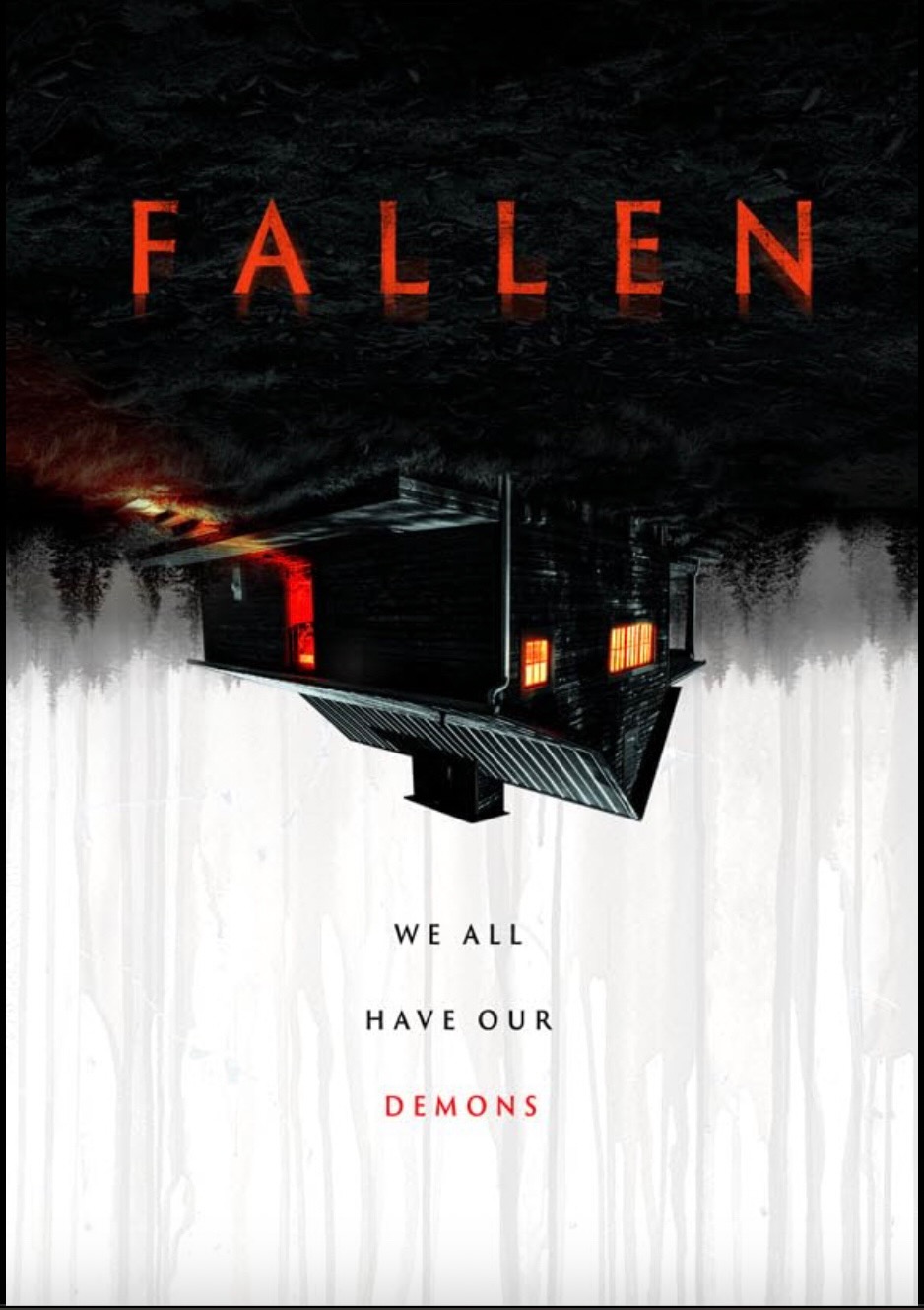
So beautifully shot, Fallen is a movie worth watching despite its disjointed plot.  Worth watching for horror fans, that is.  Apart from the night scenes, this is art house cinematography, and that may be because it’s an independent movie.  What’s it about?  That’s difficult to say, definitively.  The night scenes are so dark that you can’t tell what’s happening and the plot seems to have been intentionally obscure.  (That’s hard to substantiate because the 2022 film hasn’t generated too much discussion.)  This may have been another case of mistaken identity, like The Entity, because my notes only had the title down.  There are at least three movies with this title.  I’m learning my lesson to jot down the year when I add a movie to my “to see” list.  In any case, here goes…

A young priest (?) is warned by an older priest that it is time to take up violence because the darkness has started.  The younger priest is called “Father Abraham,” but he wears a tie in church services, and a small pectoral cross, making identification of the denomination difficult.  Since this is religion-based horror you’d think that that much, at least, ought to have been sorted out.  The heavily accented dialogue is often delivered so low that it’s difficult to follow.  In any case, this minister, after fighting “darkness” for many years, is in an isolated farmhouse with his disabled daughter.  He hunts and traps for their needs and a local boy delivers groceries, and is secretly in love with the daughter.  The minister, who seems to be presented as a tortured soul, isn’t really likable.  At night the house is attacked by physical demons.  There will be spoilers in the next paragraph.

It’s finally revealed that Fr. Fallen (apparently that’s his surname) had killed his wife for being a witch.  His daughter is also a witch, out for revenge for her mother’s death.  She summoned the demons and eventually kills her father and leaves the farm.  Religious imagery is everywhere in this film and begs for interpretation.  The lack of coherence, however, makes that very problematic.  The disabled daughter is the only survivor at the farmhouse, and is healed at the end.  By the demons?  Or because she’s a witch?  The influence of M. Night Shyamalan is evident, but his clean plotting is absent.  Online discussion is minimal, but there could be something of substance here.  If only it were better put together.  If only it were more discussed.


Quiet Now

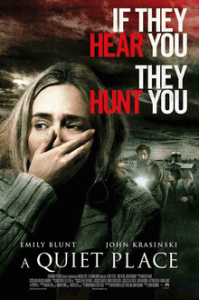
The funny thing about my movie watching is that it’s a reflection of my scattered lifestyle.  While I was teaching my career progression was linear with a goal of moving beyond Nashotah House to a college or university that shared my values better.  Publishing was a fallback, and I’ve learned a lot but I haven’t unlearned my academic leanings.  So, like the rest of my life, my movie watching is piecemeal.  I found a copy of A Quiet Place in a Halloween sale.  My wife bought it for me and on a weekend on my own I watched it.  I had no idea what it was about, but I’d read that it was an intelligent horror film, and that was good enough for me!  There may be spoilers here if you live in a cave, like I do (metaphorically), so be warned.

The backstory isn’t fully spelled out, but the monsters in this movie are blind and attracted to their victims by sound.  The focus is on a family in upstate New York that’s trying to survive without making any noise.  Since there are kids involved, you’ll see how tricky this could be.  John Krasinski’s film builds the suspense wonderfully.  Borrowing from M. Night Shyamalan at his best, and Alien and even Stranger Things, the movie has a odd effect.  When it’s over you don’t want to make any noise.  I watched it while my wife had to work over the weekend, and I put the DVD away as quietly as I could, and then went to bed.  Awaking alone the next morning, I continued the vigil.  Critics praised the movie for its silence, perhaps what we’re most afraid of in this noisy world.

I spend a lot of time saying nothing.  Editing is a quiet job.  Telecommuting is a quiet lifestyle.  At Nashotah House we had mandatory quiet days, which, if they weren’t mandatory I would’ve loved.  I’d seriously considered a monastic lifestyle when I was younger—there’s great value in being quiet.  A horror film that teaches that lesson, despite many obviously unanswered questions, is worth paying attention to.  Horror films have continued to grow more intelligent over the years.  This one is rated PG-13 and will have you on the edge of your seat (or under the bed) anyway.  And it’s got an important message.  For those of us who don’t say much (maybe that’s why I write all the time) a movie like this acts, if you will, as a loudspeaker.  Does anybody hear me?


October Devotee

Here it is October and I have hardly written about monsters.  Apart from the US government, that is.  I suspect that I could use a little escapism right about now, and most of the boxes are unpacked from the move.  Perhaps it’s time to watch a little horror and feel better about the world.  Monsters, you see, crop up in the most unexpected places.  Yes, in October we expect them to be crouching in dark corners and in dismal swamps as the light begins to fail.  Yet the trees are still mostly green around here and I think I might be in need of some new material.  As with most people my age, I get lost on the internet—someone needs to offer a roadmap to it.  Preferably on paper. 

I admit being stuck in the past.  As any music therapist will tell you, a person’s musical tastes often reflect the sounds of their youth, and some of us believe that rock hit its high point in the 1980s.  My work doesn’t lend itself to background music, so I seldom listen to the radio, and I wouldn’t even know what station to try to hear contemporary offerings.  Fortunately I know some people half my age who find their tunes on the internet, and I was recently introduced to Panic! At the Disco via YouTube.  I’m old enough to remember when music videos first appeared, although I never saw them.  We lived in a small town and, besides, we couldn’t afford cable.  Kids at school, however, talked about MTV and other places—there was no world-wide web then, kids!—that they had seen the latest, coolest video that I could only imagine.  When my contemporary young friends showed me “LA Devotee” by Panic! I was stunned.

If you haven’t seen it, just look up the official video on YouTube.  You’ve got the whole internet at your fingertips!  While the lyrics seem innocent enough—young person wants to make it big and so imitates the Los Angeles lifestyle—the video is horror show.  Literally.  Borrowing from M. Night Shyamalan the opening sequence is a cross between The Village and Signs.  Then it becomes a torture chamber for a young boy (from Stranger Things, no less, a show I binge-watched when it came out on DVD).  And Satanism.  Yes, taking on the LA lifestyle is compared to selling your soul to the Devil.  The stunning visuals kept me clicking the replay button.  Even as I felt my age, I also felt October growing.  And I was glad to see the monsters are still there.  Too bad we can’t banish them from DC, however.


A Kind of Happening

The roofers were here.  One of the things you learn only after laying down a ton of money is that those selling a house like to withhold information.  Moving during one of the rainiest summers in history, we naturally discovered leaks.  And so the roofers are here, like noisy angels banging above my head.  Given the orientation of our house, their access is outside the window of my work office.  I figured it was an opportunity to learn.  As the old shingles came raining down, however, I couldn’t help thinking of M. Night Shyamalan’s The Happening.  One of his more disappointing efforts, this horror film involved a memorable scene of mass suicide where people jumped off of a high building one after another.  Maybe other people would think of other comparisons, but the falling debris brought the film to mind in my case.

It’s a matter of framing, I suppose.  I’ve watched enough horror that it has become a framing device.  This is true although it has literally been months since I’ve seen a horror film.  (Moving proved to be its own kind of nightmare and one day I suspect we’ll be unpacked enough to watch movies again.)  Instead of losing the frame of reference, however, I find it intact.  If you spend long enough with Poe, he gets under your skin.  And changing states to M. Night Shyamalan’s eastern Pennsylvania might have something to do with it.  This is Bucks County territory, after all.  Another frame of reference, mediated by media.

As I watch the old shingles drop, I realize the window through which I’m witnessing this is another frame.  Like a camera lens, it limits my view.  At times it can be like Hitchcock’s Rear Window, seeing neighbors at their daily business.   Indulge me. For nearly the past five years I worked in a cubicle with no view of any windows whatsoever.  I was completely cut off from the outside.  (Which, for those of you who’ll admit to having seen The Happening, might not have been an entirely bad thing.)  Now that I have a window—my own framing device—I realize some of what I’d been missing.  At Routledge I had a window, but at such a level that the Manhattan outside seemed artificial.  You couldn’t see individuals down on the street.  The entire wall was a window—too much of a frame.  Gorgias Press involved working in a windowless room as well.  I’m professional enough not to let the falling material or the pounding distract me much.  There’s work to do because there are bills to pay.  And horror films prepared me for that as well.  It’s the ultimate framing device.


Robot Crossing

With my new job I haven’t been able to be as active on our high school’s robotics team this year. Not that I ever contributed much beyond moral support, but there is a very profound satisfaction at seeing teenagers concentrating on such technological marvels and building self-esteem. Yesterday was spent at a regional competition. Noisy, colorful, chaotic—it was like being a teenager again myself. I overhead engineers talking during the course of the day about the great technological marvels of the future made possible by robots. These people have no apocalypse hidden among their endless optimism. We’ve got robots on the ocean floor and rolling around on Mars, snaking into our bodies even down to the cellular level. No end of times here, only forward motion. I know that computers now define my life. If I miss a day on this blog I grow dejected; one of my biggest worries about going to Britain later this week is how I will continue posting from overseas. But I sometimes feel as if our love of technology will be our undoing.

Experts—of which I am not, I hasten to add, one—tell us that within a lifetime artificial intelligence will be indistinguishable from real intelligence. As I watched the robots playing basketball (this year’s FIRST Robotics challenge), I began to wonder about the motivation of our robot slaves. Humans are driven by biological and emotional needs. Robots, as far as we can tell, do not want anything. It is a vacuous life. Yet as the robots played basketball all day, I noticed they didn’t suffer the obesity problems so evident among humans, nor the weariness that accompanies having to awake before dawn to catch a school bus to the competition. They are built for a purpose and they stick to it. Even as I watched hours of competition, I began to miss my laptop—driven by my own emotional needs as I am. I begin to wonder who is really the slave here.

Last night my family participated in Earth Hour. We try to do it every year with a kind of religious fervor. Turning off all electronics, including lights, we sit in the dark and talk by candle light. There is a profound peace to it. As my daughter commented on how spooky the shadow play could be, I imagined our ancestors who had no choice but to rely on pre-electric light in drafty houses where real wild animals still prowled the dark nights outside. How quickly that would become a trial for us. The same thought occurred to me as I watched M. Night Shyamalan’s The Village again last weekend. We are helplessly tied to our technological advancement. We might like to get away from it all for a few days or weeks, or even months. But we want the comfort of knowing that the robots are waiting for us when we turn back to reality again. Perhaps no apocalypse is needed after all.

Robot crossing