Old Ghosts

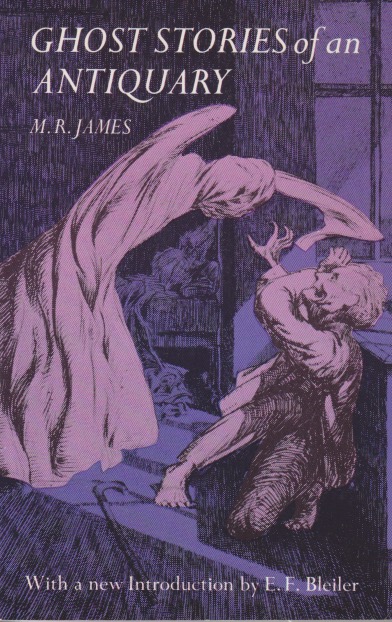
As someone who reads about ghost stories, as well as ghost stories themselves, I’ve long been aware of M. R. James.  His Ghost Stories of an Antiquary is regarded as a classic in the ghost-story genre.  Sometime in the haze, I recollect it was years ago, I found a copy at a used bookstore on the sale rack.  Something I’d been reading about ghost stories lately made me decide to read it through.  Now James was an actual antiquary.  He was also an academic at Cambridge University.  His tales are erudite, generally focusing on some ancient secret that releases ghosts, or sometimes monsters, after the individual who discovers the antiquity.  The stories are varied and inventive, but not really scary to the modern reader.  They assume a different world.  One in which antiquaries were monied individuals—often university men—who have both servants and leisure time, rarities today.

I found myself constantly asking while reading, how could they get so much time off?  How did they access such amenities that they could even get to the places where the ghosts were?  James’ world is both textual and biblical.  It’s assumed the reader knows the western canon as it stood at the turn of the nineteenth century.  The Latin, thankfully, is translated.  James, it is said, was a reluctant ghost-story writer.  A university employed medievalist, he had academic publications to mind as well.  Nevertheless he managed to publish five ghost-story collections.  Clearly the idea seemed to have had at least some appeal to him.

The aspect I find most compelling here is that an academic could admit to such an avocation.  While it’s becoming more common these days among the tenured, I always felt like I was walking the eggshell-laden pathway to academic respectability.  I was, after all, at a small, haunted seminary that few outside the Anglican communion knew about.  It was risky to admit being drawn to anything speculative.  Come to think of it, although I read novels while I was there I don’t recall reading many, if any ghost stories.  It was scary enough to be about on campus at night, particularly if you were going to the shore of the small lake to try to photograph a comet alone.  There were woods punctuated by very little light.  On campus ghost stories were fine—the librarian even showed me a photograph of a ghost in the archives—but off-campus such things could never be discussed.  I was an antiquary without any ghost stories. James showed the way.

Weird Tales

WeirdTaleSince I first discovered H. P. Lovecraft, I believe that I have read all his published fiction. Most recently a multi-year marathon took me through the S. T. Joshi editions published by Penguin Classics. Reading those editions led to a natural curiosity about S. T. Joshi; H. P. Lovecraft is still an author struggling for respectability, although the internet has brought him great fame. The literary elite consider many genre writers as gauche, and those who read them decidedly low-brow. When I saw that Joshi had written a book entitled The Weird Tale (the genre designation preferred by Lovecraft), I decided to learn more. Joshi, I had known from his webpage, is an ardent atheist, but also a true admirer of Lovecraft’s craft. Since I’ve tried my faltering hand at fiction a time or two, generally having even less success than Providence, I wanted to see what Joshi had to say.

Few things are as inspirational as reading about writing. Those of us compelled to do it find it an endless source of fascination. What drives us to it? We don’t know. Where do the ideas come from? We can only guess. Why do we do it? We must. And so, it is clear, also felt the authors surveyed in Joshi’s fine little book. Although the names of Arthur Machen, Lord Dunsany, Algernon Blackwood, M. R. James, and Ambrose Bierce mostly just tickled some remote tendrils of synapses in my skull, this study was the first real knowledge I had of any of them. While some patterns emerge, there is a notable diversity of background to the writers of the weird. One element that Joshi doesn’t fail to notice is their religious conviction, or lack thereof. In many ways this is odd, but in others it feels perfectly natural. Many materialists count creativity as the predetermined motion of particles and energy that evolution makes inevitable. The writers, however, refuse strictly to conform.

Lovecraft was an atheist and mostly a materialist. Joshi is puzzled, however, when Lovecraft seems to call this certainty into question. I’m not. Lovecraft did not believe in God, but he invented gods. How difficult it must be for a creative mind to dabble in the divine and simply walk away at the end of the day. Lovecraft was no stranger to peculiar residues that clung to the unwary and the bizarre transformations that could occur under the aegis of misplaced belief. But like the narrator of many of his tales, at the end he too knew he’d been affected. I don’t mean anything as crass as deathbed conversion. Rather, like all those who are truly intelligent, we must admit that there are some things we just don’t know. Cthulhu may not be slumbering beneath the sea but many will not sleep easily at night with their closet doors open. To expect anything less of Lovecraft, to me, seems just too weird.