Dedication

Formulas are convenient, even if they don’t always work.  I’m thinking specifically of areas I know, such as writing.  And I compare this against the advice of those who do it for a living.  How do you know you’ve made it (and it has nothing to do with not being paid for it, although I suspect that’s in the back of everyone’s mind)?  One formula I’ve heard is the hundred-thousand-word rule.  Write a hundred-thousand words then throw them away.  After that you’re a writer.  I passed that particular benchmark decades ago, but it hasn’t really led to any income (so it comes to money again).  Then there’s Malcolm Gladwell’s more stringent hundred-thousand-hour rule.  To be an expert, you need to do the activity (say writing) for a hundred-thousand hours.  

Let’s try to break that down because big numbers can be scary.  Presuming it’s not your job—remember this point—those hours, if you can spend an hour a day on what you really love—translate to twenty-seven years.  You’ve got to add a decade or so for childhood, I suspect, when, in my case, you were simply doing stupid things and being amazed you’d survived them.  There’s a certain amount of maturity required.  So, let’s say you started writing when you were ten.  If you did it an hour a day without fail by the time you’re thirty-seven you should be an expert.  But are you?  What if circumstances dictate that you can’t dedicate a full hour a day?  One of the most influential teachers in my life said that it was a matter of constancy, not duration.  “Write every day,” was his advice, “even if it’s just for fifteen minutes.”  According to the Gladwell formula, that’d take over a century to become an expert.  But it’s more doable.

Life is busy.  Remember work?  It will end up eating up far more than forty hours every week.  And if you’ve decided you’d like to read once in a while—other writers suggest that the key to success in writing is reading—that too will cut into your time.  If you belong to any community organizations, because people like to see other people once in a while, or if you have a family, and if you like to eat and sleep, time soon gets fractured.  What all these formulas have in common is the idea of dedication.  If you want to be an expert, do what you love and do it as much as you can.  Yes, there will be obstacles.  And you might not be able to tell when you’ve arrived.  But at least you’ve enjoyed the time you spent getting there.
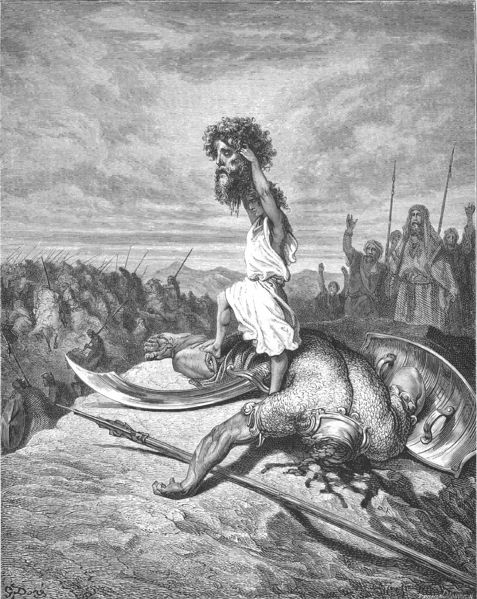

Paying Goliath

A friend pointed me to the story of David and Goliath. Well, actually, it was the Malcolm Gladwell story of David and Goliath. TED talks have become a regular part of public education and I was a little surprised to see one based on a Bible story. If you’d blink you’d miss it. I’d seen Gladwell’s new book on David and Goliath in the bookstore, and I had assumed it was about some hidden principle based on little boys challenging giants to single combat. Who knows. So when I turned on TED and heard Gladwell describing pretty much what I would do in class, and knowing that he was raking in the bucks for doing so, I gave it some thought. Yes, it is clear that he’s done some research into ancient warfare. Most of us who read the Hebrew Bible do, since ancient warfare is a large part of Holy Writ. (Yet the world seems surprised when religions turn violent.) Gladwell’s perspective is refreshing, but I can’t help think that the Bible does indeed view David as the underdog. Yes, slingers were always an important factor in warfare, just as archers were before guns were invented. I seriously doubt David was actually packing the firepower of a .45, however.

The interesting thing is that Gladwell takes the story so literally. Historically David’s existence is questionable, although I personally see the weight of tradition as bearing on the tipping point here. There were just too many stories of the boy who killed the giant in the Bible to say it was all made up. The fact that they don’t agree in details adds a hoary venerability to the tales. But can we take it to the level of seeing Goliath as having double vision because of his gigantism, and saying to David “why do you come at me with sticks” even though the lad is holding only one? Perhaps Goliath can be pardoned for using the plural instead of dual form (he is, after all, a Philistine), but the point here is that it is a taunt. David is what the dog saw, compared to the seriously shielded Goliath. Gladwell makes some good points, but, in my humble opinion, misses the giant.

Saul, the king of Israel, fears to send David into combat because the kid will be slaughtered and Israel will be enslaved. Yes, ancient armies relied on slingers, but, like archers, in great numbers. Perhaps it was David’s accuracy that was in doubt. According to the Bible, however, Israel boasted slingers who could hit a hair at distance, and these from the tribe of Benjamin, Saul’s own people. So the point of the story is that David’s victory is a miracle. Miracles no longer fly, of course. Those who write bestsellers know best. It stands to reason. Okay, so I’ll buy Gladwell’s book now, but I somehow feel that those of us who have spent a life studying the Bible really deserve something more that jobless obscurity. I come at the giant with a tiny blog, but then, I’ve alway been an underdog. An outlier, you might say.

477px-071A.David_Slays_Goliath