From the Grave

“Macabre” is a word of uncertain etymological origin.  One of the most convincing arguments that I’ve read is that it derives from Hebrew qbr, a root associated with graves.  The “m” prefix would be the preposition “from,” making the phrase miqqeber, or “from the grave.”  It has been decades so I don’t remember where I read that, but it made sense to me.  In any case, this is a fairly common word for titles, it would seem.  I recalled Stephen King noting Macabre among the scariest films up to 1980, so I thought I’d try to find it.  A simple IMDb search showed it streaming for free on a couple of platforms, so I clicked on one of them.  At about halfway through, I paused the movie to see if maybe I’d got the wrong one (I had).  But I decided to finish it out in any case.  There will be spoilers below.
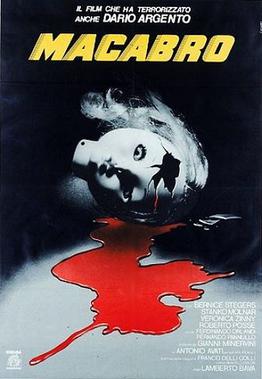
What I’d found was the 1980 Lamberto Bava movie.  Bava’s name was familiar to me from his famous father, Mario Bava, an Italian horror movie innovator.  There was a family resemblance.  So, what’s it about?  A woman with two children is having an affair.  Her somewhat unstable daughter decides to drown her brother to get her mother to come home.  On the way, her paramour, who is driving, runs into a guardrail and is decapitated.  After being released from the mental hospital, the woman moves into the apartment where the affair had been taking place.  The house is owned by a blind man who knew about the affair.  It sounds like, however, the affair is still continuing although said man is dead.  

When the daughter, who is trying to get her parents back together, confesses that she drowned her brother, the woman drowns her—echoes of Medea here—but the blind man kills the woman when he tries to save the daughter.  What makes this even more macabre, is that both the blind man and the daughter had learned that the woman was keeping the head of her lover in the freezer—echoes of Alice Cooper as well—to stimulate her as she continues the affair without her former lover.  It’s not a horror classic.  Titles can’t be copyrighted, so some repetition is bound to occur.  The Macabre I should’ve watched was the one from either 1958 or 1969.  Apparently this is a popular film title, as there was another released in 2009.  I can rule out the last one, but to find out what I should be looking out for, I’ll need to dig out my copy of, well, Danse Macabre.
Horror Homework

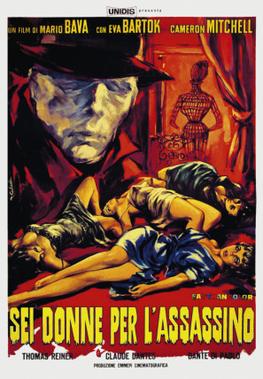
If you write about horror movies, you have to do your homework.  Of course, this means time away from house work (the weeds love all this rain and hot weather) and regular work (which can’t be compromised).  Mario Bava has often been cited as one of the influential horror auteurs, but until this year I’d not knowingly watched any of his films.  So, homework.  I saw a list of movies that made an impact, and one of them was Blood and Black Lace.  It’s horror of the giallo subspecies, never my favorite.  But it was free on a commercial streaming service, so, well that homework’s not going to do itself!  This isn’t generally considered Bava’ best work.  Besides, giallo is murder-mystery and I prefer monsters.  Who wouldn’t?

This film, with its lurid colors and stylistic cinematography, does make an impression.  The acting is poor and the script even worse—apparently it didn’t lose anything in translation.  A crooked couple run a fashion salon.  (There will be spoilers, so if you’re sixty years out of date, be warned.)  One of their fashion models is murdered, but when another discovers her diary the body count mounts.  The film lingers over the murders, which, I suppose, is one of the reasons it’s classified as horror.  With the film’s problems, however, at least this far removed, the whole thing begins to look rather silly.  The women have to die because of the first woman’s diary.  The police are singularly ineffectual, not even taking standard kinds of precautions.  Even with a run time of only 88 minutes it felt too long.

Horror in the sixties was still finding its way.  I’ve been watching a number of movies from that era—generally considered a dry spell for American-made horror—and the results have been interesting.  There are some gems tucked in amid the gravel.  What we’ve grown to appreciate in more contemporary horror cinema learned a lot of lessons from these early exemplars.  I could see foreshadowing of Suspiria here.  I’ll need to do more homework to find other direct descendants, though.  Blood and Black Lace suffers from having too few characters you get to know well enough.  The models, who all seem to have some secrets, die off before we get to know them.  Even the criminal pair behind the killings die in the end.  There’s a kind of nihilism to the story, and it’s all done for love of money.  The story could’ve been better, but you have to start somewhere when growing a genre.  And doing homework.


Colorless Sunday

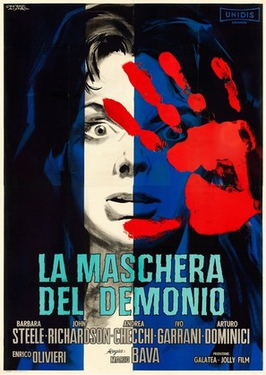
Growing up, my Saturday afternoon horror movies were catch as catch can.  I never really had a plan and I’m sure that there are several films I saw that I have forgotten.  I’m sure one of them wasn’t Black Sunday.  I knew nothing of directors and their reputations then and I was unaware that Mario Bava made quite a splash with this moody movie.  I can now understand why (thanks to Amazon Prime).  This is an unusual vampire and/or witch story, and one which had quite an impact on future films, including one of my favorites, Tim Burton’s Sleepy Hollow.  Indeed, Black Sunday is about as gothic as they come.  A witch is murdered as the film opens, along with her lover.  Two centuries later a couple of doctors stop for the night in the Moldovan town where this happened.  They find the corpse of the witch and accidentally reanimate it.

The monster the witch raises (her lover, initially) attacks people like a vampire does and the victims become vampires themselves.  The best (but not only) way to kill them is by driving a sharp spike through their left eye.  This is quite violent for a 1960 film, but it certainly cemented Bava’s reputation.  In any case, the younger doctor falls in love with the local princess, but the witch has designs on her too.  The older doctor and the princess’ father both get transformed into vampires and get killed off.  By the end, only the young doctor and the princess remain, along with an Orthodox priest who helps with deciphering how to take care of occult monsters.  The plot is more complex than that, and the film is now understood as a landmark.

At the time and place where and when I went to college, courses in horror films were not on offer.  (I was rather preoccupied with religion, in any case, and might not have taken one anyway.)  By the time I was in college, however, I viewed monster movies with nostalgia, but I was trying hard to be respectable.  You always have to be proving yourself when you grew up poor.  Learning how these early horror films fit together is a form of self-education.  And it’s fun.  And horror movies offer an escape from a world where you know you’re having trouble fitting in.  Many of the movies I watch are still catch and catch can, but I think it pays to be more intentional about them.  And I’m glad I caught Black Sunday at last.