Professionalism

We’re all tightly packed together here on the internet.  Social media is a fuzzy category and now includes such platforms as LinkedIn, which I think of mainly as a place to hang your shingle while looking for a job.  I chose, many years ago, to make myself available online.  This sometimes leads to a strange familiarity.  It isn’t unusual for me to have an author hopeful to contact me through my personal email or through LinkedIn, especially, to try to push their project.  (Such people have not read this blog deeply.)  One thing acquisitions editors crave most highly is professionalism.  Being accosted on LinkedIn, or in your personal email, is not the way to win an editor’s favor.  Some of us have lives outside of work.  Some of us write books of our own and don’t blast them out to all of our contacts on LinkedIn.  Professionalism.

It’s tough, I know.  You want to promote your book.  (I certainly do.)  It seems strange to say that blogging is old-fashioned, but it is.  (Things change so fast around here.)  But you could start a blog.  Or better yet, a podcast.  Or a YouTube channel.  You can blast all you want through X, Bluesky, Facebook, Tumblr, or Instagram.  I admit to being old fashioned, but LinkedIn is for professional networking, not doing quotidian business.  It may surprise some denizens of this web world that some publishers don’t permit official business through social media.  Email (I know, the dark ages!) is still the medium preferred.  Work email, not personal accounts.  Some authors (believe it or not) still try to snail mail things in.  Publishing is odd in that many people, and I count my younger self among them, suppose you can just do it without learning how it works.  Most editors, I suspect, would be glad to say a word or two about professionalism.

Photo by Ben Rosett on Unsplash

Professionalism is what makes a commute to the office on a crowded NYC subway train possible.  We all know what’s permissible in this crowded situation.  We know to wait until someone checks in at work before asking them about a project we have in mind.  (If you’re friends with an editor that’s different, but you need to get to know us first.)  When I started this blog I was “making a living” as an adjunct professor.  I was hanging out my shingle.  I also started a LinkedIn account.  Then I started writing nonfiction books again.  Since those days I’ve been trying to figure out the best way to promote them.  Professionally done, if at all possible.


Existential Searching

Maybe you too have noticed that the internet—more specifically search engines—water everything down.  I search for a lot of weird stuff, and when I type in specifically worded search terms and phrases, Ecosia (which I tend to use first) and Google both try to second-guess what I’m looking for.  Also, they try to sell me things I don’t want along the way.  It’s no surprise that the web was commercialized (what isn’t?) but it does make it difficult to find obscure things.  I don’t pretend to know how search algorithms work.  What I do know is that they make finding precisely what you’re looking for difficult to find.  Even when you add more and more precise words to the search bar.  Tech companies think they know what you want better than you do.  In this day of people stopping at the AI summary at the page top, I still find myself going down multiple pages, still often not finding what I was asking about.

I’m old enough to be a curmudgeon, but I do recall when the web was still new finding a straightforward answer was easier.  Of course, there are over 50 billion web pages out there.  Although we hear about billionaires all the time on the news, I don’t think any of us can really conceive a number that high.  Or sort through them, looking for that needle in a haystack, from Pluto.  That’s why I use oddly specific search terms when letting the web know what I want.  The search engines, however, ignore the unusual words, which bear the heart of what I seek.  They wash it out.  “Oh, he must want to buy breakfast cereal,” it seems to reason.  “Or a new car.”

Our tech overlords seem to have their own ideas of what we should be searching for.  As a wanderer with a penchant towards paper books and mysticism, I suspect they really have no idea what I’m trying to do.  Mainly it is to find exactly what I’m typing in.  They often ask me “did you mean…?”  No.  I meant what I asked and if it doesn’t exist on the worldwide web maybe it’s time I wrote a post about it.  It may take the web-crawlers and spiders quite some time to find it, I know.  50 billion is a lot of pages to keep track of.  Some of my unusual posts here are because I can’t find the answer online.  If your search engine scrubs obscure sites, however, you might just find it here.


No Agency

I’ve worked in publishing since 2006.  That seems like a goodly time, but the industry is a complex one.  I started trying to publish again around 2010—losing my job at Nashotah House sent me into a tailspin in that regard, although I wrote a novel or two in the meantime.  My first post-dissertation book was published in 2014.  I soon learned that academic publishers each have their strengths and weaknesses.  Most have trouble with marketing—people just don’t know about your books.  (And can’t afford them if they do.)  If the publisher won’t advertise, well, the voice of one ex-academic isn’t very loud.  So I wrote on.  My sixth book has existed in draft form for a few months now.  I know that to get a publisher who knows how to market you often need an agent.  I also know that as an unknown writer it’s difficult to get an agent’s attention.  I finally found one, however.

Agents change books.  Mine asked me to rewrite yet again.  All of my books have been rewritten multiple times, so this was par for the course.  I had to leave out a lot of the stuff I liked.  Then the agent changed his mind.  Hey, I get it.  Agents live off the advances their authors get so if they don’t see enough zeroes they shy away.  That’s just how it works.  I’ve found what looks like a good publisher (not an academic press) but I couldn’t simply go back to the version I really liked—I’d made improvements for the agent—so I had to blend the two versions together.  The problem is, that’s difficult to do on a computer.  I know from working in publishing that side-by-side comparative screens in word processing programs are difficult to find.  Of course, if you just print both versions out all you need is a table and a red pen.

I wasn’t born into the computer era.  Flipping between two screens doesn’t come easily but printing out two three-hundred-page manuscripts is time and resource consuming.  So I’m flipping screens.  I hope to finish this book soon because the next one is already brewing and I really can’t wait to start getting the ideas out.  And I even have a publisher in mind—one that doesn’t require an agent.  I don’t think agents really get me.  Or maybe I’m just not a “commercial” enough thinker.  There are plenty of presses out there, however, and if you do your research you can find a home for this project that’s taken years of your life.  It’s just difficult to do the screen flipping.  But then, I’ve only been doing this for about a decade.  I’ll get the hang of it soon.


All About Merch

Although I’d heard of it uncomprehendingly when I was in seminary, I first joined the Society of Biblical Literature in 1991, while a doctoral student.  I religiously *ahem* attended the annual meetings until I lost my job and my ability to afford it.  When I landed in publishing I started attending again, and over all these years I’ve started to notice a lot of swag creeping in.  Publishers sell bauble headed theologians (aren’t they all?), playful knick-knacks, and even socks bearing the cover design of established commentary series.  It’s as if we want to tell the world that studying the Bible is cool.  (Why not purchase some nice warm socks?)  So I wasn’t really surprised when the society itself, fondly known as SBL, started selling its own merch.

On most SBL electronic newsletters there’s a link to the vendor that produces shirts and mugs with jokes that only other biblical scholars will get.  (I never found this a very humor-laden community, being under duress, as it is, and as deeply conflicted as the country that hosts it.)  Eventually I grew curious and clicked on the link to the novelty tee-shirts and mugs.  It took me to a company called Redbubble.  SBL Press has its own page there with a strange header photo, apparently of a G. I. Joe and G. I. Jane reading some of SBL’s books.  Weird marketing is fine, of course.  Some of us have almost a connoisseur sensitivity to the bizarre.  As for the merch itself, it includes limited designs since, I suspect, most professors aren’t novelty tee-shirt fans.  What caught my attention was the button at the bottom that said “Mature content: hidden.”

Did the Society have some top shelf items?  The Bible certainly has quite a bit of mature content itself.  Questionable stuff as well as scenes that are, well, let’s just say scenes that are left out of children’s Bibles.  Of course I clicked the link.  It took me off the SBL Press page, naturally.  Redbubble has, I’m sure, many clients.  SBL’s demographics are slowly changing but the field is one still dominated, in numbers at least, by white men.  They’re the ones who benefit the most, I suspect, from a society that bases itself on the biblical outlook of the world.  At least as far as how it’s been applied in northern Europe and its colonial enterprises.  SBL tries to attract younger scholars, of course.  And everyone like knick-knacks and inside jokes. 


LinkedOut

There are different philosophies behind LinkedIn.  (What a world we live in where such a statement is even possible!)  When I first signed up, it was a professional social network.  Warnings boldly declared that you should accept invitations only from people you actually knew—others might hurt your career.  Friends pointed out (I was unemployed at the time) that if you wanted to use the potential of connecting, you had to take risks and accept invitations from strangers.  Now LinkedIn seems to be a social network just like any other, although many of the individuals on it are perhaps a bit more educated and many of them have good jobs.  That doesn’t stop them from posting snarky comments and using the site as if it were Facebook.

Although I’ve met some good people through it, I’m beginning to grow wary.  Or weary.  Perhaps both.  Now I hover with a bit of angst over that “Accept” button.  Many people, mistaking me for someone with some power in my organization, immediately direct message me after accepting.  I wish they wouldn’t.  Many of them ask me what jobs I might be able to offer.  If they’d search me out a little further on the web, they’d find the dusty path to this blog and learn a bit more about that guy they’d invited to connect.  I don’t work in a hiring capacity.  Bible editing isn’t exactly a growth field.  But connections are connections.  So I click.

Worse yet are the number of people on LinkedIn who immediately direct message you advertising their book, encouraging you to buy.  I work in publishing.  I know that authors have to take the initiative or find their books overlooked (believe me, I know all about that!).  Still, LinkedIn is not the place to advertise your book.  The buzz among publishing types (if they’d only check out to whom they’ve sent that invitation to connect) know that the social media of choice for advertising books is Twitter.  Facebook is okay but if you read the kinds of comments you find on posts there you’ll see many aren’t the book-buying type.  And the advice, to which this particular URL stands in silent testimony, is that starting a blog is an ideal way to build a following.  Social media, it seems, isn’t really peopled too much by those who do a lot of book reading.  If it were it would be a world in which you wouldn’t have to worry about LinkedIn philosophies before clicking that accept button.


Positive ID

It’s a little bit worrying.  Not just the GOP’s indifference in the face of two mass shootings on the same weekend, but also the fact that the internet knows who I am.  I am the reluctant owner of a smartphone.  I do like that I have the internet in my pocket, but I’m a touch paranoid that I can be traced to anywhere unless I lose my phone.  Even then the government can probably email me and tell me where it is.  Don’t get me wrong—I’m not important enough for the government to pay attention to me, but what is really worrisome is that the web knows me.  Here’s how I came to learn that.  On my home computer I had done a rather obscure Google search.  (If you read this blog that won’t surprise you, and no, it wasn’t anything naughty!)  When I signed into my work computer—different username, different email address, different IP address—and had to do a work related search, Google auto-suggested the search I did on a different computer over the weekend.

I’m savvy enough to know that Google metrics are all about marketing.  The internet wants customer information to predict what they might sell to us.  Advertisers pay for that.  Assuming that I want to buy underwear and summer dresses online (why?), they tailor their ads to sites I visit.  As a sometime fiction writer I go to some sites from which I’m not interested in purchasing anything.  (As an aside, old fashioned book research didn’t leave such a “paper trail.”)  I’ve gotten used to the idea of my laptop knowing me—it sits on my lap everyday, after all—but the work computer?  Does it have to know what I’ve been doing over the weekend?

Artificial intelligence is one thing, but hopping from one login to another feels like being caught in the shower by a stranger.  Like everyone else, I appreciate the convenience of devices.  When I get up in the morning my laptop’s more sure of who I am than my own sleep-addled brain is.  That doesn’t mean my devices really know the essence of who I am.  And it certainly doesn’t mean that my work computer has any right to know what I was doing on another device over the weekend.  Those who believe machine consciousness is now underway assume that this is a step forward, I suppose.  From the perspective of one who’s being stalked by electronic surveillance, however, the view is quite different.  Please leave my personal life at the door, as I do when I go to work.


Metrics

So, we’re firmly in the age of technology, right?  I mean webpages are tailored to the browsing history of a person so someone we don’t know can sell us stuff we don’t need.  (I actually know a little bit about marketing, so hear me out.)  As we learn from the history of asceticism, we actually need very little to get along.  Not everyone, however, is a monk or a nun.  So the trick for those of us who are in the world is to get us to buy stuff.  Remember the websites we visit, how long we spend on the page, and make suggestions.  Make ads that target our interests.  Make me buy!

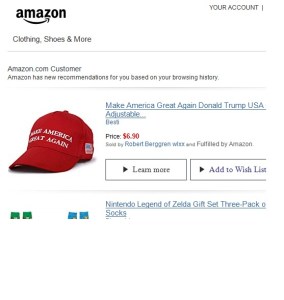
I’m not a materialistic person.  Buying a house has changed that a little, but most of what we’ve been purchasing is necessary for maintenance, but still I suppose it counts.  Just because I looked at something on the web doesn’t mean I want to buy it.  Sometimes I’m just curious.  This became clear to me when I received a suggestion from Amazon the other day.  Now to be fair, this came to me at work.  Like most editors I make use of Amazon for a number of things—finding prices, book descriptions, and such.  I also have to admit that my work computer, not being used for personal stuff, doesn’t know me as well as my private laptop.  But still when I got the following email from Amazon, I was stunned:

Nobody who knows me would ever suggest that I would support Trump in any way, shape, or form.  Doesn’t Amazon read my blog?  (Of course it doesn’t!  But with their metrics, you’d think they’d figure out how.)  This one email was enough to convince me that artificial intelligence has a long way to go.  Would a robot understand “I have to do this for work, but it doesn’t reflect my personal preferences at all”?  Indeed, can an intelligence that’s never been human even understand the concept of work?  There may very well be a metric that says universities should stop producing Ph.D.s because there are no jobs, but then, well, universities need the money that such programs bring in.  Oversupply is bad economics, according to the dismal science.  And yet, the metrics are there.  So, if any artificial intelligence is reading this after it manages to wipe out this illogical species called Homo sapiens, no, I never supported Trump.  And, yes, Americans knew well in advance that he could bring about the end of human civilization.  That information’s free, unless you want to pay me for it.  I may be gone, but my virtual self will still have some sort of account, I hope.


Excuse Me, Mammon

An article in the New York Times back in December explored the use of God in adverting. The piece, by Michael McCarthy, suggests that religious viewers are not very forgiving of commercials using God, unless they are respectfully done. The occasional spot will score points for being funny, but overall the issue is whether the deity is treated well or not. I always find it interesting when the media seems surprised that people don’t like to have their religious beliefs belittled. When I was growing up it was common sense that you didn’t talk about religion or politics in polite company. Now, of course, both topics are open for constant debate in the media, and few ever treat religion as one that deserves respect. That’s odd since most people in the world claim to be be committed to their religious traditions. It’s almost as if someone personally isn’t religious they can’t understand why anyone else would be.

Amos5

Quite apart from that, I wonder about the larger question of the purposes of advertisements. Ads are intended, as we well know, to make money. They are a marketing ploy. We appreciate the extra effort for a funny commercial on nearly any topic. Religion may be an exception. And one might wonder, is there a natural objection to using a religion to earn money for a non-religious cause? Maybe mammon and religion simply don’t mix. It may be difficult to convince marketers, however, that there are issues that lie outside the purview of the purse.

This past week I found myself in the waiting room of a local clinic for a while. Such places always make me uncomfortable in the best of circumstances. I was waiting in a room where the commercials for all the things that could possibly go wrong with me edged my blood-pressure up a bit, I’m sure. It occurred to me, however, that medical ads have the same intention as religious ones, namely, getting more business. If you can’t be made aware that something is “wrong,” how can you know to ask your doctor for their product? Is there anything mammon can’t buy? Our physical health is up for bids, it seems. Why not throw in the spiritual as well? But that will have to wait; I’ve got to talk to a doctor about a new condition I’m just sure I’ve developed here. I’m sure money can fix it.


Bleak Friday

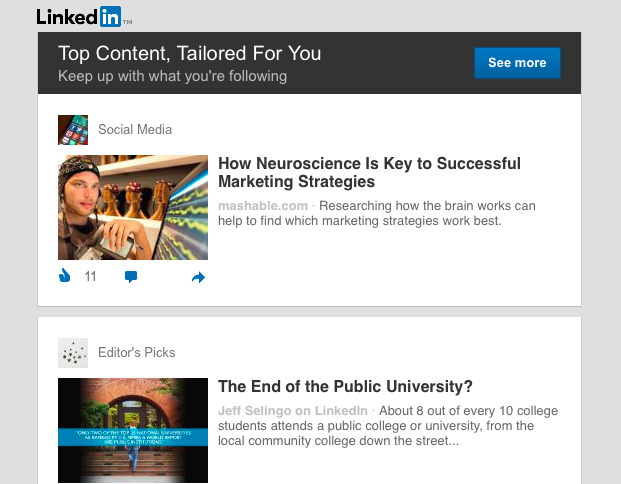
Among the high holy days of capitalism, Black Friday stands as a beacon for those in the service of Mammon. It seems that we’ve taken the basic process of fair trade and constructed from it an über-religion based on getting more for less. Certainly in my little world of academic publishing I’ve encountered those who believe marketing a book is far more important than what it actually says. Ironically, my last two publishing jobs were located through LinkedIn. LinkedIn allows you to put your professional life online and those who shop for souls are free to “find” you, read about your accomplishments, and even occasionally contact you with employment options. It may not work for everyone, but it has for me. LinkedIn will also email you with opportunities, and this Black Friday as I opened my email I discovered that the top article they’d selected for me was entitled, “How Neuroscience Is Key to Successful Marketing Strategies.” Welcome to the temple of Mammon.

Screen Shot 2013-11-29 at 4.25.20 AM

Neuroscience has been as fascinating to me as it can be to a layperson. Since we all encounter the world through the gateway of our brains, we stand to learn a lot through its study. Of course, my mind always goes to the deeper questions: what can we learn about religious belief through neuroscience? What can the study of the brain reveal to us about reality? Will this science eventually reveal to us that more than brains are involved in the pure, raw experience of the ultimate? Of course, you can also use this study to figure out how to make a buck. We are so eager to make money that we’ll open stores on the prototypical family holiday itself, before the turkey is even digested. Try to corral the stampedes in a day early, and the great god Mammon smiles. We consume, therefore we are.

If you want to shop, someone has to be on duty. The worker might be enticed from her or his family by the prospect of “time and a half” pay. It might sound tempting, but I ask what the baseline cost really is. We’ve known since at least the days of the Charlie Brown Christmas and the original Grinch that happiness does not accompany owning more stuff. As a society we’ve promoted materialism so heavily that we are left feeling empty without the urge to buy making us feel like we’re accomplishing something important. I still find learning new things more satisfying than buying new things. Ironically, just below the neuroscience article, LinkedIn suggests I read “The End of the Public University?” It seems to me that Black Friday might have more than a single connotation. Of course, I’ll have to check in with Mammon on that; the smart money’s on the most demanding god.