Words and Belief

Why do we care so little for the poor?   Part of the answer is surely the misguided idea of meritocracy—if you merit good you will be successful.  This kind of thinking emerges from the wrong end of a bull.  There may be poor people who are lazy but the vast majority of the poor are those for whom our systems make it impossible to thrive.  It’s very easy to put them out of mind as long as we can keep them out of sight and just let our prejudices do the thinking for us.  The poor are the victims of capitalism.  Loud voices proclaim them to be a drain on the system, despite the fact that many of them work—some multiple jobs—and remain unable to keep up.  Capitalism is kind only to the wealthy.

The Rev. Dr. William Barber is one of the organizers of the Poor People’s Campaign.  The full name is the Poor People’s Campaign: A National Call for Moral Revival.  The initial part is taken from an initiative that Martin Luther King, Jr. started before his assassination.  He was shifting towards a movement meant to address the entrenched unfairness deep in American society.  These nearly six decades on, we are just as deeply entrenched.  Barber is doing amazing work, organizing, speaking, and advocating.  He’s trying to give a voice to the people.  I do wonder, however, if using the word “Revival” doesn’t work against the goals of the movement.

Certain words have been poisoned by their abuse among various religious groups.  Especially among the young.  The word “revival” may fall into that category, calling to mind, as it may, repressed people working up to an emotional fever under the banner of Hellfire and brimstone.  Believing a bit too literally a message that was contained in a book viewed magically.  Names can be important.  Many of the younger generation are put off even by the word “church” since so much hypocrisy (something the Republican party has openly embraced) has come to light over recent decades.  I fully agree that we need a moral revival, we need people to wake up and demand that our government promote the justice it claims to seek.  I do wonder if religion, as previously packaged, has the credibility to do it.  No matter how we take on the task, it’s clear that the poor have been abandoned by the system, through no fault of their own.  And some in the church have begun to find their voice in the Poor People’s Campaign.

Photo by Katt Yukawa on Unsplash

Moral Compass

Recently I was introduced to The Poor People’s Campaign, in its most recent iteration.  I was drawn in because I was raised in a poor family and have struggled to make up the shortfall my entire adult life.  Those raised in middle class (and above) households often don’t realize that when you start below zero, in a humanities-based career it may take literally decades to catch up, if you ever do.  There’s no safety net and there’s no inheritance.  You begin with years of higher education debt and sub-standard pay in your profession.  But I digress.  The Poor People’s Campaign: A National Call for a Moral Revival is non-partisan and it is about more than just the poor.  It’s about restoring true morality to our political system.  Organized by the Rev. William J. Barber II, it has had some success in presenting the plight of the poor to a congress that has largely failed to care.

Politics is full of dirty money and lobbying to the point that many people are cynical and convinced that morality has no chance of survival in this city set on a hill.  The pony and puppet show in a White House run by an entrenched narcissist shows just how far concerns for justice are from the aims of our government.  Barber and his colleagues actually read from the Bible (which, it turns out, advocates justice) rather than just saying that they do.  Compared with Martin Luther King’s 1968 campaign by the same name, The Poor People’s Campaign today is smaller, but growing.  More and more citizens with a conscience realize that our government requires rescue if any semblance of fairness is to throw its hat into the political arena.  We’ve become the victims of to government’s bread and circuses, but without the bread.

The most disturbing aspect of our current political spectrum is the complete lack of a moral compass on the side of politicians who cynically use issues to win elections only for personal enrichment.  We have an Oval Office occupant who refuses to divest himself from his own business interests while using his position to increase his own wealth.  Others in his party follow suit.  The Poor People’s Campaign is non-partisan because corruption easily crosses the political aisle.  At least one party seems to be aware that the poor really do suffer even as the White House tells them tax breaks for the wealthy will make everything better.  When a government proposes “camps” for the homeless to get them off the streets, we should see that we’re clearly in trouble.  And unless someone sounds the alarm the wealthy will never bother to take notice. 


Devil’s Advocate

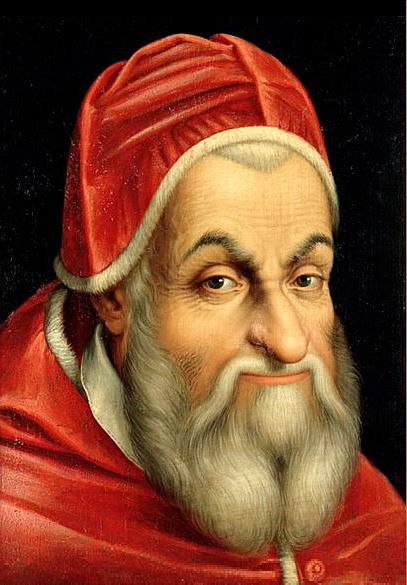
At fives and sixes, the Pope who gave us the devil's advocate.

At fives and sixes, the Pope who gave us the devil’s advocate.

When two people in completely isolated incidents tell me the origins of the term “Devil’s advocate” within a week, I figure it’s time to do a post about it. We’re all familiar with the term, and we know that it means taking the point of view of the “bad guy,” just for argument’s sake. In fact, the Devil’s advocate may not believe his (usually it is a he) own arguments, presents them to make sure the results are correct. The Devil’s advocate was an official office in Roman Catholicism beginning in the late 16th century. The actual title was Promoter of the Faith and the reason such an office was necessary was that so many people had been put forth as potential saints that the church experienced an embarrassment of riches. Canonization, the process of becoming a saint, has a number of hurdles to clear for the would-be paragon. Claims, often extraordinary, were made for miracles associated with the favored ones and the Devil’s advocate was intended to research and present contrary evidence. This made it more difficult to achieve sainthood, but in theory, at least, kept the number of candidates down to only the most deserving. There was no literal devil involved.

Those of us who grew up Protestant often had recourse to only faulty knowledge of Catholicism. We were sometimes taught that it was based on magic, what with the priest speaking in Latin and making mysterious motions with his hands. That meant, for some, that Catholics seemed particularly gullible and would believe things the rest of us wouldn’t. The Catholic Church, however, has often providing its own policing. Not as eager as Pentecostals to accept mundane miracles, when a pareidolia-inspired leakage of water or an anomalous burning of toast occurs, the Catholic Church is quick to debunk claims of miracles just because an underpass stain or a bit of bread looks like a famous religious figure. If you squint enough. The Devil’s advocate was a similar safeguard.

On the opposite side of the equation, I’ve often heard sermons among some evangelical groups claiming that we’re all saints. (Their membership, that is.) Who shouldn’t claim the name when they walk the walk? Many of these saints fail to inspire in the way of those of yore. Some of the beloved cultural heroes that keep coming back in various forms have saintly origins: Santa Claus and Saint Valentine are two that come to mind at this time of year. Some Protestants who may not have been perfect, however, should somehow qualify. Martin Luther King, Jr., another figure of the winter season, by his contributions to justice issues, might be one who would qualify. I’m sure there are many others. The fact is that making a principled stand against the wickedness that sometimes passes for the status quo is difficult and leaves one open to criticism and resentment. A Devil’s advocate might be just what society needs when looking to make saints out of mere mortals.


Just Binghamton

I seem to find myself in Binghamton again. The town, while clearly economically depressed, still retains a bit of its 19th-Century charm with some beautifully restored downtown buildings and a sense of history. While too many store-fronts are still vacant and too little money exists to improve the area sufficiently, I happened upon a warm and cheerful independent bookstore—River Read—and that always gives me hope in such circumstances. Bookstores such as this are like seeing the first crocuses after a long, harsh winter. There is some life in this seemingly dead planet yet. Outside the bookstore stands a statue of Martin Luther King, Jr., backed by a sluggish river and yet more vacant windows. I think of justice and all that it means.

IMG_0969

My own hometown (not Binghamton) is virtually a ghost town. It is a feeling difficult to describe, visiting a place that served as your first secure setting in the world only to find it crumbling under an economy with so much wealth with so little reach. Where is the justice in that? Binghamton, near the founding location of IBM, ironically began suffering at the decline of the Cold War. Manufacturing has gone for pastures of a different kind of green, leaving a sometimes sad and forlorn city in its wake. Binghamton sheltered a young Rod Serling, a man who would give the world the Twilight Zone and its endless spinoffs. It is home to a first-rate university. And a wonderful bookstore.

While in River Read we heard some locals talking, in almost Springsteenian fashion, of local civic traditions that had disappeared. Times have changed. Cities like Binghamton don’t draw in the curious or those with liberal purse-strings. Endicott Johnson, the shoe manufacturer, developed a strong sense of welfare capitalism in the city last century—capitalism with a heart seems to have gone extinct these days. The idea that those with the means to create jobs and livelihoods should care for their employees would seem to be a matter of common sense. Instead, common cents have come to rule. Binghamton University is investing in the town, and a sense of cautious optimism dares to suggest itself. Justice is a matter of distribution rather than entitlement. And that’s why I’m standing out here under gray September skies, staring at the statue of Martin Luther King, Jr.


King’s Highway

Sometimes I forget the beauty of the Bible. With its constant current of misuse in our society, it is sometimes easy to forget that, like an abused child, the Bible is not to be blamed for being the victim. As a civilization we owe a great deal to it, and even on its own, when we overlook the insensitive and sexist parts, it remains a literary masterpiece. Just over a year ago I visited a true friend I’ve known since high school. He is not a religious man, but in his living room, on a stand, stood open the Bible. It is more than a jingoistic symbol. Even the more we become aware of other great spiritual writings: the Rig Veda, the Tao Te Ching, the Gilgamesh Epic, we shouldn’t let the sublime messages from the Bible escape our notice. Even in this secular, workaday world, the words of the Sermon on the Mount often come to me, grand and resplendent. Parts of Isaiah still bring tears to my eyes. Writers from Shakespeare to Bradbury drew on its noble sentiments.

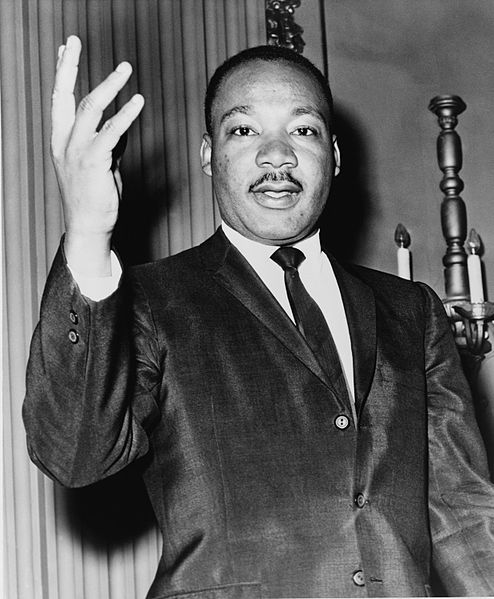
The Bible comes to mind when thinking of Martin Luther King, Jr. Our chronological spans overlapped by just five and a half years, but I followed him to Boston University School of Theology, walked the same corridors he did, meditated in the same chapel. Even then, some two decades after his martyrdom, his vision had not been fully realized. It still remains unfulfilled. At Brown University in May of last year, I was fortunate enough to be in the crowd when John Lewis received an honorary doctorate. His remarks to the crowd were humble, few, and profound. He said he never thought of the civil rights movement as a way to greatness. He was only trying to help. He admonished the affluent, the comfortable sitting on a hot Ivy League green, “Find a way to get in the way.” Injustice must come to end. The color, gender, sexual orientation, place of birth or financial status of no person should ever be used to judge her or him. With remarks I’ve heard about President Obama, most vulgarly on Facebook, we still have a long, long journey ahead of us.

In a day when the internet weaves millions of people into a fabric that should remind us we are all part of a whole, some still insist that their shading, location, or special pedigree make their part of the cloth the most valuable. Even as revolutions against injustice—something with which Americans especially should sympathize—take place in “backward” nations by using social media, we in the “first world” still judge one another by the origins of our ancestry and the mythical superiority of our skin tones. The greatest asset the United States offers to the world is its unique blend of people from everywhere. Our country demonstrates what can happen when people from every continent put their minds and wills together to work for the common good. This clashes with the biblical brand of separatism, I know. But even Isaiah, even if it is in his third incarnation, reminds us, “Also the sons of the stranger, that join themselves to the Lord, to serve him, and to love the name of the Lord, to be his servants, every one that keepeth the sabbath from polluting it, and taketh hold of my covenant; Even them will I bring to my holy mountain, and make them joyful in my house of prayer: their burnt offerings and their sacrifices shall be accepted upon mine altar; for mine house shall be called an house of prayer for all people.”

Martin_Luther_King_Jr_NYWTS


Monkey See, Monkey Do

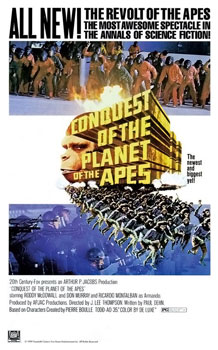
ConquestPlanetApesThe year was 1972. In the continuing saga of the Planet of the Apes, the fourth installment, Conquest of the Planet of the Apes, addressed the civil rights movement directly. Caesar, the son of Cornelius and Zira, is the last speaking ape left in the past to which his parents had escaped. Inexplicably, the other great apes have all suddenly evolved by 1991—the year in which the story is set—into large sized, almost upright creatures whose population matches than of humans (almost). Initially purchased as pets since the cats and dogs had died off in the late 80’s, apes have been imported as slaves. They are given menial tasks and beaten mercilessly if they make errors. A deep fear pervades the establishment that these apes will try to take over. Breck, the governor of California, decides to find and kill Caesar, at any cost, while his deputy MacDonald tries to save him. When Caesar reveals himself to MacDonald, an African-American, he states that he especially should know what it means for a people not to be free.

Martin Luther King Jr. had been assassinated only four years earlier and although civil rights had made progress, there was still a long way to go. Still is a long way to go. As an affluent culture, we remain reluctant to share. We still see disproportionate numbers of African-Americans and Hispanic Americans forced to live in areas that the amorphous “white” population has fled. Xenophobia is one of the less noble traits with which evolution has endowed us. Even so, the classes we devise aren’t always helpful in determining who people really are. “White” can mean anyone from the southern tip of Chile to the tundra of eastern Siberia. On job applications now “Hispanic” is classified as “white.” I get the feeling that there’s a few unresolved issues here. The sense of entitlement did not begin with this generation. Those who have naturally suppose that they deserve. Caesar observes the unfair treatment and, down to the detail of the weapons the apes stockpile, leads a plantation-style revolt that overcomes a heavily armed command post. Gorilla warfare indeed.

In classic 1960s-70s style, Caesar grandstands after his victory. He was about to order Breck’s execution, but stays his hand in the recognition that even humans deserve to live. We do have to wonder where he might have learned about God, being raised by a circus trainer and in what is an otherwise completely secular society in the film. In any case, his final words in the movie place the apes on a higher moral plane than humans. “But now… now we will put away our hatred. Now we will put down our weapons. We have passed through the Night of the Fires. And who were our masters are now our servants. And we, who are not human, can afford to be humane. Destiny is the will of God! And, if it is man’s destiny to be dominated, it is God’s will that he be dominated with compassion and understanding. So, cast out your vengeance. Tonight we have seen the birth of the Planet of the Apes!” Maybe it’s all the dead bodies around, but I’m still having a little trouble with the “Destiny is the will of God” part.


Important Days

A few years back, during that nightmare called the Bush Administration, a petition was going around to try to prevent the United States from going to war in Iraq. A phone petition was put in place to encourage those against the war to telephone the White House and peacefully make their convictions known. I decided to call in. Since I worked at Nashotah House, I had forgotten that Martin Luther King Day was a national holiday (the seminary did not commemorate it). I telephoned the White House from my office only to receive a recorded message stating that the offices were closed because it was “President’s Day”! I hung up astonished. Our own government did not know what day it was (in retrospect, not such a surprise —).

A couple of years later while I was working on my book of holidays for children, I recalled the incident. It still strikes me as very odd, given the importance of today’s commemoration. I am including below my brief write-up for Martin Luther King Day from my still unpublished book:

One of the few national holidays in the United States to honor an individual is Martin Luther King Day. There are only three individual based holidays – Washington’s Birthday and Columbus Day are the other two. Martin Luther King Day is observed on the third Monday of January, and it had a hard time making it through the government process of becoming an official holiday. It seems like old prejudices die hard, since the bill proposing this holiday was introduced in 1968 but was not signed into law until 1983!

Martin Luther King Day is the only national holiday commemorating an African American individual. While school kids are probably just grateful for a day off so soon after the Christmas holidays, this holiday stands out as important for many reasons. Perhaps the main reason is that the United States were united around the idea of freedom, a basic right for all in this country.

Martin Luther King Jr. was born on January 15, 1929. His story of a courageous, non-violent challenge to unfair practices in the United States is an inspiration to all who care about justice. King was a Baptist minister and a main leader of the Civil Rights movement. He was awarded the Nobel Peace Prize in 1964 for his example of peaceful protest; King was the youngest person to have ever been awarded this honor. He was assassinated on April 4, 1968. Even so, this holiday was not officially observed in all 50 states until 2000.

The federal government (pay attention!), that is, the government over the whole country, has the right to set holidays. Anyone who works for the federal (national) government gets the day off. Individual states, however, can decide if they will observe the date as a holiday or not. That is why some state workers get a holiday off while those in another state do not.

The United States stands for equal rights for all citizens. King stands as a symbol for that belief and his life shows that sometimes it takes everything you’ve got to make sure that the right thing is done.

Another factoid about this holiday is that it shows just how different holidays can be from one another. Some are fun while others make us think.