Forest of the Subconscious

The mind is not the brain. This isn’t mystical mumbo-jumbo (although there’s nothing wrong with mystical mumbo-jumbo either). We’ve been bombarded with the message that we are meat machines for many years now. Those who have studied physics and plumbed its depths often tell us that if we had all the bits of information involved, we could figure out anything. Our minds are our brains and it is merely electro-chemical signals that form a kind of operating system for this biological computer. The idea that we have a separate mind, we are told, is an illusion. Interestingly, studies of the subconscious mind raise significant questions regarding this interpretation. The subconscious, it is generally acknowledged, was discovered by Sigmund Freud. Prior to Freud many people did things and didn’t know why. Now we know, despite debates about the details, that we have to consider the subconscious mind as well as the more familiar conscious one.

I’ve been on a Through the Wormhole kick lately. Since we don’t have television, I have to watch the episodes after they air, but at least I have the option of doing this when I have some time. I recently watched the subconscious episode. The truly amazing takeaway from this was that our minds often, daily, in fact, operate on a level that we know nothing about. There are ways of tapping into the subconscious mind—meditating, as I mentioned earlier this week, is one way. Others are more scientific. Stimulating areas of the brain with small amounts of electricity can enhance abilities that we never knew we had. In fact, we might even be able to enact a Matrix-like download of information. I think I may have swallowed the blue pill after all.

DSCN2021

Call it a gut-level reaction, but I have always had a strong resistance to the idea that we are mere automatons. Consciousness, which, increasingly we’re discovering, involves a dose of subconsciousness, doesn’t feel at all like a we’re programmed. Theologically, I always objected to the strange notion of predestination. It made no sense, theologically, or experientially. One very wise professor once told our class, “If you want to test this, tell your spouse that you’ve got her or him completely figured out. They will do something you don’t expect.” Our minds are perhaps the most miraculous parts of human beings. The concept that we are merely following the pre-determined laws of physics makes no sense unless we believe in a literal Hell that we’ve made of this world. Are we programmed to self-destruct? I believe not. Whether in my conscious mind or in the true mind that lies underneath it.
Wired for God

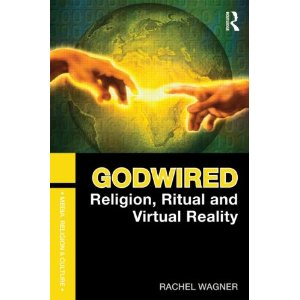
I am not now, nor have I ever been, a techie. When my fascination with the newest technological marvel borders on the rhapsodic, I suddenly realize it’s all electrons and immediately the fascination dissipates. It feels like an illusion. I am a guy who likes the sensation of a paper book in his hands and prefers conversation accompanied by all the subtle biological clues of being in the same room with somebody. Maybe it is lack of imagination on my part, but I will often get bored on the Internet and pick up a book instead. One book I recently picked up, and one that challenged my perception of reality, was Rachel Wagner’s Godwired: Religion, Ritual and Virtual Reality (Routledge, 2011). Wagner is one of that generation of younger scholars who is asking what the implications of electronic culture are for religion. If concepts such as online prayer walls, chat-bot salvation, and storing sacred texts on the same device as secular ones intrigue you, do yourself a favor and read this book.

As Wagner ably points out, religious individuals are tapping into the vast communications’ potential of the Internet to spread their faith abroad. There are apps to help you pray online, there are electronic games to prepare you for the fictitious rapture, and there are virtual churches. We have indeed sealed God in an Xbox, and we have beamed the divine across wireless networks and learned to confess our sins in cyberspace. And physicists are starting to confirm that, at our most basic level, we are energy rather than matter after all. Maybe we are tapping into ultimate reality here. Wagner explores how the level of engagement with virtual worlds constructed by software engineers (the new gods) becomes so intense as to provide an alternate reality. It all depends on how you define what is real. And it is clear that for many people, life without the Internet is now unimaginable. Those of us born before the supercomputer scratch our physical heads with amazement. How did Nebuchadrezzar or Alexander ever conquer the known world without GPS technology? Does my iPhone have a secret life about which I know nothing?

Within our culture live many older people who have never touched a computer. They exist alongside grandchildren practically born with some iDevice in their grasp (may be a choking hazard for children under three). I have lived long enough already to have witnessed keyboarding being replaced by thumbing, and research having shifted from long treks to the library in the snow to a few taps on a glass screen that can feel the electricity from my chilly fingers. From the comfort of my lonely room sings my soul, how great thou art! Perhaps Terminator didn’t go far enough, perhaps Skynet really is god. Maybe this matrix of blood, muscle, bone, fat, and spit is really just an illusion and the Internet is true revelation. Wagner pries open some very important questions in her book. And none of us should be surprised if, when we approach the pearly gates, we find a touchpad next to the electronic lock inscribed with this legend: “Welcome to Heaven. Please enter username and password. Type in the letters you see in the box below.”


Aye, Aye, Robot

As students gave their final presentations, the very last group discussed the End of the World. This is a topic upon which the Hebrew Bible is generally silent, despite the rants of many who misunderstand the Zoroastrian influence upon the apocalyptic book of Daniel. No, the Hebrew Bible’s apocalyptic material looks forward to a change of ages, a radical new beginning, but not an end of the world. Well, maybe the end of the world as R.E.M. knows it, but not the cessation of everything. In an interesting twist, this group moved from the Hebrew Bible to scientific scenarios of the end of it all. What became obvious is that undergrads these days are faced with multiple doomsday scenarios, most of which are of human origin.

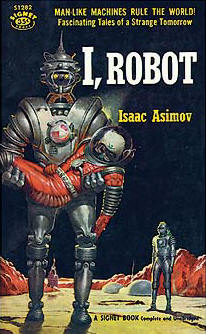
Last month I was inexplicably elected as the president of the adult chapter of my daughter’s high school robotics team. An unemployed religion professor hardly seems the logical choice for leading the way into a technological future. I even declined the nomination but was persuaded to give it a try. Robots have improved the quality of our lives to a degree that most people do not even recognize. So I listened in amazement as the students last night presented the doomsday scenario entitled “iRobot.” Clearly this is a Transformer-like blend of iMac/iPod/iPhone and Isaac Asimov’s sci-fi classic I, Robot. (Is it mere coincidence that his name can be written iAsimov?) Their description was terse and scary: nanobots and more boxy industrial models will commandeer the Internet and take over. We will be Matrix-like slaves. And I am the president of a robotic club booster association. I felt like Judas, with a MacBook.

Robots, we are told, lack empathy. Experience teaches me the same about Republicans. This weird hybrid of religio-politics is not unlike our hypothesized robotic nemeses. Religion has given us a rope to hang Judas that can double as whip against the backs of the underprivileged. Where are Asimov’s Laws of Robotics when you need them? “A robot may not injure a human being or, through inaction, allow a human being to come to harm.” Yes, the old ways are breaking down indeed. I think I’ll take my chances with the robots. At least when a robot is cutting off your life support systems it is not doing so in the name of Jesus.


What Hath AI Wrought?

Earlier this week an op-ed piece in the New York Times afforded the laity a rare glimpse into The First Church of Robotics, that is, Silicon Valley’s incredible and slightly disturbing vision of the future of technology. The writer of the piece, Jaron Lanier, an insider, expresses a concern that his area of specialization, a kind of artificial intelligence, is blurring the hard line between human and machine. Perhaps it is time we all watch Terminator again. Quoth Lanier, “It should go without saying that we can’t count on the appearance of a soul-detecting sensor that will verify a person’s consciousness has been virtualized and immortalized. There is certainly no such sensor with us today to confirm metaphysical ideas about people, or even to recognize the contents of the human brain. All thoughts about consciousness, souls and the like are bound up equally in faith, which suggests something remarkable: What we are seeing is a new religion, expressed through an engineering culture.” To put this in context, Lanier had been discussing the current concept that it might be possible to digitize human beings to incorporate all people in a Matrix-like universal brain.

I am woefully undereducated on the technology side of this issue to discuss whether or not such high-end digitization is possible. What interests me is the suggestion that this is a new religion. We haven’t even figured out the old ones yet. Defining what a religion is presents a nearly insurmountable barrier even to specialists in the field of religious studies, and some disgruntled conservatives claim that atheism and “sciencism” are religions. No matter how fast or how far you run, someone will always be able to label you as the adherent of one religion or another. Religion is an all-consuming category, a mental conundrum that cannot be contained by mere academic classification and circumscription. It is the universal solvent.

Meanwhile, universities and other learned bodies are reluctant to support the study of religion. In a world where the vast majority of individuals, university professors included, are motivated by religious guidelines and parameters, it is the elephant in the room we’d rather not discuss. From the sidelines I have watched reputable school after reputable school disembowel religion departments since they “don’t bring in money” and add nothing new to our understanding of the human condition. The sad truth is, religion indoctrinates much of the world. Deans and university presidents could learn a lot by reading op-ed pieces in the New York Times. Or at least have their avatars read them and store them away for future recall.