Slow Jinn

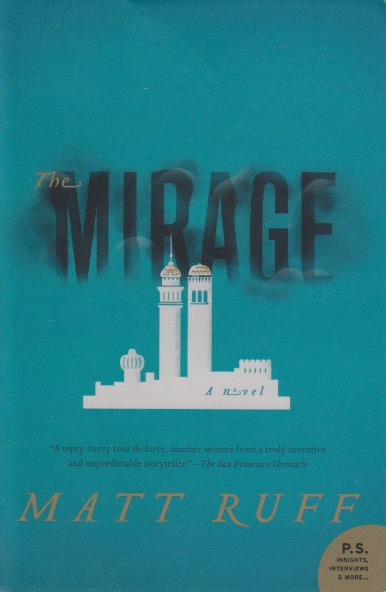
You can sort of tell when an author has a background in religion.  Early on in my blog writing, I made note when novels had religious elements.  It’s so common that I seldom do that anymore.  Matt Ruff’s father was a minister.  His understanding of the religious landscape comes through in The Mirage.  It wasn’t on my reading list, but someone gave me a copy and the story drew me in.  In case, like me, you only know Ruff from Lovecraft Country, this tale’s quite different.  There may be some spoilers here, so if you’re thinking of reading it fresh, you’ve been warned!

Set in an alternate reality in which the superpower in the world is the United Arab States, the story follows three police agents of Homeland Security as they uncover a perhaps unwelcome truth: the world they know is a mirage.  It is, in fact, the work of a jinn.  Before commenting on that, I would say that you don’t learn about the jinn until a good way into the story.  Up to that point I’d call this simply literary fiction.  The jinn adds a speculative element to it, and also explains, mostly, how things ended up the way they did.  Jinns, by the way, are often considered demons in Arabic culture.  They are quite different from Christian demons, and that point makes itself clear as the story unfolds.  Our three protagonists begin to uncover hints that the twin towers didn’t actually stand in Baghdad, and that Christian terrorists didn’t fly planes into them on November 9 (11/9).  They have run-ins with Saddam Hussein and Osama bin Laden as warring factions vie for power in the UAS.

This is a great story for trying to understand the world from the point of view of a different religion (unless you’re Muslim).  This is a world where Christians are terrorists (you get to meet David Koresh as well) and the United States is a backward country divided over religion.  Reading this as events unfolded in Washington, DC last week was a little bit disconcerting.  Alternative realities are often just a heartbeat away.  The plot is a bit complex at points, but it’s a fairly quick, if profound read.  Religion is the heart and soul of this book.  That religion could be either Islam or Christianity.  Perhaps even something different.  The way it plays out is very much like real life, dividing people against each other until reality becomes difficult to bear.  For anyone interested in what a Muslim-run world might have looked like, this is a good starting place.
2017 in Books

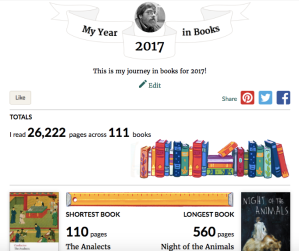
At the end of each year I think back over the books I’ve read in the past twelve months. Since I don’t blog about every single book, I use Goodreads to keep track of my numbers. I pushed my reading challenge at that site to 105 books for last year, and the meter stopped at 111. In 2018 I’m planning on reading some bigger books, so I’ll scale the numbers back a bit, I think. In any case, what were the most memorable books of 2017? It’s perhaps best to divide these up into categories since the number of books has become unwieldy. I’ve written a book about horror movies, and much of this year’s reading has been in support of that. Since my book addresses, among other things, possession movies, I’ve read several tomes on the topic. Noteworthy among them have been the three books by Felicitas D. Goodman that I read over the year. J. H. Chajes’ Between Worlds was exceptional, and Jeffrey Burton Russell’s The Devil, was likely the overall best on the topic. Also noteworthy for purposes of my book research were Catherine Spooner’s Post-Millennial Gothic and Monstrous Progeny by Lester Friedman and Allison Kavey.

For books on religion, Stephen Prothero’s Religious Literacy was an important start. Amy Johnson Frykholm’s Rapture Culture and James William Jones’ Can Science Explain Religion? addressed aspects of the topic that will continue to bear further exploration. God’s Strange Work by David L. Rowe and American Apocalypse by Matthew Avery Sutton stand out in my mind as a memorable treatments of William Miller, and of understanding American religion respectively. Chris Hedges’ American Fascists is remarkably urgent and should be read widely, especially since he has shown where current political posturing will lead if it’s not stopped cold. We will be struggling against a situation like Nazi Germany for many decades to come, and forewarned is forearmed.

It wasn’t all doom and gloom, however. Much of the fiction I read was excellent. Bill Broun’s Night of the Animals, Auður Ava Ólafsdóttir’s Butterflies in November, Robert Repino’s D’Arc, Matt Ruff’s Lovecraft Country, Christobel Kent’s The Crooked House, and Leah Bobet’s An Inheritance of Ashes all stayed with me long after I read them. And of course, Neil Gaiman’s The Ocean at the End of the Lane. Some non-fiction read just as engagingly. The autobiographies by Carly Simon and Bruce Springsteen were deeply engrossing. The Hidden Life of Trees by Peter Wohlleneben and John Moe’s Dear Luke, We Need to Talk were great guilty pleasure reads along with Dani Shapiro’s Still Writing, W. Scott Poole’s At the Mountains of Madness, and Mathias Clasen’s Why Horror Seduces. The latter title brings us full circle. I suspect that’s appropriate for rounding out a year. Many of the other books were also quite good; I tend to rate books favorably. Read the revolution—make 2018 a memorable year with books!


Making Lovecraft

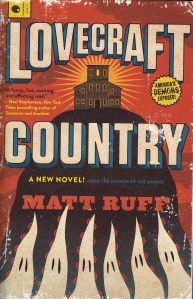
Perhaps it’s all just coincidence, but once in a while a number of unexpected things come together. Since I do a lot of reading this often happens in the context of books. The current case begins with my first noticing Matt Ruff’s Lovecraft Country. I saw a review online, and since I enjoy contemporary novels that build on the worlds created by H. P., I added it to my reading list. The first coincidental aspect of it was that I found in Buffalo Street Books in Ithaca. Like most independent bookstores, it’s not huge, so the selection of books that cater to my odd tastes is always adventitious. I found it on the staff recommendation shelf and recalled that it was on my reading list. A second coincidence came in finding Neal Stephenson’s name under a cover blurb. My brother-in-law’s name is enough to get a book onto the bestseller’s lists, but I had no idea this kind of book would be to his tastes as well.

I began reading it right away. The third happenstance is that Ruff crafted a biblically literate story here. In a day when those of us associated with the Bible are definitively passé, it is nice to see popular fiction fighting back a little bit. Not that Ruff is advocating or proselytizing, but his finely tuned story is definitely enhanced with a bit of biblical knowledge. He’s unapologetic about it. In our religion-critical outlook these days we sometimes forget that the Bible has several stories that maintain, and even reward, contemporary interest. The most obvious example in Lovecraft Country is the story of Cain. There are plenty of others that can be dug out as well, and Ruff even leaves some on the surface so that they aren’t hard to find. Not that this is a religious book. It’s just not afraid of religion.

Some may find that odd in a homage to the noted atheist Lovecraft. What they may not see is that the master himself used religion from time to time in his tales of horror. Also, for those who are willing to be honest, we know that an unsavory racism resided in Lovecraft’s outlook. Ruff, like other writers who see the positive side of this author’s work, tells a story of African-American struggles in the “idyllic” 1950s. The protagonists, dropped into a world of real Lovecraftian magic—and in a very self-aware way—are all a close-knit black family and their friends. Which led to another coincidence. Quite unconnectedly, I’d been reading Dr. Jekyll and Mr. Hyde. This plays an important part in the story as well. Sometimes reading itself can lead to a cascading set of coincidences. Lovecraft Country is one instance where it happened, but that may just be my unusual taste in books.