Whose Holiday?

I write a lot about holidays.  One of the reasons is that even long before capitalism, societies took breaks right in the middle of things.  One of the major seasons of celebration was the vernal equinox.  Easter is tied to Passover, of course, but since nobody knows the year of Jesus’ crucifixion the actual date can’t be determined.  Passover is a moveable feast and since the lunar calendar is essential in setting Passover’s date, Easter is calculated as being the first Sunday after the first full moon after the vernal equinox.  There has been talk of the three major branches of Christianity—Catholic, Orthodox, and Protestant—agreeing on a set date for Easter but even if that happened there would be splinter groups who liked it the old way and the confusion would only grow.

Since astronomical observation has grown so mathematical, the date of Easter can be calculated far into the future.  We know just when the vernal equinox will occur, and we know when the full moon will come around.  All that’s needed is some calendars and a whole lot of patience (and maybe a calculator).  Despite society’s obvious preference for Christmas, Easter has its own array of attendant holidays for some Christians.  (Not all Christians celebrate Easter.)  For instance, for some today is Maundy Thursday.  Tomorrow most will recognize as Good Friday.  Nobody’s quite sure what to call Saturday, and many Christians will begin to celebrate Easter at midnight even before Sunday wakes up.  Easter does last more than a single day, in some traditions, but it’s not quite as developed as the twelve days of Christmas.

Lately I’ve been considering that how these holy days are sacred for some and secular for others.  One of the realizations that globalization has wrought is that not everybody shares the same concepts of how universal events—such as the vernal equinox—should be commemorated.  Although on the equator every day’s not quite an equinox due to the earth’s tilt, it isn’t as dramatic as the changes that occur in temperate zones.  Christianity was custom-built for European holidays, which is what it tends to keep.  The history of the holidays is more complex than it might seem at first.  Add to that widespread disagreement around the world as to both religion and to when certain events should be calculated and you’ll need more than a slide-rule to figure it out.  So as we begin the Catholic and Protestant Easter season (Orthodox Easter is about a month away yet), it may be helpful to remind ourselves that what day it is might just be a matter of perspective.
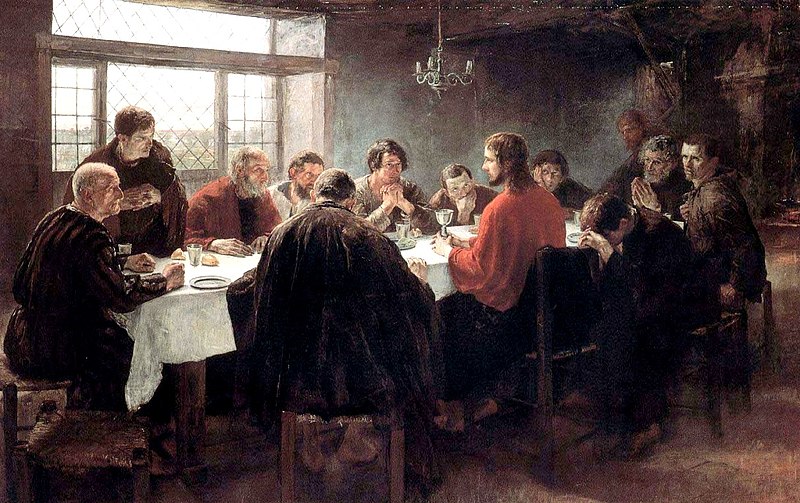
Stiftung Gertrud Schnürle 1975, Fritz von Uhde, The Last Supper, via Wikimedia Commons


Holiday Complex

Now that we’re in the midst of a complex of Judeo-Christian holidays (Passover, Maundy Thursday, Good Friday, Easter, as well as other spring rites), I’ve been thinking of obligations.  I’ve had people introduce themselves to me as “Chri-easters.”  This isn’t a new form of religion, but rather a way of indicating that they attend services on Christmas and Easter only.  For others of us it’s never been so easy.  I was raised with the stern belief that Sundays in church were a matter of absolute obligation.  Serious illness was the only reason to miss.  If you were traveling (which was rare for us, being not terribly affluent), you found a local church to attend.  Never mind that you’ll look like strangers and won’t know how it’s done (unless you’re in one of the “liturgical” denominations, where variations are minimal).  Every Sunday was an obligation.

The minister at our church has been offering virtual holy week services.  The idea haunts me.  You see, back in Nashotah House days the sternness of days of obligation was palpable.  Yes, you had to attend chapel twice daily, but there were still days of obligation.  At this time of year we’d have had long rehearsals already for “the Great Three Days.”  Forsaking family and fellowship, we’d be forced to be together for long hours while the dreary events of two millennia ago were replayed.  Of course they were reinterpreted as well.  Made more Episcopalian—even a crucifixion should be done properly and in good order.  Knowing they had to get to their own churches on Sunday, students were kept up until about two a.m. for the Great Vigil and First Mass of Easter.  Obligation, not love, drove all this.

Coronavirus has us separated, of course.  Some of us are daily seeking coping techniques to help us get through a crisis that throws off schedules and sets new priorities.  To have someone suggest in the midst of all this that we could “come to church” (virtually) transports me to those fearful days of obligation.  As a teen I sought them out.  I’d ask to be driven to a different town on Good Friday so that I could spend it in church, hoping to be in connection with the tragic events.  I’d curse the sunshine when I stepped back out after three p.m., if it was shining.  This was supposed to be a dark and dreary day.  Nature, however, had its own ideas.  Spring was in full swing.  It was time to be thinking about life, not death.


Mystic Connections

Those of us who find rationalism a bit too constricting sometimes find solace in mysticism.  My reading of late, which is mostly research for Nightmares with the Bible, frequently touches on mystics of the past.  This isn’t a new fascination.  All the way back in college, as a religion major, I mentioned to one of my professors that I found it appealing.  A frown settled across his academic face.  “Mysticism is dangerous,” he said.  He went on to explain that churches (he was Presbyterian, and I Methodist) had belief systems into which mystics—those who experience the divine directly—didn’t fit.  A direct experience of the divine could cast doubt on church doctrine and nothing, as you might guess, is more important to true believers than dogma.

That discussion at such an impressionable age set me aback.  Here as we enter (for the non-orthodox) the Triduum, or “Great Three Days” the faithful are hoping for some kind of divine experience, I expect.  Many of us will spend two-thirds of it working.  In any case, if nothing mystical happens why do we bother?  Mysticism is equally deplored by science since it suggests something that doesn’t fit into rationalism’s toy box.  A universe where the unexplained—and oh so subjective!—direct experience with naked reality threatens to undo all the neat columns and tidy formulas that describe the entirety of existence.  Conventional churches tend to agree because you never know what God might do if you open that box.

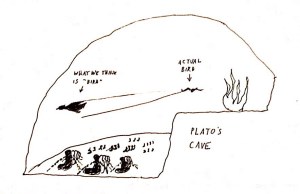
There are religions that welcome mysticism.  They recognize that human-built systems are only approximations—Platonic shadows, if you will, cast upon the cave wall.  Mystics are those who, temporarily unchained, dare to turn around and face the fire directly.  Who knows?  They might even catch a glimpse of the sun itself.  More conventional religions are run like businesses.  You come to a certain building at a certain time.  You perform prescribed actions on cue.  You place your money in this specific receptacle at this specific time.  Leave and forget it all until next week.  Our younger generations don’t find this engaging, just as they see through the lie of the inherent fairness of capitalism.  I can still see the frown of my theology professor.  The old systems are falling apart even as those not too weary after work will head to Maundy Thursday services for a slip of bread and a sip of wine.  The mystic, however, doesn’t know what might happen next.