
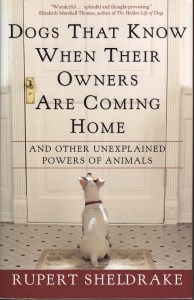
 You know that feeling of being dropped into a very strange place? Sure, it’s disorienting for a while, but once you get used to it, you start to enjoy your surroundings. Now ask yourself: what if my entire way of looking at life is based on a faulty paradigm? Many, I suspect, will drop out at that point. There’s strange, and then there’s going too far. For those wedded to the idea of finding the truth, however, weirdness is part of the journey. I just finished reading Rupert Sheldrake’s Dogs That Know When Their Owners Are Coming Home. Yes, it felt like the room was spinning (actually, I read it on the bus, so that might’ve been true a time or two), but it confirmed something I’ve suspected for many years. The reigning, mechanistic universe paradigm is wrong. Please don’t take this as an anti-science statement. Sheldrake is a bona fide scientist, and I’m an avid reader of science books. It’s not so much that science is wrong as it is that science doesn’t go far enough. Ever since the Industrial Revolution—not coincidentally—we’ve been informed that the universe is really a giant machine. We can figure out how it works using this squishy stuff in our heads that insists we can find Pokemon everywhere we look when it’s not busy solving the riddles of the mulitverse.
Sheldrake, who is given a wide berth by many scientists, states what any of us who grew up with pets knows: they know more than they’re saying. Admitting up front that much of the evidence is anecdotal, Sheldrake provides empirical studies to demonstrate what folk say. Dogs do know when their owners are coming home, before they are within sight, hearing, or smelling range. His study, however, isn’t limited to dogs or to knowing when someone’s coming. Animals, by virtue of their own minds, have abilities that we do not. Since they don’t speak our language, we assume they are dumb. In fact, as this book shows, a great many animals know a great deal more than we do. The question is, if this is the truth why don’t we hear more about it?
We prefer, it seems, our truth to be qualified. There’s a lot at stake here. The reigning paradigm keeps us plugged into this corporate machine we’ve devised. Our lifestyle cannot subsist without the subordination of animals. We can’t give them abilities we lack, apart from tastiness. If the universe isn’t a machine, it might open the door for a broader view of reality. Maybe it is better to be post-Christian, but religion has proven benefits to humans (and perhaps animals). Why does religion remain in a mechanistic universe? Perhaps what we call “souls” are the same as “minds” and perhaps they aren’t the same as brains. If we really do have minds, it is in our best interest to care for them, develop them, and improve them. It may seem like a strange world indeed where your dog informs your view of reality. Read Dogs That Know When Their Owners Are Coming Home, however, and see if you don’t find yourself wagging your tale, just a bit.
 Steve A. Wiggins