
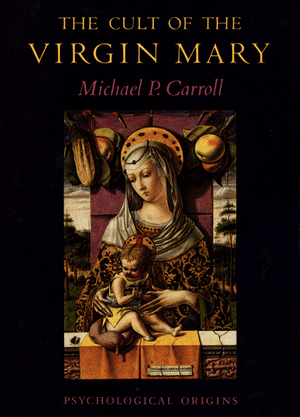
 Why do people pray to Mary? The question is a complex one and answers range from a desire to find some feminine compassion in an angry masculine god to the distinctly Freudian. Michael P. Carroll, in The Cult of the Virgin Mary: Psychological Origins, falls into the latter category. Yes, the book was written in the 1980s, but even then Oedipal complexes and penis envy were deeply suspect. Still, at various points along the way Carroll had me scratching my head and muttering “there may be something to this.” For a few pages, anyway. The problem begins much further back than Mary. To start with, we can’t all agree on what religion is. From there we move to the stage where ancient religions had as many goddesses as gods—even the divine don’t like to be lonely. The heads of most pantheons were male, which likely matched most earthly political systems. Powerful females still existed, at least in mythical realms. Monotheism effectively put an end to that, but before too terribly long, Mary emerged and eventually became almost a goddess.
Indeed, early on in his book Carroll discusses how Mary differs from the goddesses of antiquity, drawing parallels with only Cybele. Mary is the virgin mother completely dissociated from sexuality. Deeper study would reveal some mistakes in Carroll’s reasoning—there were virgin mother goddesses, such as Anat, who might in some ways fill in the gaps. Indeed, arguing for the uniqueness of Mary is kind of a goddesses-of-the-gaps theology. The more we learn the less unique any deity becomes. Still, looking to the psyche to explain Mary is a logical step. Tracing Marian devotion to the ineffective-father family, where a machoism hides a longing for the protective mother, Carroll offers us a Freudian feast of options here. Still, in the light of developments in psychology over the past quarter century, his premise is a bit dated.
We simply don’t know why Mary became such a strong devotional interest in a religion with a masculine Trinity. It would seem that women might be the motive force behind it. Given that half of Christendom was displaced, by default, from the male savior, why would Mary not emerge as the mother all people crave and whom, women know, often soften the harsh decrees of martial law? Delving into the apparitions of Mary from Our Lady of Guadalupe to Fatima and Medjugorje, Carroll finds illusions and hallucinations based on strong females behind each one. Rational inquiry into the deeply spiritual. This, however, remains the proximate cause only. What is really seen can’t be known, except to the seer. And it seems that seers tend to find, amid a religion with an omnipotent man at the top, that it is the mother who appears in times of need. Unless, of course, it is a matter of healthcare where, as government shows, father knows best.

 Steve A. Wiggins