Do I Know You?

How do you know someone without ever seeing them?  How do you know they are who they say they are?  I’ve been spending a lot of time on the phone, much of it trying to establish my identity with people who don’t know me.  This has happened so much that I’m beginning to wonder how many of the people I’m talking to are who they say they are.  I never was a very good dater.  Going out, you’re constantly assessing how much to reveal and how much to conceal.  And your date is doing the same.  We can never fully know another person.  I tend to be quite honest and most of the coeds in college said I was too intense.  I suppose that it’s a good thing my wife and I had only one date in our three-year relationship before deciding to get married.

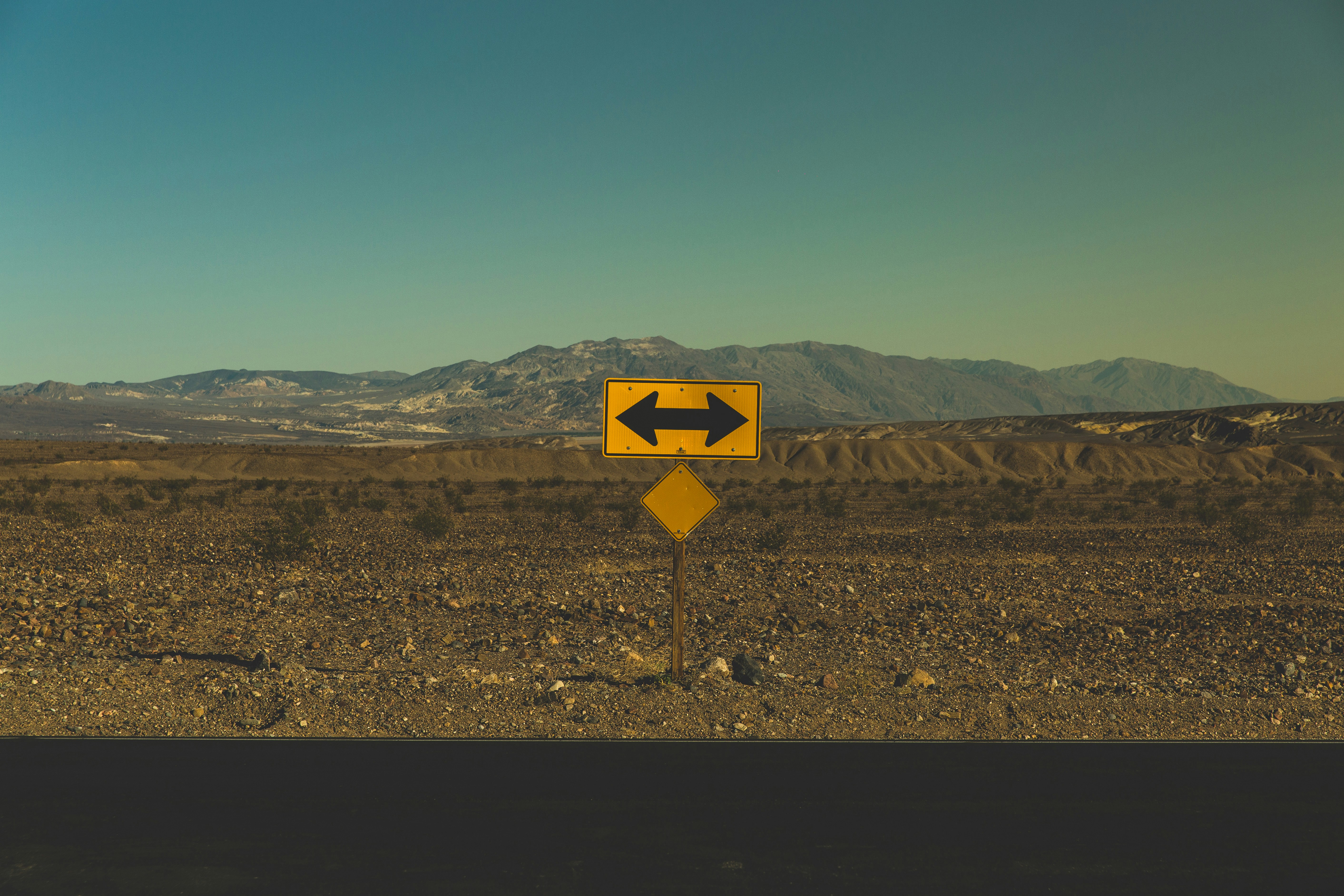
Electronic life makes it very difficult to know other people for sure.  I don’t really trust the guardrails that have been put up.  Sometimes the entire web-world feels false.  But can we ever go back to the time before?  Printing out manuscripts and sending them by mail to a publisher, waiting weeks to hear that it was even received?  Planning trips with a map and dead reckoning?  Looking telephone numbers up in an unwieldy, cheaply printed book?  You could assess who it is you were talking to, not always accurately, of course, but if you saw the same person again you might well recognize them.  Anthropologists and sociologists tell us the ideal human community has about 150 members.  The problem is, when such communities come into contact with other communities, war is a likely outcome.  So we have to learn to trust those we can’t see.  That we’ll never see.  That will only be voices on a phone or words in an email or text.

I occasionally get people emailing me about my academic work.  Sometimes these turn out to be someone who’s hacked someone else’s account.  I wonder why they could possibly have any interest in emailing an obscure ex-academic unfluencer like me.  What’s their endgame?  Who are they?  There’s something to be said for the in-person gathering where you see the same faces week after week.  You get to know a bit about a person and what their motivations might be.  Ours is an uncertain cyber-world.  I have come to know genuine friends this way.  But I’ve also “met” plenty of people who’re not who they claim to be.  Knowing who they really are is merely a dream.


Stigmatic Thoughts

Stigma is a funny thing.  Almost a superstitious mindset.  Especially when it concerns a non-contagious agent.  When a person becomes a victim of such an agent, the tendency is for others to withdraw from them, as if afraid they might catch it.  One such instance of this is cancer.  When someone is diagnosed, many people either keep silent or distance themselves from the person who received the diagnosis, as if even saying the word might put them in harms way.  Being married to a cancer survivor, I have experienced that firsthand.  Another instance, I recently discovered, is when you’re the victim of a scam.  Not only do you feel bad for your loss, but others tend to step back silently, as if they too might contract scam germs.  In both these cases, and many others, it’s easy to feel isolated.

As social animals, humans long ago learned that shunning is an effective tool in controlling social behavior.  A shunned person leaves a community or withers and dies within it.  As much as we value individualism, it means nothing if there’s no social group to acknowledge it.  Stigmas can lead to a kind of shunning.  A perhaps more lighthearted example is the person who tells others they’ve seen a UFO.  There’s adequate documentation that, beginning in the forties, the US government instituted a policy of ridicule to prevent such reports from proliferating.  It worked.  I remember growing up in the sixties and seventies that anyone who’d claimed to’ve seen such a thing was socially stigmatized with ridicule and claims of insanity.  We crave the approval of others.  Stigma and the associated shunning are among the most effective forms of social control.

As an introvert, I think quite a lot about this.  I’ve moved several times in my life and it takes quite a long time for me to get to know people.  Even now, having lived in my current town for over seven years, I know only four others in town  by name and none of them socialize.  One of the reasons I keep at this blog is that it develops a sense of community.  Those who are really successful on the internet develop followings of thousands, or millions.  My posts tend to be thoughtful (I hope) and often deal with stigmatized subjects.  (Although it’s starting to gain some respect, horror is a stigmatized genre.)  I very much appreciate my readers.  These thoughts are in my head and I let them out to roam on this blog.  I do hope that this post on stigma doesn’t lead to any shunning.  It’s just something I’ve noticed over the years.


Mighty Mouse

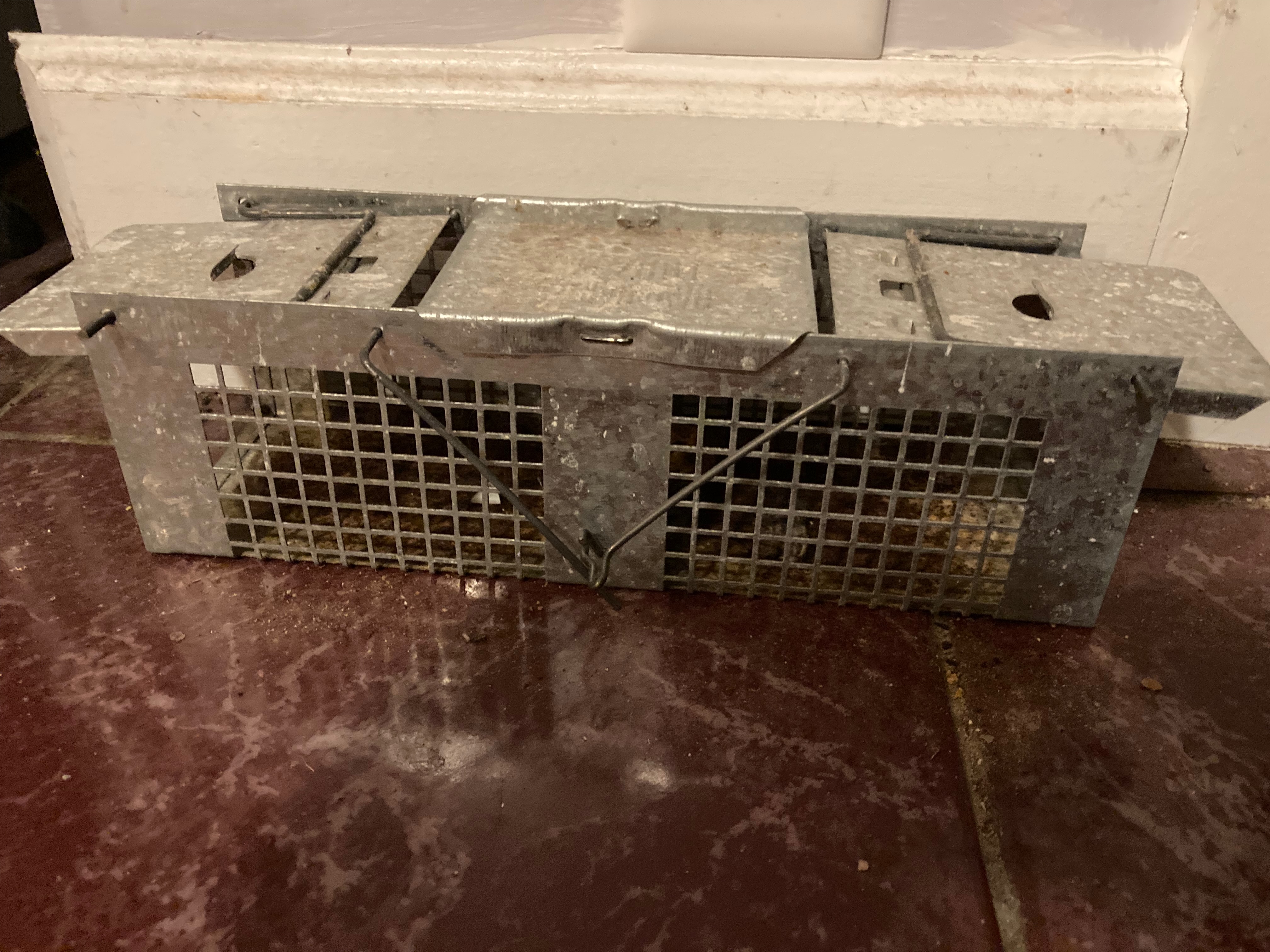
The only way I write my books is by living a regimented life.  It’s front loaded too.  Most of the work is done sometime between two and seven a.m., before starting work.  Disruptions to that time aren’t welcome, but then, many things in life aren’t.  Perhaps the most disruptive weekday event is when a mouse makes its way into the house.  We live in an old house and mice find their way into even more recent structures.  I can’t see killing them for doing what they’re evolved to do—we began using a humane trap when I found a mouse trapped by its paw back at Nashotah House.  I couldn’t stand seeing its distress, so we bought a cage trap that works pretty well.  Fortunately, we don’t get many rodentine visitors, but when we do, my crowded morning becomes even more busy.

I jog at first light and this time of year it’s straight to work after that.  I like to take our mice into the woods, far enough away that they’re not likely to find their way back.  Ideally that means driving, but since my wallet’s in the bedroom where my wife’s still asleep, during weekdays it generally means somewhere along the jogging path.  The trap is probably on the scale of a room at the Ritz for a mouse, and I don’t want to be scolded if I choose to release them in the wrong place.  I put the trap into a bag, for privacy.  Now, I normally jog to the trail but the trap rattles and I can’t imagine how horror movie this must be for a mouse.  Besides, running down the street with a bag in your hand in the dark isn’t at all suspicious.  Why not just paint a dollar sign on the outside of it and be done with it?

 I try to make sure the release spot is across a big road or a river.  There are places like that on the jogging trail.  But then, with the mouse safely released, I have to find an inconspicuous place to leave the trap in the bag so that early-morning garbage collectors don’t take it.  Jogging with a rattling trap is just a bit too strange for even me.  Although I’m an early jogger, I’m seldom the only one on the trail just as it’s light enough to see.  All of this adds up to considerable time carved out of my usual writing period.  And all because of a mouse.  The small can be significant.  Maybe I should write a book about it. 


Routine Weirdness

I’m weird.  Nobody has to tell me that.  Like most people, I suspect, with my mental condition, I value routine.  Although the time I post on this blog varies, that’s usually due to one of two factors—the wobbling of the earth, and whether I get wrapped up in something that makes me forget.  The wobbling earth changes the time of sunrise rather dramatically, of course.  I jog at first light and my routine before that jog is pretty solid.  Then something comes along to interrupt it.  I have to begin planning the day before how to make it all fit.  So, routine bloodwork.  The lab where I have it done is within walking distance.  Of course, you have to go in fasting so everybody wants to get there first.  The lab opens at 6:30 a.m. and this time of year vampires are still safe out and about at that time.  

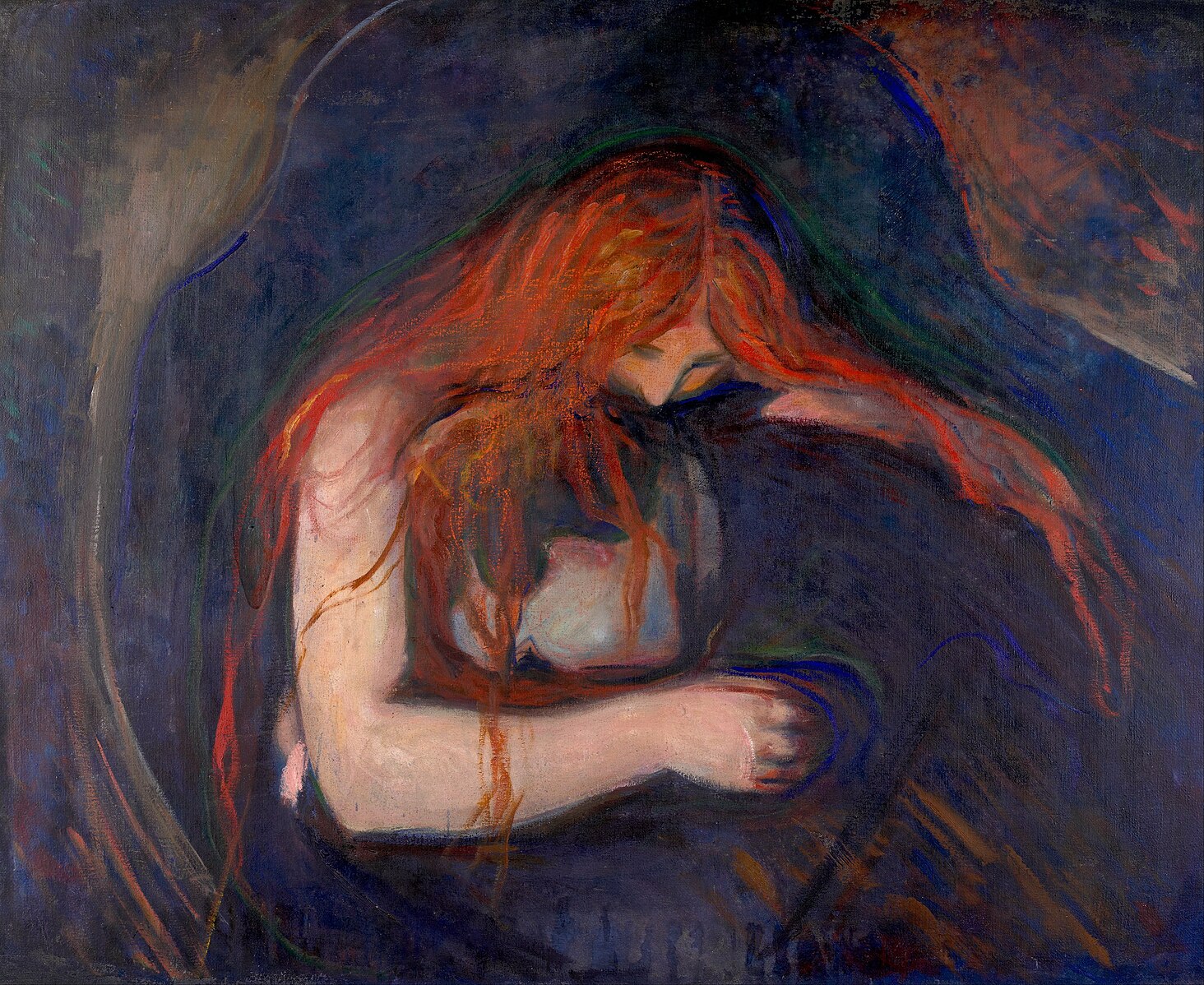
Edvard Munch, Vampire. Image credit: Google Art Project, public domain via Wikimedia Commons

But by 6:30 I’m usually dressed for my jog.  I’ve been writing and reading, typically for three hours.  I forgot to wash my jogging clothes this week and this was a Friday.  Hmm, better think about that.  Then there’s the whole question of my eating routine.  If I’m going to have something it has to be a couple hours before I jog—can’t do that with anything on my stomach.  Will I be too weak with nothing until afterwards?  After all I’ll be missing a vial or two of blood.  And there’s the matter of my shoes.  I only wear my jogging shoes on the local rail trail.  It’s pea gravel and it’s been raining lately which means they get a bit muddy.  All the rest of my shoes are in the bedroom where my wife’s (sensibly) still asleep.  Besides, I need to be on the trail right after giving blood, and changing shoes takes too long.

I’ll need to change my shirt when I get home.  The jogging tops are a bit too much to expect even a phlebotomist to put up with.  Besides, the under layers are tight-fitting since it’s only in the thirties today.  Why all this fuss about going to the lab before work?  That’s the magical word.  Work.  Also, lines have always been a problem for me.  Although I take a book I dislike waiting in line.  I need to get there before the doors open.  Be first in line.  There’s already a car in the parking lot, but standing beside the door in the cold has to earn you something, doesn’t it?  I’m back home just as the sun is rising.  Throw on my under layers and out before anyone else gets on the path.  I know I’m weird.


Evolution of Psychology

We are a fragile species.  Those of us who experienced childhood trauma carry it all our lives, even if it only seems to pop out unexpectedly from time to time.  This gets me to thinking about the evolution of psychology.  Not the discipline psychology, but of the human mental map.  Things that can upset a roomful of people these days would’ve washed over an entire village unnoticed yesteryear.  Did people then really feel as angry and breakable as we do now?  Please understand, I’m not advocating the view that people of previous ages were better, or even stronger than we currently are.  I just wonder if their circumstances made it so that what we think of as therapy wasn’t really necessary.  For one thing, much of human history has been dominated by short lifespans.  Historically, many women died in childbirth in their twenties.  The majority of men, until modernity, didn’t make it to fifty.  Sitting here musing, I’ve got ten-plus years on that and yet I wonder.

Those facts of life would’ve had to have affected people’s outlooks.  Our extreme squeamishness around reproduction also didn’t exist in antiquity.  Privacy, as we know it, wasn’t part of their world.  How many people see a therapist these days because of sexuality issues?  When did this turning point take place?  If we go back to early Cro-magnon, perhaps living in caves, did they come back traumatized from the hunt?  Surely they must’ve seen death on a nearly daily basis.  Today it’s difficult to get anyone to consider the mortuary sciences for a career.  We don’t like to think about death.  We pick up the phone and dial our therapists. 

When I was still teaching I thought often about how differently people framed their lives in the past.  It’s only now, however, that I’ve come to wonder about the psychological support we require.  I suspect life was, for most people, a literal daily struggle to survive.  Agriculture tamed the environment somewhat, and if current evidence is taken into account, religious gathering looks to have developed even in advance of that.  Perhaps the larger issues, what we still recognize as religion, helped to cope with the constant uncertainties of life.  Unfortunately, there’s no way for us to really get their mental maps.  We can read ancient writings, many of them pro forma or religious in nature.  We start to get some insight in pieces such as the Gilgamesh Epic, but that is so very brief.  I wonder when we started to require help going out the door in the morning or facing another day of the same old, well, you know.  Psychology had to evolve but it left so very few traces.  I, however, have an advantage in years great enough that I ponder our mental states.


Secrets

It’s a mystery.  All parents do it and even when you’re a parent yourself you’re surprised to find your parents doing it to you.  Keeping secrets, that is.  Parents have their secret lives that they don’t tell their children, and when we’re given a glimpse into that life sometimes we’re shocked.  My mother kept a diary.  Not religiously, and not for much of her life.  I inherited one volume, and I’m afraid to read it.  I tend to be an honest guy.  I try to answer my daughter’s questions with complete openness.  There are, however, some things I won’t talk about.  My secrets.  And despite the fact that I reveal something of myself daily on this blog, I do have many parts of my life that remain unrevealed.  Those of us who write sometimes don’t want everything we put down to be read.  Or maybe we do.

I used to keep a diary.  It was partially to remind me but also, in part, to explain myself.  It’s quite personal and I lost maybe two or three volumes of it years ago.  I stopped keeping it after I got married.  I guess I figured a Ph.D. and publication record would do the job for me.  Probably those missing volumes were with stuff left at home that Mom unwittingly threw away, like our old baseball cards from the early seventies.  Some of my stuff got damaged by water, foreshadowing what’d happen when we moved.  Perhaps they were thrown away then.  They had secrets, I’m sure.  Our private lives are a mystery to others.  That’s one reason that I try to be kind whenever possible.  We don’t know the burdens that others carry.  Why add to them by a sharp reply?  Even typing this, I’m not sure it will end up on the blog or not.  Other pieces haven’t.  Secrets.

Photo by Yogesh Pedamkar on Unsplash

Some intelligent animals try to hide things.  Corvids, for example, look around to see who else is there before hiding food.  I once saw a doe giving birth.  She was in a secluded glen in the early morning and I just happened to be jogging quietly by.  I’ve started multiple autobiographies.  I’m not sure anyone has an interest in reading them, but I have hope.  Despite my secrets, most of which I keep out of the autobiographical musings, I know I have a story to tell.  That’s why I keep at this blog, day after day, year after year.  It brings no money and has only a few followers, but it’s a chance to tell my story.  Even if I keep the secrets closely guarded.


End of the Story

You know that feeling?  Like when you’re driving in thick fog and you know you should stop but you’re late and you have to keep going?  There comes a moment as you’re driving when you know that it’s going to end, and probably badly.  Yet you keep on going.  Trump has me thinking of the end of the world quite a bit.  I know there are many evangelicals out there praying for it fervently while the rest of us would like a little more time on this beautiful planet.  I’d be lying if I said I didn’t understand this outlook, because I do.  I grew up with it and I’ve never forgotten the sensation it caused.  And then I pondered that we are story-telling, and story-thinking creatures.  Perhaps other animals don’t think this way, but we constantly tell ourselves stories.

A story has a beginning, a middle, and well, eventually, an end.  We all know, at some level, that we’re mortal.  Life will end, and every completed story has an end.  Why not the world?  It’s a strangely haunting idea, the world continuing on without us here to make it interesting.  Plants will grow in any soil they can find, even microscopic cracks in the pavement.  Every year it’s like one day everything is suddenly green where only the day before we could see the sky through the branches.  And animals continue their quests for food, mates, and shelter.  Some live to hide while others strut.  Each has a role to play and if you watch them closely you’ll find yourself narrating their stories.  That rabbit.  That bluejay.  That fox.  They have a beginning, middle, and end.  If they can’t tell it, we can do it for them.  It comes naturally to us.

Long ago I learned how one version of Bible interpretation came up with the end of the world as we know it.  I also learned that this was contrived, just as all interpretations are.  This particular one has landed, like a seed, in the cracks of our mind.  It grows, just like that weed in the pavement.  This story must have an end.  We can imagine it no other way.  Even when we grow up and realize that the story was only one we told to children—children old enough to handle it, of course—we still have this certainty that an end is coming.  Like driving in the fog, we just know it.  Even when we realize that in reality we should be putting on the brakes.


Little Things

Those on anti-clutter campaigns (whose lives I can’t imagine) claim that we have too much stuff.  That may be true, but when you reach a certain age these realia can serve to remind us where we’ve been.  How we’ve become who we are.  We moved to our house in a whirl.  Neither my wife nor I had enough vacation days to take any time off and we had to move 55+ years of stuff over a weekend.  Lately I’ve been going through some of the boxes of little things you keep.  They were generally mixed in with papers I didn’t have time to file, bits of hardware, and a few things I’m not sure why I kept.  In the archaeology of my life, the layer labeled Nashotah House retains a prominent place.  It took many years before I could look at my little Nashotah House things without being overwhelmed by emotion.  Nearly twenty years on, I hope I’m beginning to get over it.

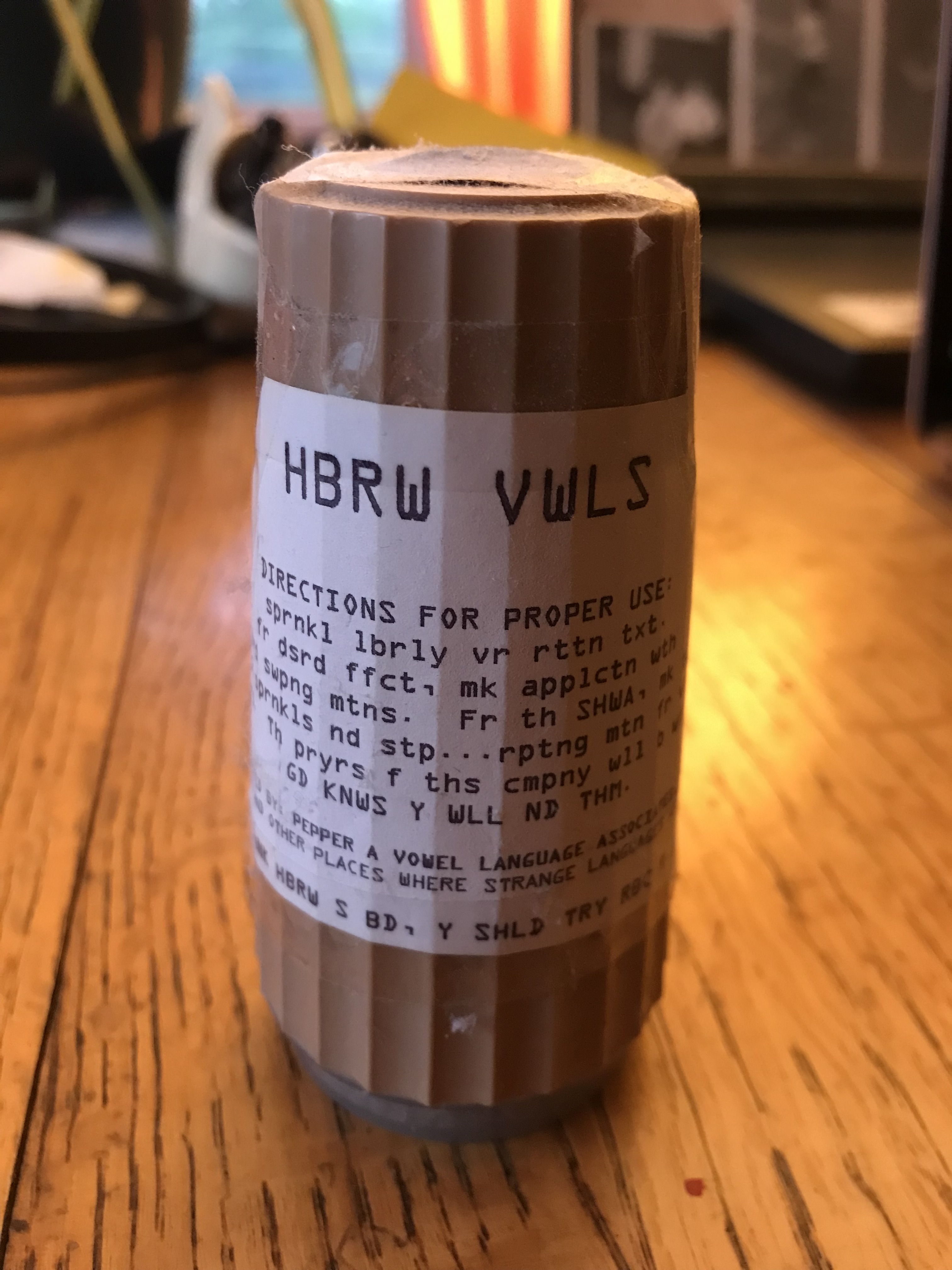
One of the little things I unearthed was a pepper shaker.  One of my students (now sadly departed) had made a label to express her frustration and humor at trying to learn Hebrew as a mature woman.  I’m probably now the age she was then.  This little artifact has been with me through a great number of momentous changes in my life.  It can still bring a little smile, however.  I see it and I remember Judy giving it to me with a laugh.  I probably shared it with the class.  Even now it has two-decade-old pepper in it.  The declutter experts would say it belongs in the dumpster.  They’re wrong.

Nashotah House was the only job on offer following those intense Edinburgh years.  As all of these things recede further and further into the past, they become more valuable.  No matter how small, these objects played a part in what I remember and rubbed me in a way that influenced my shape.  I don’t know what that final shape will be, but I jealously guard my little things, these boxes of years.  They are points of contact between my life and those of others.  I found many other pieces of myself in these miscellaneous boxes.  I know that someday, all things being equal, this stuff will probably end up in some landfill somewhere, waiting for some future archaeologist wondering what realia we kept back in the years when the world went insane.  And if s/he is really brave, they might even try some of the pepper on their future lunch.


Decide

Decisions we make when we’re young influence our entire lives.  It’s not that you can’t change course—I’ve seen it happen and it can be a thing of true beauty—but the fact is our young lives become our old lives, if we survive.  I’m now in my sixties.  I reflect a lot about my youth and the fact that I grew up in an uneducated, blue-collar family.  I had no idea what college was, and had not a minister convinced me that I might have the right stuff, I would probably never have gone.  It was foolish in a way.  My family contributed nothing financially—they couldn’t afford to.  I started with optimistic scholarships that eventually became less sanguine and I had to borrow more and more.  Once I’d begun on that path, however, turning back looked to be nothing but disastrous.

The internet allows us glimpses, only glimpses, into the lives of those we knew in our younger years.  Many of my surviving high school friends (and that number decreases every year now) have followed paths to their current situations.  I didn’t know them well, perhaps, but they too seemed set to follow in the courses of their lives.  I really hope they’re happy.  I hate to see anyone sad.  Still, there’s a melancholy captured well by a rabbi, who it is I can’t remember, who once said “You can either be wise or be happy.”  There’s an almost kabbalistic truth nestled in that sentiment, it seems.  Your rudder is small and the ocean is very, very big.  As a penurious boy living in an economically depressed refinery town, I never dreamed I’d have the privilege of living in Edinburgh for three years, with a wonderful wife, no less.  And yet, and yet.

The course of my life is not over yet (I hope).  Every day I make hundreds of decisions but none of them seem as momentous as the ones I made before I had seen much beyond rural western Pennsylvania.  I know this is true of others as well, reacting to the pain and angst of the moment, they turn to whatever gives them comfort.  For me it was books.  And church.  The course of a life.  And in a way that will only make sense of those who knew me in high school (none, or very few of whom ever read this blog), when I do my daily exercises, they always include twenty-two push-ups.  A number that, mystically, corresponds to the number of letters in the Hebrew alphabet.  Way stations along a curriculum vita.


For the Camera

Smile 2 is getting some good critical notice and I hadn’t seen Smile (1) yet.  Psychological horror often bothers me, but I figured I’d grin and bear it.  I’m glad I did.  The ideas in the film, which participates in “the stigma trope,” are disturbing because it’s unclear if Rose (the protagonist) is mentally ill or not.  The stigma trope posits that something has infected someone either by having seen something they shouldn’t (as in Ringu) or by physical contagion (It Follows) and the victim can’t shake it.  Smile may trigger viewers with suicidal phobias since the premise is that an entity feeding on trauma passes from person to person by having the new victim witness the previous victim’s suicide.  Rose is a therapist who hasn’t gotten over the trauma of her mother’s death.  Rose witnesses a patient die by suicide, and who smiles just before she does it.

The patient told Rose that she’d watched one of her professors die by suicide.  Rose subsequently learns that the professor also witnessed a suicide and so on and so on.  Each prior victim had watched someone else die.  Now Rose has to figure out how to break the cycle, otherwise she’ll perpetuate it.  The idea of inadvertently obtaining a “sticky” entity is pretty scary, and a very human concern.  One of the more frightening aspects of possession movies is the belief that now that demons know that you know, they will target you.  Interestingly, what makes this film provocative is that the victim has to have suffered trauma before.  As such, it is a study of trauma and its lasting effects.  I suspect most people don’t intentionally traumatize others (world leaders excepted).  Trauma can be dealt with (or not) in very different ways.

Smile did quite well at the box office.  I suspect there are a lot of us traumatized people around.  Capitalism encourages traumatizing others through slow violence, if not the more obvious quick way.  People don’t easily walk away from events that scarred them, particularly if they happened at an early age.  Such people, if experience is anything to go by, find themselves in vulnerable positions in life and rather thoughtless people, often for religious reasons, end up traumatizing them even further.  I have to admit that there were triggers for me in Smile.  I still struggle with a few of my own traumas that were never resolved.  Like Rose, I sometimes don’t know who can really be trusted with such things.  This is a perceptive movie.  I guess now I can put on a happy face and see Smile 2.  But first I’d better talk to my therapist.


Thinking Thinking

Something that’s been on my mind (anticipatory pun) lately, has been thought.  More especially, the quality of thought.  We are conscious beings, although we’re not sure what that means.  Beyond a Cartesian self-awareness.  Everyone knows what it is to have times when you’re not thinking clearly.  Or are feeling confused.  Those of us who tend to live quasi-monastically (keeping to a routine, early rising, writing and reading daily before the 9-2-5 routine) notice the ways subtle things can influence the quality of our thinking.  For me, first thing in the morning is the best time.  (Although I must confess that lately I don’t wake up with the crystalline clarity that I have for years, as if sleep is beginning to intrude on my earliest hours.)  Once I’m up and going, though, routine, you’d like to think, would provide the same results.  But it doesn’t.

Photo by Pierre Acobas on Unsplash

I’ve written before how the quality of sleep can affect the quality of awake thinking—something we’ve all known all along.  But even when I have somewhat identical nights (same quality of sleep more than one night in a row), the subtleties of difference in thought persist.  To understand this, you need to realize that I’ve been rising well before the sun for a dozen years now.  I awake to a quiet house and spend a couple, sometimes a few, hours writing and reading.  (It’s how I write my books, as well as this blog.  And my fiction.)  Even on “identical mornings” where the weather’s pretty much the same, and all other factors seem equal, the quality of thought differs.  Sometimes it depends on whether I’m writing fiction or non.  As I transition into my reading time, that can make a difference in the reading experience.  I suppose that’s one reason I value good writing.

We don’t understand consciousness.  Identity is also somewhat negotiable at times.  We’ve all known a family member or friend to act “not like themselves.”  More to the point, to think not like themselves.  We have no real way of understanding thinking itself.  I think about thinking quite a bit, and I marvel at how intensely personal it is.  We may, at our will, keep our thoughts to ourselves (and that’s a good thing, in many circumstances).  Thought, it seems to me, ought to be a very high priority in our academic pursuits.  It’s a powerful thing, capable of more than we’re even presently able to imagine.  And it can differ from day to day.  Do you suppose I wrote this after writing fiction or non?


Work for Good

You learn a lot as a primary caregiver.  Since dealing with a family cancer diagnosis last year I joined a local support network for caregivers.  Three things I’ve learned: healthcare is very uneven, we ended up in a good facility, and finding a social worker on your own is very difficult.  I see lots of messages on the support boards from people in poor facilities that can’t find the help they need.  I know what social workers do—I had several friends who majored in social work in college—but in this age of all the information in the world at your fingertips, just try to find a social worker!  I was trying to find a website to suggest to a person on my board who didn’t know where to turn.  Searches bring up links to places trying to sell you their services to find a social worker.  Are we really that callous?  

People tend not to try to find a social worker unless they really need one.  Many people, I suspect, wait until they feel pretty desperate.  This is not when you need some salesperson trying to sell you something.  Medical care can be very expensive—devastatingly so—and there are professionals out there who specialize in helping you get through such things.  Why are they so difficult to find?  I tried government sites that seem more interested in telling you how to become a social worker than how to find one.  If we’re in such a state that we don’t have enough social workers why don’t we pay them more?  Here’s a hint, most politicians could stand a salary cut.  My college friends all said they knew it didn’t pay well, but social work was a way to help people. Saints still walk among us.

We have the means to help everyone.  What we lack is the will.  We continue to let capitalism and the hope of individual wealth run our economy.  Economy means nothing without people.  And we have many people who are willing to receive less personally to help others get by.  Why do we have to hide them behind a pay wall?  What does that say about us?  We’ve been fortunate.  Our medical facility immediately put us in touch with a social worker.  If, however, you end up where healthcare choices are limited, or don’t know how to find a social worker on your own, the internet’s not a great resource, unless you want to pay someone to help you find help.  What have we become?


Using Brains

I’m old enough to know better.  Here’s a thought.  I recently saw a headline that suggested human brains filter out things like ESP because brains evolved to help us survive.  No matter what you believe about ESP, the idea got me to thinking.  We often act as if our brains are able to determine the Truth (that capital is intentional).  At the same time we don’t understand what consciousness is.  We know that other animals have brains and that the evolution of said organ is to help individuals survive to reproduce.  Some animal species end their existence at that point, but others linger on to wonder.  And I’m wondering if our brains are filters.  Stick with me here: we know that there are stimuli that we can’t perceive that other brains can.  For example, it seems that migrating birds can perceive magnetic fields.  Even if they can’t there are magnetic fields that we perceive only through their effects on objects.  Our brains have no direct access.

Image credit: Andreas Vesalius‘ Fabrica, showing the Base Of The Brain, by user Ancheta Wis

Here’s where it gets spooky.  If our brains filter out things that may hamper us in survival, what if they overzealously teach us not to perceive things that actually exist?  We’re somewhat limited by our “five” senses, no doubt.  We get along okay.  But what of those people who see things that others don’t?  We tend to medicate them or lock them away, but what if their brains have learned how to shut off part of the filter?  Having written a book about demons, naturally they come to mind as a test case.  Or, if you prefer, ghosts.  We tell our children these things aren’t real.  Trust the filter.  Get on with life in “the real world,” right, Cypher?

I didn’t have time to read the article, but I’d experienced a perspective shift.  If our brains are all about gathering information (and in part they clearly are), that’s one thing.  If they are actively filtering things out, well, that’s quite another.  We laud the imagination of children until they become “old enough to know better.”  Do we teach them to shut out what they can actually see, or sense, in order to accept the inevitable, material, adult world?  This idea has startling implications.  As we plunge ahead inventing AI to do our thinking for us, perhaps we’ve left something even more fundamental behind.  Have we lost interest in the Truth?  We may not be able to access it directly, but I wonder if we’re taught to give up without even trying.