Who’s Calling?

The first twenty minutes are impossibly scary.  I didn’t see When A Stranger Calls back in 1979, when it came out.  I prefer my monsters in non-human form, thank you.  But still, to be writing books on horror movies without ever seeing what is widely regarded as being the scariest opening ever?  Although the first twenty minutes were indeed scary, and extremely tense, for me the scariest part came after that because I didn’t have any idea what else would happen.  Of course I knew the initial calls were coming from inside the house.  That urban legend seems to have been around since I was a kid.  I wasn’t sure who survived, if anyone.  And psychopaths are scary in real life, let alone in fiction where they can break into locked houses pretty easily.
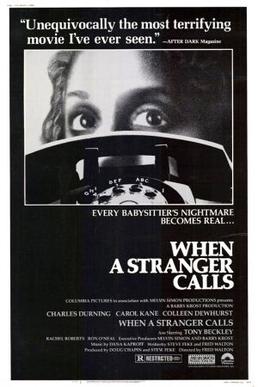
The story, as laid out, is better than most critics give it credit for being.  The only part that seemed difficult to believe (and don’t get me wrong—I love Charles Durning) was that an overweight John Clifford could do all that running (particularly up stairs).  It’s believable that the criminally insane can escape—Michael Myers seems to do it every couple of years—and even that they could blend in on the streets of any city.  I do have to agree with the critics that the writing isn’t great, but those who say it’s not scary enough, well, they’re made of sterner stuff than me.  Or perhaps they lack empathy, which is a scary thing in itself.

Curt Duncan, perhaps because he’s clearly killed at the end of the movie, never became the serial boogyman that the aforementioned Myers, or Jason Voorhees, or Freddy Kruger, or Hannibal Lecter became.  Although sequels were made, once you’ve seen that first twenty minutes of Stranger, you get the sense that they’re not going to be able to do it any better.  Snopes tells us the legend began in the sixties.  It was clearly a reaction to the proliferation of telephones and the potential to abuse such technology.  That’s an object lesson we still haven’t learned.  We now seem never to be more than inches away from a device at all times.  Except maybe when in the shower, but that’s a scary story for another time.  Although I won’t be going back to rewatch or analyze this one over and over, still I feel I somehow earned a stripe or bar for watching it.  And I now feel even more appreciative of caller ID.

October Early

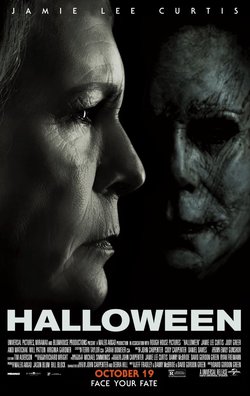
Still feeling that August is the new October, although that particular day happened to reach over ninety degrees, I watched Halloween.  Not the John Carpenter original; I’ve seen that one a few times before.  No, I watched the 2018 version only to learn it’s a retcon.  If you’re like me you’ll wonder what a retcon is.  It’s a portmanteau of “retroactive continuity.”  That’s where a sequel goes back and makes adjustments, or simply ignores, story elements from the original to take the story forward.  I haven’t followed the Halloween franchise.  There are too many movies I want to see that are original, with fresh ideas, to be spending my time trying to find my way through an emerging mythology of a serial killer.  Michael Myers, as horror fans know, inexplicably killed his sister as a child.  As an adult he terrorized Haddonfield, Illinois  one Halloween and Laurie Strode was the final girl.

What drew me to this sequel was that Jamie Lee Curtis was back as Strode, all grown up.  Michael predictably escapes again and goes for an even higher body count in Haddonfield.  Laurie, meanwhile, has gone NRA and booby-trapped her entire house in anticipation of this day.  You can see the draw, I hope.  You kind of want to see how this ends.  The original had Michael’s apparently dead body disappear at the end.  In the retcon he was arrested after that and re-institutionalized.  The thing is, you can never really kill a monster.  Original scenes and scenarios are revisited, and those familiar with the Carpenter story are rewarded by situations that subvert expectations.  Where is he hiding this time?  You always watch the credits roll wondering how “the authorities” don’t realize that a guy shot, stabbed, and incinerated and keeps coming back might be something other than human to be put in an asylum.

I should know better than to watch these kinds of movies when I’m home alone, but I don’t.  So it’s a good thing that I try to piece all these things together.  We have three strong women—three generations of final girls here, and the obligatory basis for a sequel.  (At least two, in fact, bringing the franchise up to thirteen movies.)  Laurie’s granddaughter is among the virginal, non-drinking final-girl prototypes.  Her less Puritan friends are killed off, although her worthless boyfriend survives the night.  You’ve got to love the endless self-references of such situations.  That’s why we keep on coming back.  We’ve seen it before but we still want more.  Even if it’s only August.