
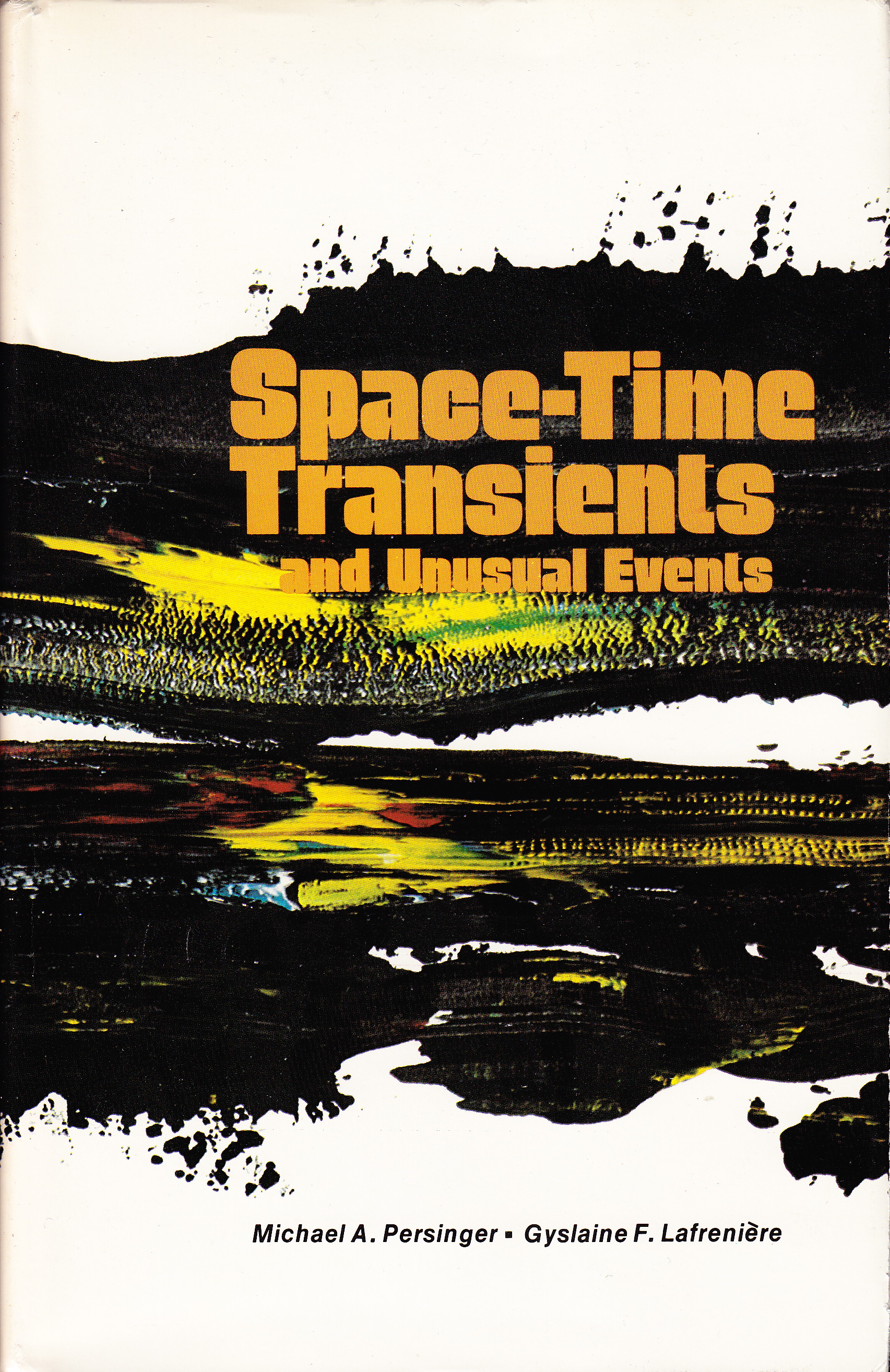
 Michael Persinger is a curious and rare scientist. Apart from occasionally making it onto Through the Wormhole episodes, he is also known for his somewhat unorthodox willingness to ask unfashionable questions. I just read his book, co-authored with Gyslanine Lafrenière, Space-Time Transients and Unusual Events. What makes Persinger (the lead author here) so unusual is that he is willing to admit that unusual events happen. Most scientific studies begin with the assumption that the uncanny is unreal, and that people who witness the unusual are unbalanced. Most of us, I would venture to say, have noticed that strange things do happen from time to time. Those who read all the way through Space-Time Transients may be surprised to discover that Persinger and Lafrenière offer an empirically-based hypothesis that places many unusual events squarely in the realm of scientific explanation. The acceptance of woo this is not.
For an old religious studies student, such as me, it is refreshing to see scientists at least asking the question rather than sweeping all the unorthodox evidence off the table. Not everyone who has experienced a fall of fish from the sky or a poltergeist in the bedroom is a deluded liar. Strange things do happen. Space-Time Transients, however, asks what seems to me the perfectly logical question: what’s going on here? Yes, some accounts are exaggerated. Others are fabricated. Still others clearly remain. Should we call names or should we try to figure out what is behind all this? One of my favorite unusual events is the coincidence. There may be nothing supernatural at work, but the oddity of the situation leaves us wondering. Shortly after being hired by Routledge, on my way home through a very crowded Times Square, I saw someone crossing Seventh Avenue drop a five-dollar bill. This person was hurrying in the opposite direction from me in the midst of a crowd, and was far enough away that calling out “you’ve dropped some money” would have only caused a feeding frenzy. It was only a fin. The next morning, coming to work over on Third Avenue, I found a five-dollar bill on the pavement. With the exception of pennies, just about all the dropped money in Manhattan is quickly scooped up by the needy. Could this have been the same dropped bill from over twelve hours before, on the other side of the island? Perhaps not. But why a fiver in both cases? Money does not grow on skyscrapers. The story gets even weirder, but you’re not here to read about that.
Scientists who are willing to admit that strange things happen (the names of Rupert Sheldrake and Dean Radin come immediately to mind) often face difficult times being taken seriously. They are, however, asking the big questions. Ironically, it is often the notice of strangeness that leads to advances in science. As one quip has it, science grows not because an observer says “Eureka!” but rather, “that’s strange.” In a world where strangeness is associated with religion, and religion is for the deluded, we have perhaps cut off an obvious avenue for learning about our strange universe. As Persinger and Lafrenière point out, we live in a very small habitation, viewed as a cross section of a planet that is itself not terribly massive, in an infinite yet expanding universe. To think that we’ve figured it all out by now is perhaps the strangest idea of all.
 Steve A. Wiggins