
Friday the thirteenth. The very concept awakens images of horror movies and inauspicious happenings. An interview with a Psychology professor at Rutgers recently discussed this unusual phobia. Mike Petronko of the Graduate School of Applied and Professional Psychology had this to say: “Exactly how this got started is difficult to say, but the belief appears to date back to ancient times. Often, superstitions are rooted in religion. Some folklorists believe the fear may stem from the Last Supper, when, according to Christian belief, Jesus and his 12 disciples gathered for the final meal, which set the stage for his crucifixion, on Good Friday.” There is no doubt that the origin of the superstition is religious and that Fridays earned their notorious reputation because of Good Friday. Even today, as any Roman Catholic can tell you, Friday dietary requirements differ from those of other days.
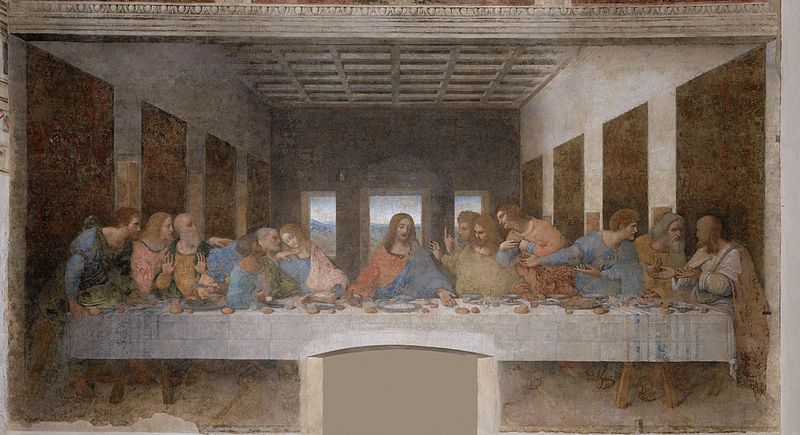
But wasn't this a Thursday?
Thirteen is a little harder to pin down. It is a prime number after ten, but then, so are eleven and seventeen. It may have its unlucky associations back in the old Mesopotamian base-six numerical system. Once you reach past the first doubling of six you meet thirteen. Even today hotels are designed with no thirteenth floor, although pasting a fourteen over the actual thirteen is merely for psychological relief. Mathematics insists thirteen follows twelve. As Petronko notes, the fear is real. Airliners do not have row 13 and hundreds of millions of dollars of revenue are lost because so many people refuse to engage in regular practices (such as flying) on Friday the thirteenth.
Religion and fear are not strange bedfellows. In fact, religion, in its earliest origins, seems to have been a coping mechanism for fear. People are afraid of many things – that is the curse of consciousness. We can anticipate eventualities that will never materialize. We imagine them happening to us. Religion seeks to placate those forces that are beyond our control. We may lay claim to a highly advanced and technologically sophisticated society, but millions of people are anxiously awaiting the end of this day. Rutgers, like most universities, hardly sees the need to fund the study of religions. Nevertheless, our very culture belies that indifference. Many people are afraid today and we still don’t even know why.
 Steve A. Wiggins