
I watched Oculus for two reasons: it kept coming up as a “freebie” on a service I use, and I’d been thinking about haunted mirrors. Well, three reasons—I also liked the sound of the title. (Not all decisions are a matter of science.). I was pleasantly surprised that it turned out to be pretty good. I’ll probably throw in a spoiler or two, so if it’s on your list, you’ve been warned. Kaylie and her brother Tim were attacked by their parents, but Tim was being framed by the mirror. Both parents attempt to kill the children, but end up dead instead. Tim is sent to an institution since he pulled the trigger, and Kaylie has spent eleven years researching the mirror. When her brother is released she convinces him that they have to keep their promise to destroy the mirror.
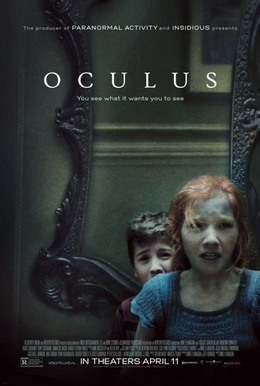
The problem is, the mirror messes with perceptions of reality. The two go back to their childhood home where Kaylie has set up a device to drop an anchor onto mirror. This is set to happen with a wind-up timer since the mirror can control electronics. She’s also set up the room so that everything is being recorded. If she can prove the mirror is what she believes it to be, her father will be exonerated and her brother proven innocent. The movie gets a little tricky to follow since their current story is intercut with flashbacks as to what happened when they were children. Also, the mirror records events on the cameras that didn’t really happen. Add to this the fact that Tim has undergone therapy for eleven years and he’s convinced that his sister is delusional. It’s one of those movies that messes with your perception of reality.
When Tim doesn’t see his sister in front of the device meant to destroy the mirror, he accidentally kills her. The police arrive, believing he has repeated his murderous attack from eleven years before. The ending is rather nihilistic, but the scares are effective. There are a few gross-out scenes and some jump startles, but overall it is the story that conveys the fear. For me, the mental issues were almost triggers. But then again, I watched it on a day when I was a bit fuzzy-headed because of waking up too soon. I really didn’t know what to expect when I hit “play.” I’ve done that enough times and ended up with films that were wastes of time, so I was glad to have found a competent one this time. These are my reflections, in any case.
 Steve A. Wiggins