Good Horror

As strange as it may seem, my goal in life has always been to bring more good into the world.  As they phrase it in Nerdfighteria, helping “to decrease world suck.”  There are many ways to do this—give encouraging words to others in a cancer support community, volunteer time (structured or otherwise) to civic organizations, even trying to help make sense of it all through an obscure blog.  My motivation in entering teaching as a profession was to help make the world a better place.  (Also, I’m pretty good at it.)  When that fell through as a profession, I began yet another odd way to try to bring good into the world.  Writing books about religion and horror.  Please hear me out—this is part of a larger plan which, in the nature of plans, may or may not work out.  It involves getting people’s attention for a moment (kind of like teaching).

There are a significant number of people who enjoy horror.  The vast majority of them are not bad people.  They find something enjoyable, or cathartic, or perhaps even spiritual in consuming horror.  I’m one of them.  My piece “Exorcising The Pope’s Exorcist” appeared yesterday on Horror Homeroom.  (Hey, it’s free—check it out!)  Exorcism, as a social/religious phenomenon, owes its popularity to a horror movie.  And if the rite brings some measure of relief to someone suffering mentally, spiritually, or physically, it has decreased—you guessed it—world suck.  It makes this planet just a little bit better for a little while.  Movies that promote exorcism can, believe it or not, help people.

Some time back I was invited to offer a course at the Miskatonic Institute of Horror Studies.  I am deeply honored because if you look at the list of names of past (and present) teachers there are some superstars in there.  By the way, my course is titled “Believing in Sleepy Hollow.”  (Maybe those of you who read daily may now understand why I’ve been posting so much on Sleepy Hollow of late.)  Teaching a course that will bring enjoyment to others is a way of bringing a small measure of good into the world.  Once you leave secondary education, you’re never obligated to take a course.  It’s something we want to do. That means if someone gets something out of my course I’ve brought just a little bit of good into the world.  It counts, I hope, toward my life’s amorphous goal.

Wrong Entity

In one of those weird synchronicities the universe likes to play, the very next day after I watched The Entity (2015) and wrote a blog post on it, this happened.  In yesterday’s post I noted that I couldn’t remember where I’d read about the movie, or who had recommended it to me.  I couldn’t even be sure which The Entity it was, since I didn’t write down the movie’s date.  The next morning I had the privilege of watching Claire Donner, of the Miskatonic Institute, talking about The Entity and it immediately came to mind that it was she who’d suggested I might like it (or might not).  Also, that I got the wrong one.  I haven’t had the opportunity to watch the one actually recommended yet, but it brings back to mind just how the Miskatonic Institute contributes to understanding horror.

The Institute has asked me to present a course this coming October and I will be posting more on that closer to the time.  It got me to thinking about a couple of things.  One is that I missed some major horror films growing up.  When I “got religion” in high school (I always had it, of course, and saw no problem with enjoying monsters too) I began to steer away from horror.  In college I had a dating occasion or two to watch horror, but it really only started again in earnest after being booted out of academia.  I was interviewed in seminary by a sociology grad student interested in why people watch horror, but my watching was (and still is) circumscribed by lack of cash flow.  The Entity made quite a splash in the early eighties, but it took someone in the 2020s telling me about it before I realized I probably should watch it.

The other thing Donner’s talk brought to mind is how religion and horror relate.  Such films are scary because of an existential threat—THE existential threat.  There’s nothing more powerful than God, but in such movies God can do nothing.  I haven’t seen the movie yet, but I suspect that’s true.  It’s certainly true of The Exorcist, with which it’s sometimes compared.  God doesn’t deliver Regan McNeil, no, Fr. Karras does.  And only by sacrificing himself to do so.  The existential threat has to involve a universe entirely out of kilter.  What is a God that’s powerless (it’s implied) to drive out evil?  The exorcism in The Exorcist doesn’t work, does it?  Yet there’s some benevolent force in the universe that gives us synchronicities and, it seems, is looking out for goodness in an often cruel world.


Truth and Belief

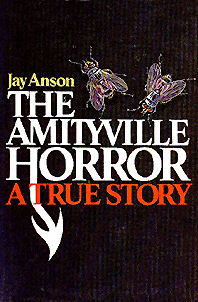
I met Claire Donner the way I meet most people these days.  Online.  I’m not sure how she found me in this dusty little corner of the internet, but she has one of the coolest jobs of all time: the New York City Director of Miskatonic.  If you don’t know Miskatonic, and if the title doesn’t at least give you a hint, you need to go back to your Lovecraft.  Its full title is Miskatonic Institute for Horror Studies.  They also have offices in London and Los Angeles.  Miskatonic offers a variety of one-session courses on horror and Claire had emailed me about the vexed idea of the nature of belief as it relates to horror movies.  Her course on the Amityville Horror—“‘Based on a True Story’: The Importance of Audience Faith in The Amityville Horror”—was excellent.  It left me in a thoughtful mood.

The way that I write books is that I have several projects going simultaneously.  Eventually one reaches critical mass and starts a chain reaction until it gets finished.  One of those projects that hasn’t yet attained critical mass is on Ed and Lorraine Warren.  It’s such an avocation that on a visit to Jim Thorpe on a family trip, I stopped into a shop where the owner proudly displayed articles about the Warrens in his window.  I asked him about the Warrens—whom he knew—but I wasn’t prepared for an interview (and I’m sure, neither was he).  Meanwhile, relatives waited patiently outside.  One thing I’m pretty certain about is that the Warrens sincerely believed in most of what they were doing.  There are nagging loose threads, however, that suggest they kept the financial angle firmly in mind.

To bring this back to Amityville, the course raises the question of the Warrens’ involvement.  They were among the earliest of “investigators” to take what was largely a hoax seriously.  They, however, didn’t get a cut in the profits.  I suspect this is what launched them into their promotional activities.  That book and movie combo brought in, and still brings in, the cash.  Who wouldn’t feel cheated?  But still, there’s belief.  For many of us belief requires some evidence, some tangible trace of truth.  These are the kinds of things explored in this fascinating course.  Horror and religion have been bedfellows for a very long time.  They often converge on this concept of belief.  There’s so much more to the Amityville Horror than meets the eye, even if we all know it was largely a hoax.