A Concept

Pardon me for being perplexed in public. You see, things aren’t as clear cut as they used to be. In the world in which I grew up Evangelicalism was good and Satanism was bad. Very bad. It still has the ability to scare people straight. A recent NBC story my wife sent me titled “Satanic Temple challenges Missouri’s abortion law on religious grounds,” by Corky Siemaszko, shows how the GOP has turned the tables on this equation. The Christian Right has utterly aligned itself with the pro-life camp. Most people would agree, I suspect, that abortion shouldn’t be the first choice of birth control options, but life comes with many unpredictable circumstances. There are times abortion is the most humane option and the burden falls almost entirely upon women. It’s not an issue on which men are competent to decide.

The evangelical posturing on the issue—which has, by the way, changed in recent years—has placed the weight fully on women. A rutting male, like a bull elephant in musth, can hardly be responsible, so the thinking goes. Or, to put it more politely, boys will be boys. Women suffer on the tusks of this tautology; it’s no wonder Satan has horns. Only women conceive, so men can make the laws and feel empowered by a male god who, you know, understands where they’re coming from. Missouri Satanists are striking back. The problem is the state requires women to be presented with indoctrination that says life begins at conception before electing for an abortion. Does life begin at conception? The Bible says “no.”

Biblical science was primitive. Ancients understood there was a connection between sex and pregnancy, but infant mortality rates ran very high. Life, in the biblical view, started at first breath. Spirit, breath—the very word for “soul” in the Bible—was the marker of life’s origin. The Bible may not advocate abortion, but in a world where few children made it past five, there was a shortage of surviving progeny. So it turns out that in Missouri Satanists are actually advocating the biblical view while the Evangelicals are violating the constitution by misreading it. Life begins at conception isn’t a scientific premise, it’s a theological one. A theological one on which Christians disagree. And Satanists. In their efforts to keep men on top of women, the Christian Right has no support from the Good Book on the matter of conception. Of course, why read the Bible when you can get what you want by quoting only your favorite verses? After all, God, they say, is a “he.”
Eye in the Sky

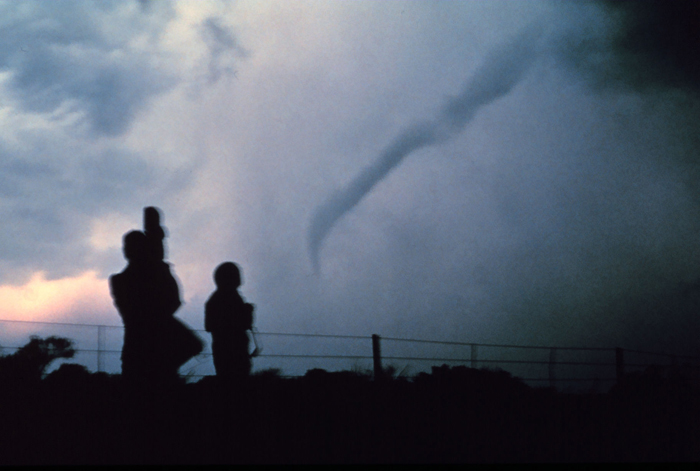
No one is safe. The calamitous tornadoes that have been devastating the south are indeed tragic. Some years ago while working on my weather in the Psalms book, I experienced a brooding fascination with tornadoes. Since I was living in Wisconsin at the time, this was natural enough, but the facet that always gleamed the darkest was the arbitrariness of it all. Tornadoes are notorious for destroying one building while leaving the one next door unharmed in a rapture-like abandon. And there are those who claim the righteous survive while others soberly state the good die young. The fact is life always ends in death, and if tornadoes don’t get you, earthquakes, comets, or microbes will. Our religions help us cope with the fact that consciousness leads to a sense of victimization—things are always after us. Religions teach us that something (God, spirits, Tao, karma) will balance it out. We so hate to see the bad guys win.

Tornadic devastation does have the divine edge, however. Apart from the randomness are the celestial origin, the sharp distinction between those reaped and those sown, and, of course, the angry brow of the frowning wall cloud. What is purely a natural event feels like punishment from our species-specific view. And who doles out the punishment if not a parent stronger than the cowering children? Does religion reassure in this case? The one who is begged for comfort is the same one who sent the storm. As humans the best we can do is help those who are within reach.

The photos emerging from Joplin, Missouri are heart-rending. The more we build the more we stand to lose. Long before European settlers laid claims to this land, cool, dry air masses tumbling over the Rocky Mountains collided violently with warm, moist air flowing in from the Gulf of Mexico. For as long as prevailing weather patterns have been established, there have been tornadoes. Believing in God’s protection and blessing we build on dangerous fault lines, in drought-stricken plains, and in the shadows of biding volcanoes. Disasters are a matter of perspective, for they are as natural as the air we breathe. Perspective transforms them to divine chastening and us into helpless children.

Coming for you?


Our Daily Bread

Over the weekend when my wife wanted to escape the East Coast heat wave and eat out in an inexpensive, but air-conditioned location, we ended up at the local Panera. While we were there, she mentioned that Time had just run an article about the chain because of its new, non-profit wing, the Bread Company. This store opened in Clayton, Missouri, and the store offers the option of paying what you can. Intended to help out the hungry but disadvantaged in an affluent St. Louis suburb, the customers are encouraged to pay more, if they able, to support those who can’t afford to pay. To the surprise of those on Wall Street, it seems to be working.

The article states that some wealthy take advantage of the system. No surprise there, we will always have the rich who feel the world owes them still more. Nevertheless, a successful company that offers to feed the hungry who can’t afford it – could this be a Gospel dream come true? It is easy to be cynical when the daily news feeds us a non-stop conveyor belt of corrupt politicians, CEOs greedy beyond the pale of human ambition, and the overall lack of concern among the privileged. Fat guys wearing cufflinks, jowls redolent with satisfaction, stare at the camera and inform us that they know what they are doing. Obviously.

In a nation as religiously inclined but as socially inert as the United States, it does me good to see a wealthy company offering something back to the community. The modest profits from the Bread Company are not channeled back into some executive’s already overstuffed wallet, but into community programs. I’m sure the cynical will say it’s a publicity stunt to win more customers. Perhaps so. Those who need help are nevertheless still able to access it. In a world where something as basic as bread is daily denied from many because those at the top can never have enough, it does my weary eyes a great deal of good to see any company with a modicum of social consciousness succeed.

A little bread shall lead them


Truth in Fiction

In my more optimistic moods, I like to think of myself as a literary sort. Not constrained by the narrow confines of academia’s hallowed — and often hollow — halls, I have spent much of my life reading literature. I can’t say what started me on this track; my parents were not readers and the small-town school I attended encouraged little beyond subscribing to MAD Magazine. When I stumbled onto the literary giants, I was hooked. There are still great writers I have yet to explore, but one that I only really discovered at the prompting of my wife is Mark Twain. I’d of course known who he was. In my youth I never read any of his books. Then on a fateful, if carefully planned out, trip to Hannibal, Missouri to dig geodes during my geologist phase, we were rained out. The geode farm was closed. Sullen beyond shattered rock-hound dreams, I was at my wit’s end (not a long trip) when my wife suggested we not waste the miles we’d traveled, since Hannibal was also the boyhood home of Mark Twain. While there we bought souvenir quality volumes of Tom Sawyer and Huckleberry Finn. Upon returning home, I read them non-stop.

While on vacation last week my wife was discussing her literary pursuits with her family and it emerged that the full, uncensored, autobiography of Mark Twain will begin its public appearance in November of this year. One of the topics to receive his attention is religion. Twain was a Christian, insofar as any Presbyterian can make that claim, but he was critical of formal religion. A quote purporting to be from his autobiography runs: “There is one notable thing about our Christianity: bad, bloody, merciless, money-grabbing, and predatory. The invention of hell measured by our Christianity of today, bad as it is, hypocritical as it is, empty and hollow as it is, neither the deity nor his son is a Christian, nor qualified for that moderately high place. Ours is a terrible religion. The fleets of the world could swim in spacious comfort in the innocent blood it has spilled.” A bit caustic, but honest. When the books come out, I’ll be able to check it for veracity.

One of the things I value most about Mark Twain was his ability to hit his readers without giving away that they’d been hit. He accomplished this through a brutal honesty, often cloaked in fiction. When I explain myth to my students I tell them that it is an attempt to clarify the truth through story. Modern people tend to be fixated on historicity and sometimes miss the importance of a story because “it never happened.” If Huckleberry Finn never navigated a raft down the Mississippi, it would not affect the truth of the story or the insight of the author. It seems to me that with a writer so honest we would do well to consider what he had to say about his own religion before unsheathing our swords and rattling our sabers.