
MSNBC ran a fascinating article yesterday that strangely validated this blog. The Quai Branly museum in Paris is opening a display of Mochica artifacts from ancient Peru. Although I am no expert on ancient Peruvian religion, I do recognize the obvious connection that I have introduced here a time or two: the connection between sexuality and religion. The article states that (but does not show) artifacts of an explicitly sexual nature are among those recovered from the Mochica civilization. Bringing violence (in the form of human sacrifice) and sexuality together, the ancient Moche were just as religious as medieval (and later) monotheistic faiths that assert their right to control sexuality and dole out violence.
The MSNBC article makes clear that the sexual, sometimes violent, images are not representations of everyday life, but religious rituals associated with the death of dignitaries. Emma Vandore, the author of the article, notes that the images demonstrate the social control Mochica religion had on its people. She is clearly right. Religions, while often in the position of providing “theological” rationales for their decisions, are actually forms of social control. Individual salvation aside, your clergy want control over your life.
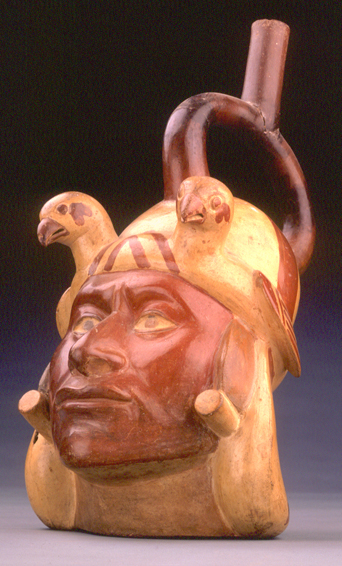
Tame Mochica pottery from Wikipedia Commons
Because religion is so large and so mysterious, the populace often simply complies. The Mochica artifacts, some of which are reported to be disturbing, justify this interpretation. Even an image search on the web will reveal how graphically cruel religious representations of Hell are; much more compelling in scariness than are feeble attempts in alluring one into an idyllic representation of Heaven. (Heaven is often shown as a garden, and as a sufferer of hay fever, I imagine myself sneezing through paradise.) It is no coincidence that organized religion appears on the historical scene on the coat-tails of civilization itself. The Moche were straightforward about what modern civilization would prefer to hide: religion is more about control than it is about belief.
 Steve A. Wiggins