
Dog Daze

I read quite a bit about animals. One reason is that when you’re counting all the species on the planet we’re pretty clearly among the animal part. Having grown up with many pets, the dogs particularly stand out. We tended to have only one dog at a time and they were so full of personality that it obviously wasn’t a matter of projecting to understand that one was more or less optimistic or joyful than another. Some could be mean while others were loving. There was quite a bit of buzz about W. Bruce Cameron’s A Dog’s Purpose back in January. For Modern Mrs. Darcy’s 2017 Reading Challenge the book fit one of the categories for me, and so I found myself reading about animals again. The thing about buzz is that I listen with only half an ear. I didn’t know much about the book except that it was a novel narrated from a dog’s point of view.

A couple of things struck me as I got into the story. One was that the protagonist ended up still believing that humans were more important than dogs. I suppose there’s some kind of evidence for that, from a dog’s viewpoint, but it doesn’t seem very strong to me. After all, we’ve bred wolves into pugs and cockapoos with an intentionality that even Mr. Darwin would’ve recognized as unnatural selection. Left to their own wolves would’ve adapted, but they’re pack animals and while dogs may think us the alphas, they’re each an important part of the group. They are giving, but that’s the nature of being in a pack. It’s also something that elected officials in Washington could stand to learn. When there aren’t rifles and traps, pack animals prosper.

The second thing that stood out about A Dog’s Purpose was reincarnation. The idea scares me. Life’s been a long challenge this time around and, unlike Nietzsche I’m not sure I could face it this exact way again. In any case, reincarnation only works if there are souls to pull it off. Cameron posits that for Toby to become a fully developed Buddy four cycles of reincarnation are needed. Like a good Platonist, our protagonist recalls the important lessons from each previous life and is able to develop into a more fulfilled dog each time around. The karma here is good. Cameron does seem to “get it” from a human-projected dog’s point of view. It can be fun, and it can be sad. The important lesson, for me, is that animals are who we are and to be a successful pack we need to look out for the good of each other.
Superstar Detective

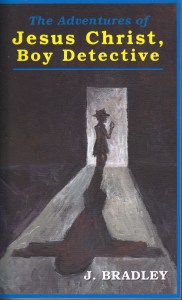
One of the reasons I accept reading challenges is that they take you places you otherwise wouldn’t go. Not all the books I read for the Modern Mrs. Darcy 2017 challenge make it onto this blog (to find the full list you need to see what I post on Goodreads.com), but some I can’t help but talk about. My wife had noticed a book that ended up in her Christmas stocking and for which I had admitted curiosity: J. Bradley’s Jesus Christ, Boy Detective. Now, Jesus is no stranger to fiction. In fact, he appears in lots of books as either the main character or as fulfilling some supporting role. In some books you have to really squint to find him. In others he’s obvious. In Bradley’s novel he’s a bit of both.

There’s a good bit of theology going on in the background of Jesus Christ, Boy Detective. As the title suggests, Jesus functions through a new incarnation in the body of a, well, boy detective. With some assistance from a criminal uncle and Saint Peter, he investigates bizarre murders and other crimes. There seems to be an ulterior motive, however, since he’s trying to get his father to own up for all the suffering he’s caused humanity. That’s right, this book is a modern theodicy.

Theodicy is a word for considering how a single deity can be both all powerful and all good. Since there’s plenty of suffering in the world we all experience, the question naturally arises: why doesn’t God do something about it? Theologians are fond of reminding us that we can’t see the bigger picture. It’s like global warming—it’s easy not to believe since we only live a few decades and the climate takes a lot longer than that to react to our pouring toxic stuff into the ecosystem. Maybe, theologians say, we have to suffer because we don’t see everything. Only God does. The boy detective disagrees. The deity in this story is truculent and culpable. A strong-willed divinity. If he doesn’t sound familiar, take another look at the Bible. I don’t know if J. Bradley has any theological training—I don’t even know his first name—but it’s clear that he’s down here with the rest of us wondering how all the pieces fit. And where there are clues it’s not a bad idea to call in a detective.


Wild Things

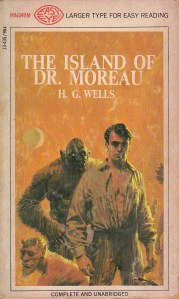
islanddrmoreauLast year my wife suggested we each do a reading challenge for the year. The one we selected was Modern Mrs. Darcy’s, which, with only a dozen books, seemed doable. What makes it a challenge is that to meet Mrs. Darcy’s expectations, you have to read certain types of books, not just go through the stack beside your favorite chair than never seems to get any smaller. I finished the challenge in October or November and posted on most of the books on this blog. This year’s challenge includes a book you’ve read before. Since I’ve been reading about horror movies I decided to reach back to childhood and once again read H. G. Wells’ The Island of Dr. Moreau. It was a timely choice.

For anyone not familiar with it, the story concerns a mad scientist (Moreau) who experiments on animals, making them “men” on an isolated island in the Pacific. These creations aren’t fully human and most of them are blends of different animals as well as part human. They can talk, and they can reason, in a rudimentary way. To create them without anesthesia, Dr. Moreau subjects them to tremendous pain and to prevent them from attacking him, he establishes a basic religion where they obey his rules or he will subject them once again to the “House of Pain.” The narrator, victim of a shipwreck, ends up on the island and has to come to an uneasy peace amid these very strange circumstances. The heart of the book is the chapter where Moreau explains what he’s doing and to justify it he makes a secular theodicy. He is, after all, god to these poor creatures. The book has been made into a horror movie or two over the years, but I’ve never seen any of the cinematic treatments.

What struck me as particularly interesting, revisiting this book some forty years after I last read it, was how easily Wells slips into theological thinking. This is a book unafraid of implicating the Almighty in the troubles of an island that clearly stands in for the world. I wouldn’t have noticed that as a tween. I don’t think there even were tweens when I was one. In any case, the story ends in chaos, rather than creation. What makes it such a timely choice? I suppose the arrogance and entitlement of Dr. Moreau suggested themselves as analogues to our current situation here in the US. Only Moreau is clearly intelligent as well as deranged. This little book is a cautionary tale of what happens when a strong will has its way, unimpeded. It might be a good time for all of us to pick up a copy.