Religion Underground

Imagine a world where the affluent live in lofty houses and the poor, working class citizens trudge to long, dreary, factory shifts in order to keep the system working from their underground world. Although it’s not exactly post-recession America, it is not too hard to imagine. On my final day of vacation from relative unemployment, I watched Metropolis for the first time. A 1927 silent film, this movie of a dystopian world run by an unsympathetic ruling class is experiencing somewhat of a revival. Panned by early critics, the film is now often categorized as a classic of the silent era. It was also the most expensive silent movie ever filmed. Shot in Germany between the two world wars, the story follows a surface dweller who has fallen in love with a troglodyte. It even has robots.

This Fritz Lang film fits in this blog because of its many biblical references and themes. Freder, the protagonist, falls in love with Maria, a working-class preacher among the underground laborers. Following Maria to the underworld, Freder sees the gargantuan machinery that runs the lives of the poor, and when workers die in an accident he calls out “Molech!” Molech, the putative god of child sacrifice in the Hebrew Bible, is shown as a fiery factory door consuming the forlorn men who dutifully march inside. Maria, however, teaches love and patience in suffering. In an underground cathedral she is the sole cleric long before most denominations recognized women as ministers. She compares the skyscrapers of the rich to the tower of Babel and insists that a mediator will come. With its strange blend of Christian and communist themes, this film made a significant impact in its time.

In our own day of entrepreneurship with faux-Christian backing it goes unnoticed that the Christianity of the first century was what might be called communistic. According to the book of Acts, early Christians keep their goods in common to ensure that everyone had what they needed. Among the disciples, Judas kept the common purse. What marked these early Christians as exceptional in the eyes of their earthly overlords was the concern that they had for one another—selfishness had no part in their religion. When Christianity became the religion of empire the lure of worldly goods distorted it almost beyond recognition. Christian industrialists built the tower of Babel with its leering Molech beneath the surface of the ground. Judas, it seems, has become the ideal role model for such a religion.
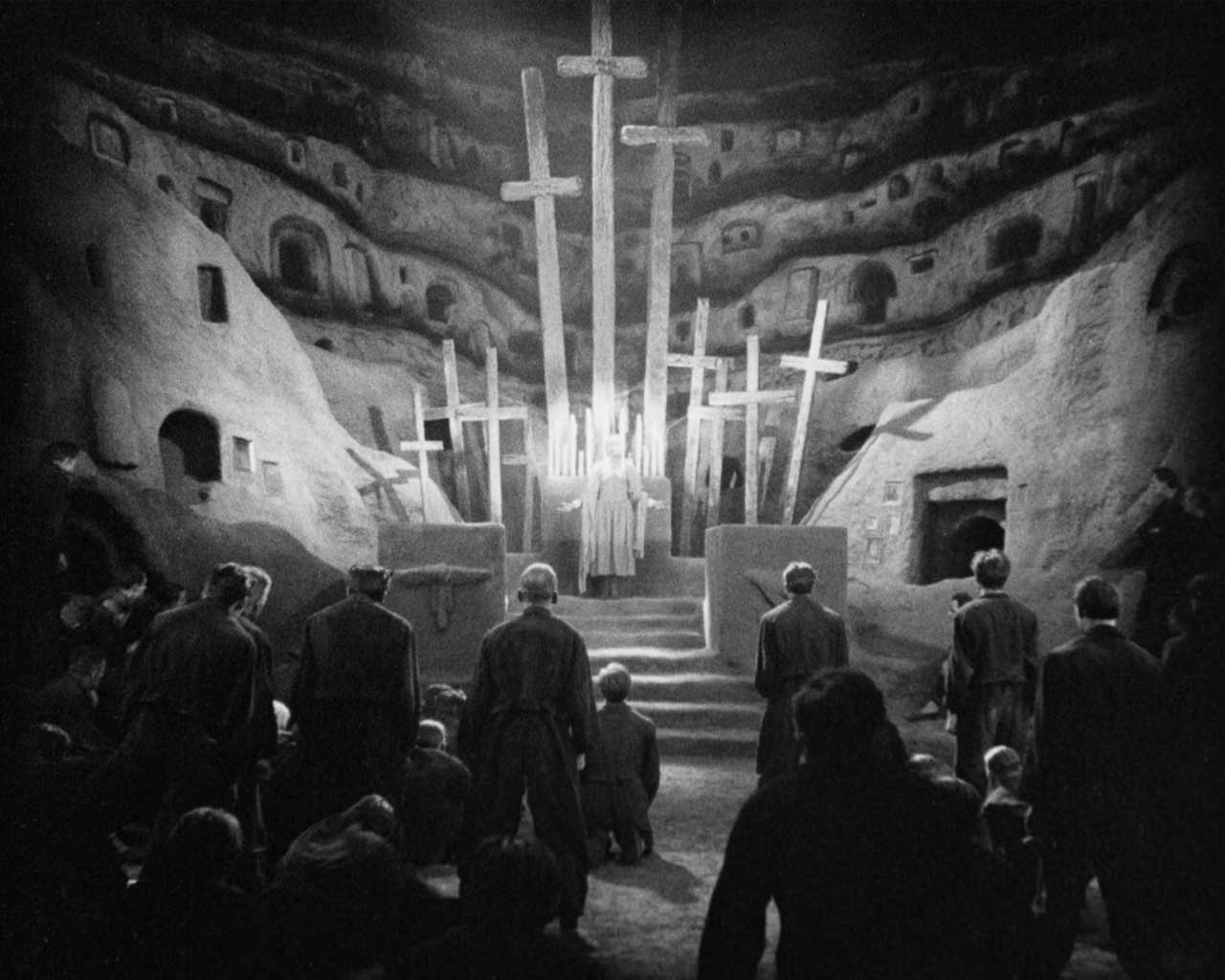
Maria's underground cathedral


Harry Potter and the Evangelical Emperor

There’s a chill in the air this morning that warns of impending winter and the visceral melancholy of autumn’s graceful death. As I try to warm up like a lizard awaiting the ascending sun, I think that maybe I’d better write this post before everyone forgets Harry Potter completely. It is the beginning of the witching season as sometime late tonight fall officially begins and people in temperate climes are permitted to show their fears as the barrier between seasons becomes effaced and the darkness slinks in. A few Harry Potter novels ago, a local town in Wisconsin sponsored a downtown release party for the book with a street-fair sporting a feel of general bonhomme. While sauntering down the incongruously sun-lit streets, enjoying the sense of people just having fun, I spotted this man with a placard across the street.

No caption necessary!

No caption necessary!

The truly scary part of this scenario is that I knew exactly where this fellow was coming from: the Bible says it, I believe it, that settles it. Black and white. Right and wrong. Good and evil. Strangely enough, there was no such dividing line for fact and fiction. Yes, I knew that the Bible condemns witchcraft, but I also knew that J. K. Rowling was a fiction writer. I had read the Bible enough times to know that it contains no commandments about what genre of fiction is permissible and to know that some biblical heroes were deeply flawed characters. Jonah and his big fish. David and the giant monkey on his back. Hezekiah and his doubts. I can’t pretend not to know the searing sting of needing a clear answer, and yet I had already discovered the infinite shades of gray that reside between pure white and absolute black. Bible covers should all be gray.

That very year a conservative evangelical administration had axed a highly praised job of over a decade’s duration, believing it to be in the name of righteousness. A conservative evangelical president was unleashing hellish terror on a country that had the misfortune of being the victim of a bloodthirsty dictator. And this man with a placard felt he had to underscore that even a flight of fantasy on a broomstick over a quidditch field of imagination was evil incarnate. Once again my mind turned to Molech, the perhaps fictional Canaanite deity who is never satisfied. In the Bible it was enough simply to believe that people were sacrificing their children to the fiery Molech. “White and black,” I could almost hear the tremulous author whispering as he penned his horrid fiction. History tends to paint a different picture, but then, historians make liberal use of the myriad shades of gray.