Be Neith It All

Goddesses have lately been on my mind. Both an occupational hazard and an avocation, study of the divine feminine deflects the trajectory that traditional monotheism traced and places us in the realm of the empowered female. This week my mythology class considered Athena, perhaps the truest embodiment of divinity in classical Greece. I regularly mention that in the ancient world even Plato suggests a connection between Athena and the Egyptian goddess Neith, one of the most ancient of the gods of Lower Egypt. When a friend coincidentally emailed a question about Neith, I realized the goddess was calling out for a blog post.
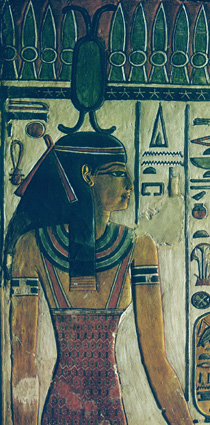
Neith is difficult to define partially because of the nature of Egyptian religion and its evidence, but also because of her great antiquity. She is a predynastic goddess, dating from before the founding of a united Egypt (back in the days when Egypt was united). She is represented by symbols of both weaponry and weaving (thus associated with Athena), and since she is so ancient, she became a creator. She is occasionally regarded as the mother of the gods. A question that naturally arises for all creators is from whence did they come – the classic chicken-or-the-egg conundrum. Mythology offers a number of options for self-generation, but most often creator gods simply bring themselves into being without many details being supplied. After all, no one was there to witness the miracle of the first birth.

Like most Egyptian creator gods, Neith represented preexistence and creation. She is occasionally androgynous – a necessary precondition for being an initial creator – and is said, by Proclus to have claimed, “I am all that has been and is and will be.” In short, nobody knows where she originated. Like many pre-biblical gods, Neith practices creation by speaking aspects of the world into existence, a technique called creation by divine fiat. This is something that Yahweh will later borrow in Israel. Although the Egyptian myths do not directly address the coming into being of Neith, she represents what every observer of nature knows: monotheism loses an essential element when it supplants one gender instead of embracing both.

Origins of Evil

The Bible might have benefited from a good editor. The final product is a world classic, of course, but contemporary people with their busy lives prefer straight and simple answers. These, often, the Bible refuses to yield. During a discussion of prophecy in class the other night the question of the origin of evil arose. I incidentally made reference to Isaiah 45.7 where God casually drops the line, “Forming light and creating darkness, making peace and creating evil, I am Yahweh making all this.” Many English translations attempt to mask the bald use of ra‘ “evil,” in this passage with nicer words such as “woe” or “calamity.” As I explained to my students, however, in a truly monotheistic system all fingers must point the same way for the ultimate responsibility. In this passage of Isaiah, Yahweh is presented as causing evil.

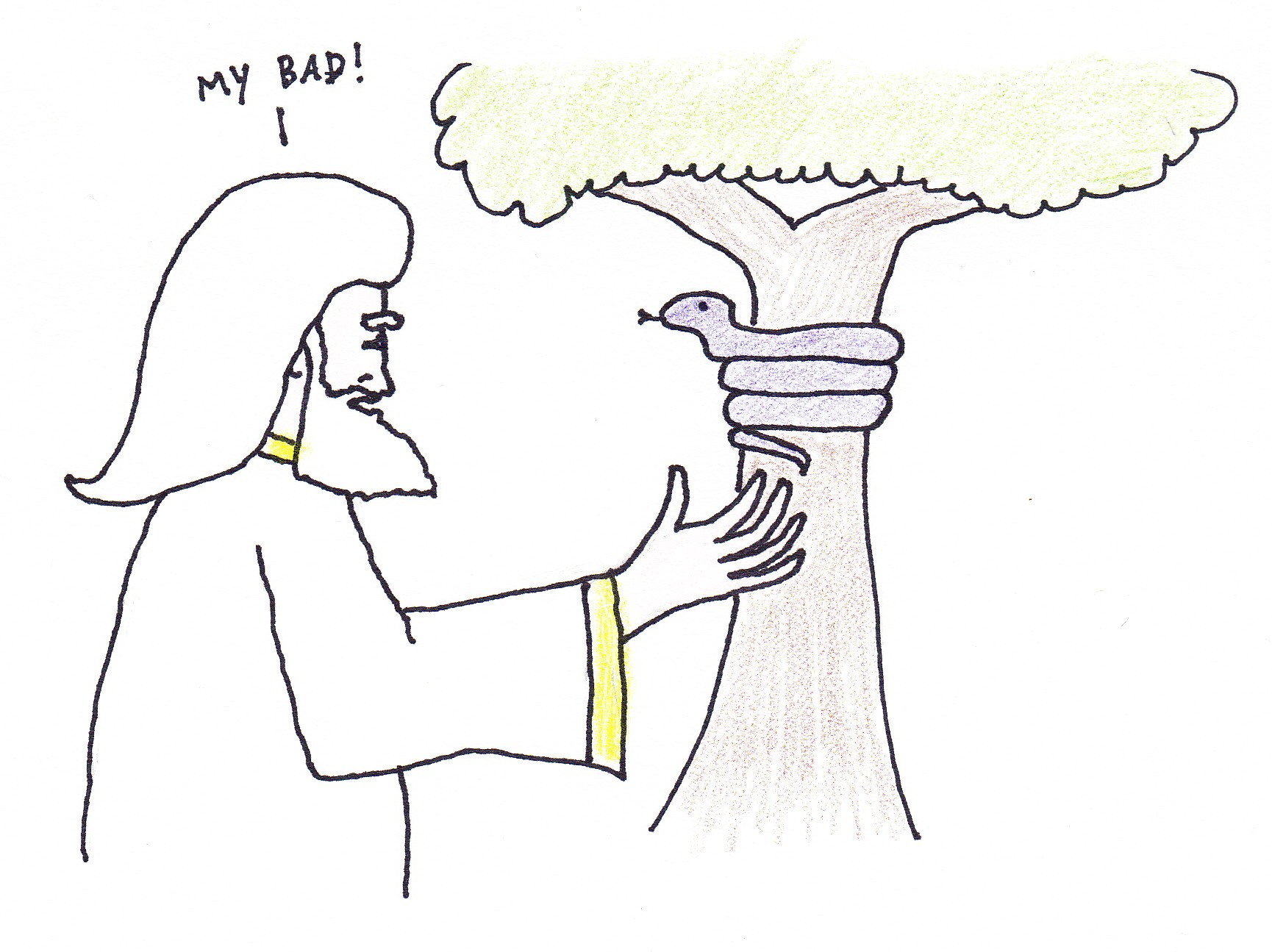
Now the editing of the Bible was never undertaken with the intention of creating uniformity, despite the railing of Fundamentalists. There are plentiful internal inconsistencies and disagreements. We should expect no less of a book written over a period of about a thousand years by several different writers grappling with life’s big questions. Inevitably students ask about the Garden of Eden. Genesis 2.17 has Yahweh state that newly created people must not eat of the “tree of knowledge of good and evil (ra‘).” Here the evil grows on a tree. Who planted that tree? It’s like blatantly laying the keys before your teenager and saying, “now don’t take the car.” Who is the source of that tree? (And, less frequently noted, the eating of the fruit in Genesis 3 is never called “sin.”)

The quintessential problem with a compilation is lack of uniformity. This did not bother ancient people as much as it does modern Fundamentalists. One reason is that many people equate the Bible’s value with it being a book that has all the answers from a single viewpoint. This the Bible lacks. According to the Bible there are various sources of evil. According to a strict monotheism (late in the Hebrew Bible) there can only be one. Enter the devil. To save the goodness of God a Zoroastrian anti-God had to be introduced. But the devil must stand in line to make his patent claim on evil.


Blessed Virgin (Not)

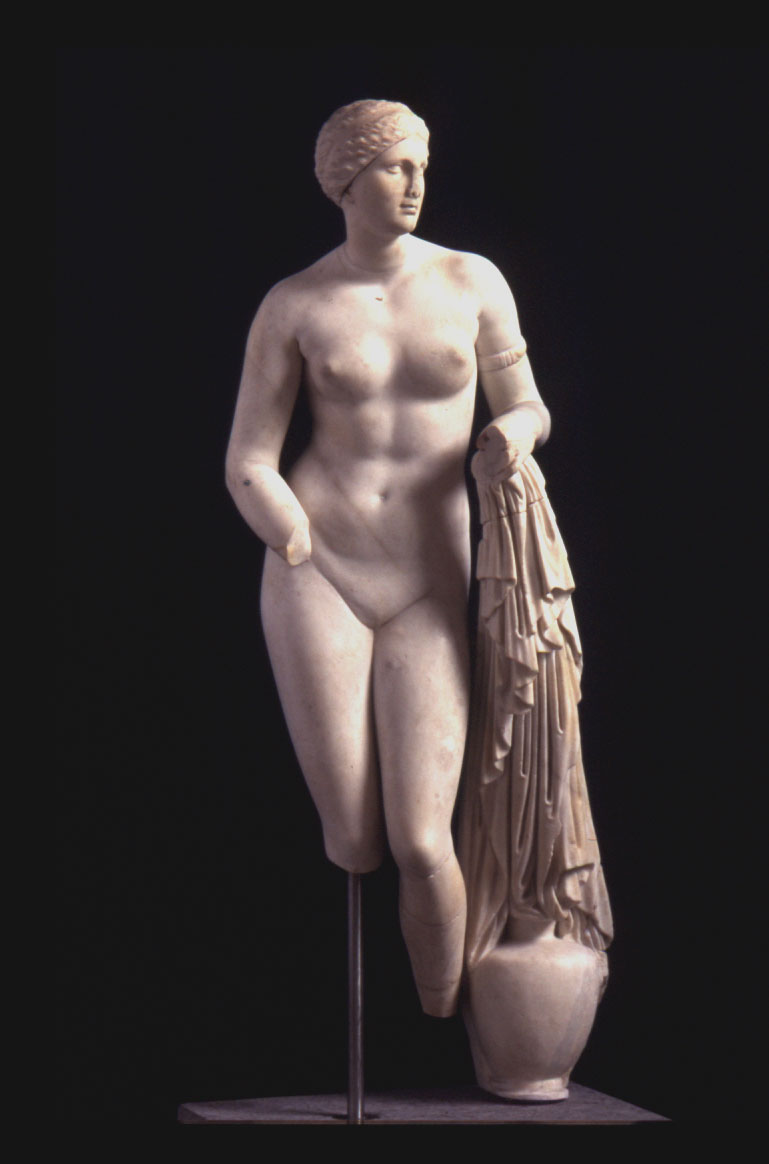
What’s not to like about Aphrodite? Hesiod’s first Olympian, she represents the exuberance of life itself in the pursuit of love. In our patriarchal world her erstwhile consort Cupid has come to represent that strange and compelling force that drives so much of what mere mortals spend their time on. A colleague has pointed me to a new documentary that is being produced on Aphrodite (trailer available on YouTube). In addition to fascinating footage illustrating modern Cypriot rituals to the goddess, the film contains what many would consider a sacrilege: on Cyprus the virgin Mary and Aphrodite are viewed by many as two forms of the same entity.

While the modern, monotheistic sensibility bristles at any notion of shared divinity, it seems perfectly natural that when the “mother of God” was introduced to the island that gave the world its Venus, “its desire,” a mental connection became inevitable. Unlike many “virgin goddesses” of the ancient world, Aphrodite had no false modesty regarding matters of love. Even the mighty Zeus, so powerful that he might be called simply “God,” was unable to resist her draw. Ancient peoples often celebrated the gift of love without the embarrassment that the Victorian Age has so generously bestowed on much of the western hemisphere.

Pressing the point even further, when monotheism emerged the equality of genders became an impossibility. The one god must, by the standards of all human imagination, possess a gender. And since men dominated the societies that embraced monotheism the divine feminine was lost. Orthodoxy replaced humanity, and thus it remained until only recent years when women finally managed to make their voices heard. Aphrodite, unlike Hera, is not under the control of a lordly king. The film by Stavros Papageorghiou offers viewers a chance to see what has been lost by the western world keeping half of the human race silent.


The Triumph of Baal

“Snow weariness” is no strange phenomenon even to those of us who were reared in the legendary snow belt of Lake Erie. Although Buffalo consistently topped our records, months of deep snow burying all the familiar features of our landscape in northwestern Pennsylvania were regular expectations of winter. Snow weariness generally settled in around March when we longed for green pastures and unstill waters. As an adult in generally snow-deprived New Jersey, the weariness sets in much quicker. Attempting to drive on highways with sneophytes is a challenge; before I had my license I had driven in plenty of snow, otherwise I’d have had to hibernate from December through April of each year. Digging out from New Jersey’s third major snow-plop of January, however, the magic seems to have vanished.

Baal was a god who controlled the weather. Some years back I finished a book (still unpublished) on weather terminology in the Psalms. Many psalms are notable for containing archaic imagery and phrasing, leading some scholars to suggest they might have been new, revised “Canaanite” versions of songs originally dedicated to Baal. Perhaps so. The Psalms frequently note the wonder of weather, even occasionally of the snow. Psalm 147 contains the lines:

16 The one giving snow like the wool,
he scatters hoarfrost like the ashes,
17 throwing his rime like crumbs,
before his cold who will stand?

Originally a paean to Baal? Who knows? It’s just that we’re all shivering down here. And Israelites didn’t have to shovel a path to their cars to turn over reluctant engines to get a modicum of warm air circulating before they actually arrived at work.

Once Israel’s monotheism set in, Yahweh took control of the weather, thank you. Even a glance at the Psalms demonstrates the superiority of Israel’s divine weather-maker. From the view down here, however, it looks like maybe Baal has a few tricks still to play. Would Yahweh ever cause a Bible class to be cancelled because of inclement weather?

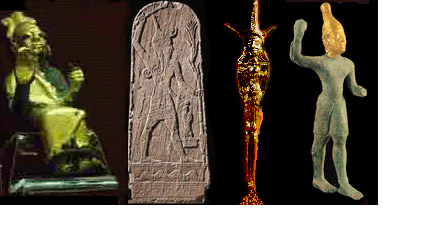
Dawn in the new snow Baal


The Selfish Meme

Although we may know deep down that one day is pretty much the same as another, people have always held profound reverence for the new year. Symbolic rather than empirical, hopes resonate around the concept that a good start presages better things ahead. That’s why tragedy early in the year sometimes possesses such solemnity; we had hoped that things might begin anew. The headlines today announce that a church bombing in Alexandria, Egypt, started a new year of violence in the southwest corner of the cradle of civilization. Muslim extremists are suspected as there has been some tension between the Coptic Christians of the city and their Islamic compatriots. Although details are not clear, one matter remains in focus: the violence is based on religion.

One of the more savage legacies of monotheism is the absolute truth claims that follow in its train. If truth be truth, there be only one. So the meme goes. Multiple mutually exclusive truths cannot coexist in a religious universe. Scientists might well claim that in this non-empirical universe, no testing may reveal the actual answer. Belief takes over where knowledge fails. And belief in a religion, like it or not, follows the dictates of survival of the fittest. Memes, like genes, can be quite selfish. If one is to stake eternal, unchanging consequences on a religion, the proposition is all-or-nothing. Even purgatory is not forever. The coin falls one way or the other. Religions fight for the memes of truth, and those with the highest survival rate win.

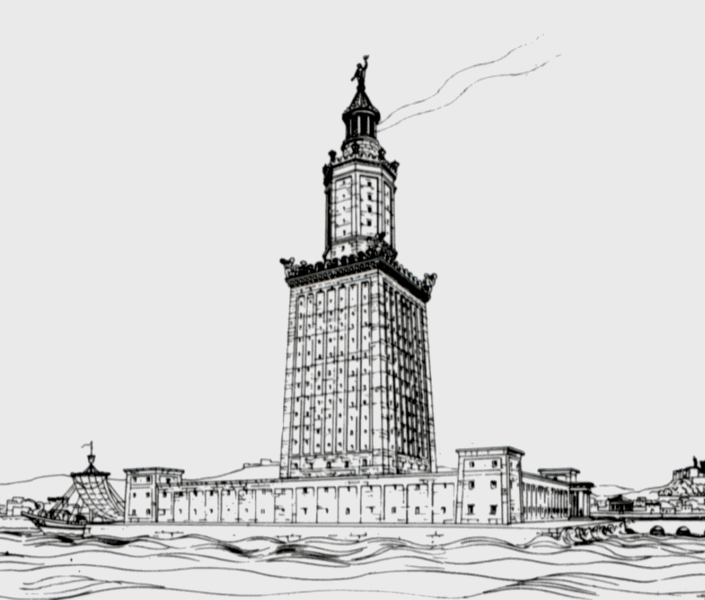
Lighthouse of Alexandria before the bushel

Alexandria has suffered its share of violence in the past. Its famed library, the center of learning in the ancient world, traditionally underwent four destructions, the final two religiously motivated. The books surviving antiquity fell under the Christian ban of paganism in 391. Arabic sources note the destruction of the institution after the Islamic conquest in 642. The end result is the same – the irreparable loss of centuries of knowledge. The lighthouse of Alexandria, one of the seven wonders of the ancient world, might well stand as a symbol for the influence of rationality. Tradition states the light could be seen 29 miles away, but earthquakes and the need for building material saw the extinguishing of the light so that by 1480 the darkness settled for good. A fort was built from its remains. Given a choice of light or fortification, it is clear which way the selfish meme will go.


Understudy Angels

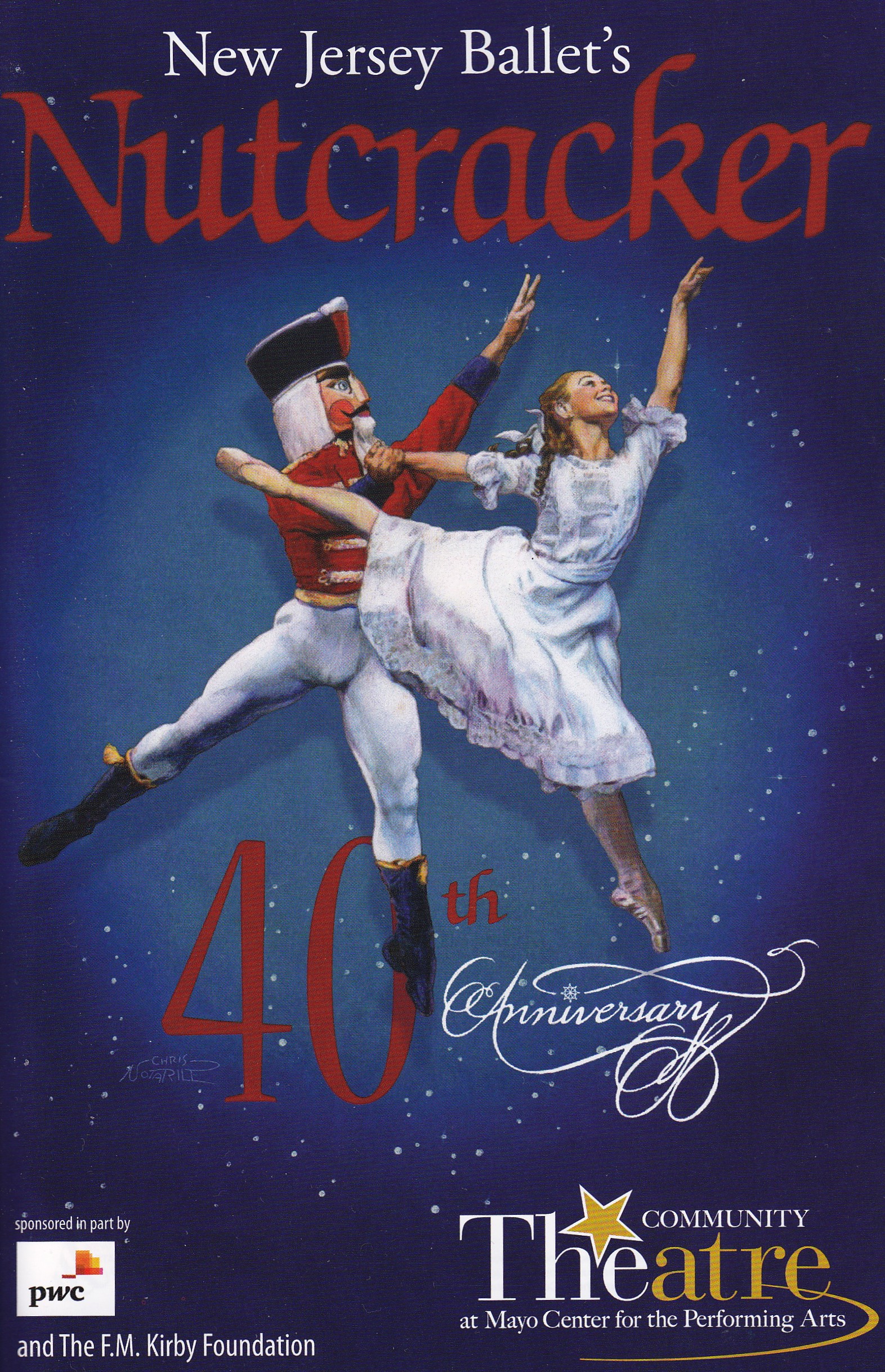
Since moving to New Jersey my family has attempted to sample as much of the vibrant arts scene as we can on our modest income. At times it feels like being a starving man locked in a fine restaurant. So we scrimp, save, and buy the cheap seats when we can. Thus it was on Christmas Eve we found ourselves in the audience for Tchaikovsky’s Nutcracker ballet. I’ve been on this planet for nearly five decades and I’ve never before seen a ballet. I knew the basic story of the Nutcracker: weird uncle gives niece an odd toy, jealous brothers soon break the toy, and the niece has a bizarre, if exceptionally graceful, dream where the toy becomes her escort. Beyond that I didn’t know what to expect. When I looked through the program, I was interested to see that there were angels, snowflakes, clowns, and mice. And there were understudy angels.

Students sometimes ask me what became of the ancient gods. In the cultures surrounding Israel, as well as in early Israel itself, polytheism reigned. Once the Exile had conceived monotheism what happened to the other gods? Did they all get absorbed, Borg-like, into Yahweh? It seems not. Many of these ancient gods continued to eek out their existence as supernatural, yet strictly sub-divinity, beings. We recognize such beings as angels today, and every holiday season they are ubiquitous in store windows and church lawns. It should come as no surprise that with so many angels a few understudies must be necessary.

In popular imagination – (dare I say it?) Christian mythology – angels derive from dead Christians. Many children are taught that if they are good, when they die they become angels wafting through the heavens. This popular doctrine does not match the official teachings of any major branch of Christianity. Angels are different in substance, essence, or whatever else a theologian might care to call it, from humans. You don’t evolve into an angel. Either you’re born one or you’re not. And so it seems we are earth-bound in our existence. No cause to mourn, however; even the gods had to learn how to be angels. We can only hope they had the benefit of many understudies to carry on the tradition.


Ouroboros

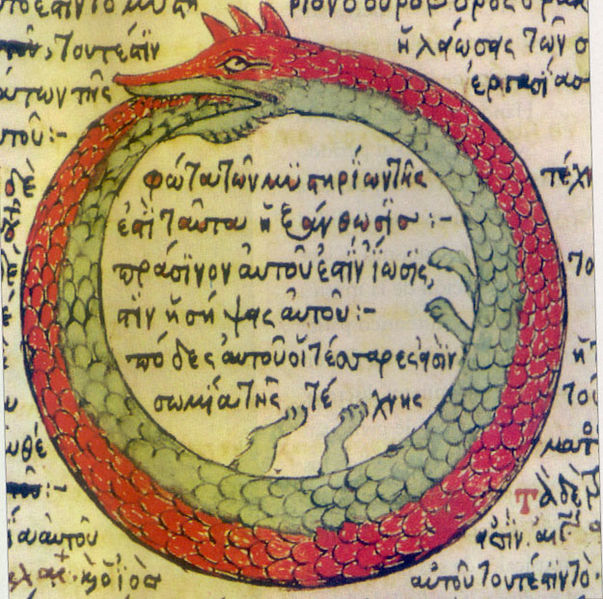
The Science Channel’s program, Through the Wormhole, hosted by Morgan Freeman, has a noble goal: help educate non-scientists with cutting-edge ideas. The series opens with an episode on God: “Is There a Creator?” Interestingly, in our society there are those who turn the question around. Religious folks ask the question: does science really have the answers? It is the classic ouroboros, the snake swallowing its own tail. Perhaps the best way to consider this entrenched issue is to consider its history. Gods emerged as explanatory figures. In the days when the Bible was the oldest known book, it was believable that God had dictated it and therefore the idea of God required no explanation: the ultimate tautology. When extra-biblical material predating the Bible was discovered, a warning bell rang. Most established religions in the western world simply pretended not to hear.

Snake, dragon, whatever.

Neuroscientist Michael Persinger of Laurentian University features in this Wormhole episode, demonstrating his “God helmet.” The principle is that stimulating the specific part of the right hemisphere of the brain that corresponds to the left hemisphere’s region of “selfhood,” a brain will fabricate a presence. While the experiment has promising results, it can’t fully explain God. Other neuroscientists are working on the issue as well. Historically we know that Yahweh was one among a polytheistic entourage of deities. With the stresses and mysteries of exilic existence, monotheism was born. Only one of those many gods survived. By studying the character of Yahweh’s departed compatriots, however, we can learn of the origins of gods as well.

Science entered the picture much later. By the time of truly empirical observation, God was an assumption as certain as ether. When science offered an alternative explanation, religion countered. “I see your Big Bang and raise you one Prime Mover.” And thus it will always go. With no witnesses, alas, no intelligence even yet evolved, our universe began. We can ask the physicist or we can ask the priest. Even if God is discovered and described in the laboratory, with or without a helmet, those standing outside will always believe, with Anselm, that there is an even bigger one somewhere out there.


Pleasant Points of Prayer

Point Pleasant Beach, New Jersey, is a fine place to meet the ocean. On the first day my wife and I were scouting out apartments in the state, my brother drove us to Point Pleasant Beach after dark that October evening. The rollers were thundering on the deserted beach as we raced down to dip our fingers in the Atlantic. We went back on sunnier days to enjoy the miles of delightful beach for which the state is justly famous. Point Pleasant has an old-fashioned boardwalk, hearkening back to more innocent days when entertainment was carnival style and the only electronics involved were the blinking, colorful lights. As a borough, however, Point Pleasant Beach has been opening its council meetings with the Lord’s Prayer for six decades. A judge has called that practice to a halt, according to Saturday’s New Jersey Star Ledger.

Perhaps the greatest challenge to all religions is globalism. Historically, the religions of antiquity developed when pockets of human habitation were relatively isolated from one another. Yes, people traveled, but not with the ease or frequency borne by steam or gasoline engines. Religions evolved slowly and took on the local character of the only people most believers were likely to ever meet. The ancient religions of trading centers already show the traces of syncretism that religious purists so abhor. When the sea-farers of antiquity met new people it was only polite, politic, and profitable to share their religions. Monotheisms, however, demand complete adherence to doctrine. They don’t mix well. In today’s world where travel is easy (if accompanied by strangers groping your privates, if you choose to fly) and lifestyles and religions become connubial, civil meetings have to take their new clientele into account.

The Lord’s Prayer is about as inoffensive piece of Christianity that may be muttered. Nevertheless, it makes assumptions about the religious make-up of the community. New Jersey is startlingly diverse in constitution. It is a fascinating experiment in people from all over the world learning to live together. In the past sixty years the ethnic make-up has shifted and no longer can boroughs assume that all members are Christian. The prayer does affirm the wish that the kingdom of the patriarchal Christian God should establish itself on earth. And as much as tradition is to be valued, so much is religious government, on any level, to be feared.

Simpler times on a New Jersey beach?


Not As We Know It

According to an article from the Associated Press yesterday, scientists are having to rethink life. Some of us do that on a regular basis anyway, but there is actually cause for this scientific reevaluation. Bacteria have been discovered in Mono Lake, California, that utilize arsenic to sustain life. The article also notes the announcement that the number of stars in the universe has recently been increased on a magnitude of three times the old estimate and that potentially life-bearing planets are regularly on the increase. Seems that we may no longer be alone. No one knows what forms life may take “out there.”

The eye of a lesser god?

I wonder what impact new life forms will have on religion. I suppose there’s not a revelation immense enough to shock a true Fundamentalist from his/her confident “God could do that” outlook, but when we find life not as we know it, does it not affect all of our worldview? Even the definition of life is up for grabs. Is the earth itself alive? Did the animists have it right all along? Does arsenic-based life have a soul once it evolves to hominid status? Would they have equal opportunity housing? When such revelations come to light, I would find it comforting to have Mr. Spock at my side, stating in his flat, unemotional voice, “It’s life, but not as we know it.”

Life was complicated enough to begin with, what with trying to hold down two part-time teaching jobs and many secretive efforts to launch new careers. Religion can’t let go of this information, however, as one of the prime definitions of the divine is as the guy who creates life. Religions such as Buddhism and Jainism – religions that believe taking any life is wrong – will certainly have more work cut out for them. When it is boiled down to its prime components, religion is ultimately concerned with life. Monotheism has no room for a Hades or Ereshkigal. One might only wonder who the gods of the arsenic eaters might be.


Round Tables and Belligerent Gods

One of those bits of mail in my part-time lecturer mailbox at Rutgers informs me that the Oxford Round Table is hosting a discussion entitled “Civilization at Risk: Nationalism, Religion and Nuclear Weapons.” Given that the cost for attending is about what I make for teaching one of my adjunct classes, and the fact that they spelled “civilisation” the American way, my guess is that the target audience resides on this side of the Atlantic. Still, the topic is indeed vital. Nationalism is a relatively new plague to arise in the human menome. Cultural differences matter little in the face of nationalism; the real issue in this ideology is dominance. Nuclear weapons add a unique poignancy to the issue, but the heart of the matter is clearly behind door number two: religion.

Religion usually makes the list of the hallmarks of early civilization. Along with complex governance and the arts, it is considered one of the aspects that marked the break from merely subsistence living. Religion, however, in its monotheistic form has more divisive power than nearly any other aspect of civilization. Polytheistic religions hardly worried if people worshipped the “wrong god.” Monotheism bears a larger burden, and that burden is not dissimilar from that of nationalism: dominance. Let’s face it – what kind of respect can you expect for a god who can’t throw the brimstone behind all those threats? And if your god doesn’t readily ante up (no visible actions, depending on who you read, since the first or the seventh centuries) then the devout must take up the spear, cudgel, or atomic weapon to prove the honor of their all-powerful god.

Uranium in the hands of an angry God

Is there a solution to the “Middle East” crisis? I’m no politician, but I would make the following humble observations. The crisis as it exists today is as much about nationalism as it is about religion. Religion serves as a convenient excuse when one’s way of life feels threatened. (Push any Neo-Con into a corner and when all the cards are on the table it will amount to precisely this.) We all want things our way. If we can’t get it, we can take it by dropping the G-bomb. It may be apt that the region of the world that instituted civilization is destined to destroy it. A cosmic symmetry pervades the idea. It might be a lot less messy if we’d all admit what the arguing is really all about.


Chosen Ones

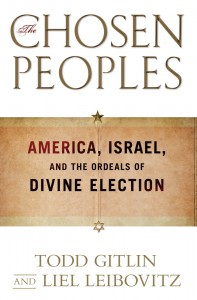
Religious dominance has been so much in the news lately that when my wife pointed out the review of Todd Gitlin and Liel Leibovitz’s The Chosen Peoples in today’s paper my mind once again fastened on the issue. I have not read the book; today’s review is the first I’ve heard of it. The salient point, however, is the continued evidence that monotheism is a tremendous burden on society. Most rationally considered analyses of western religious traditions recognize that the same “base God” is recognized in Judaism, Christianity, and Islam. These three religions are so deeply intertwined in their influences and theological commitments to the singularity of God that such a convergence is inevitable. Nevertheless, three religions sharing a God is like three children sharing a lollipop. Each wants to claim exclusive ownership.

The issue becomes more complex when ethnic identity is tied to religion. Given the nature of religions, this is, however, another inevitability. Religious thought and practice develop among populations separated, in Darwinian fashion, and those who lived in the original arenas of religious development were probably closely related. This is evident in the easy blending of Judaism as a culture and a religion, as well as ethic Orthodox Christianities that maintain a strong cultural component, and in Middle Eastern descent and Islam. People accept the religion of their own people. Monotheism then takes over with the demands of exclusive rights to chosenness or theological correctness. Religion itself contributes to its own fractionalization.

Those who are excluded protest: who wants to be left out of the chosen ones? If there is one God, who wishes to be the second or third or fourth favorite? If we (whoever “we” may be) are those legitimately chosen, are we not in some measure better than other believers? This logical crux slices through all theological niceties for those who examine the issue honestly. Many religions and one God. Chosen people abound. Perhaps it would be less dangerous if God could be divided among the many: one God, divisible, and available to all.


Natufia to Say

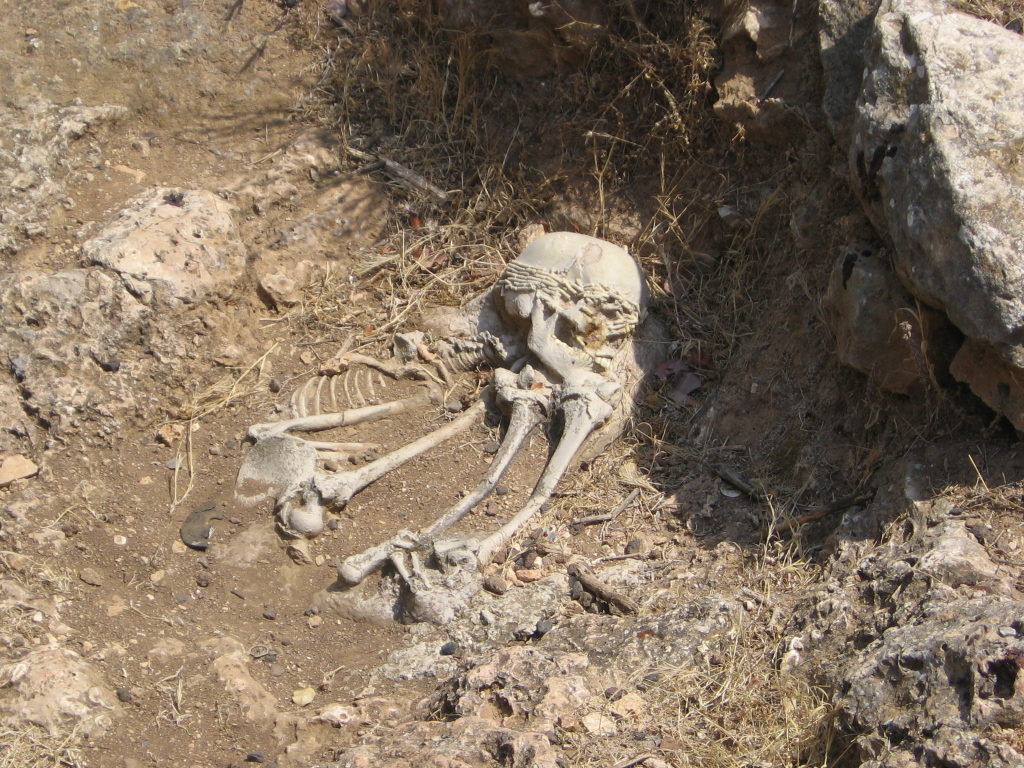
The Natufian culture predated the Israelites by millennia. They were gone by at least 7000 years by the time Israel appeared. The Natufians seem to have been the first permanent residents of a hotly disputed piece of real estate: Israel/Palestine. On Monday MSNBC reported on the archaeological find of a feasting hall among the Natufians. The story reminded my wife of similar stone-age sites that we visited in the Orkney Islands several years ago. What the story reminded me of, however, was the marzeah. The Natufian site features two activities: feasting and burial. The article notes the coincidence of 28 human burials, including one shaman, and the unmistakable signs of feasting. Bring them together and its sounds like marzeah time to me!

Natufian burial, from Wikipedia Commons

The marzeah is an imperfectly understood social institution from the ancient Levant. It is mentioned in the Bible as well as in the Ugaritic texts. Although plausibly reconstructed by modern theorists, we simply do not have a complete record of what the marzeah entailed. Two of the key elements seem to have been feasting and a funerary nature. Monotheistic religions tend to downplay the role of the dead as influential entities since they interfere with a monistic view of the divine. The two Hebrew Bible references (Amos 6.7 and Jeremiah 16.5) do not speak highly of the practice. The Ugaritic material suggests drinking may have been involved as well, further problematizing the ritual.

Now here is where the ambiguity of archaeology is thrown into sharp relief. The fact is we do not know what the Natufians were doing when they buried or feasted at this site. The Hilazon Tachtit Cave does not seem to have been a regular occupation site, and we do not have any reason to connect the burials with the feasting. Beyond a hunch. The hunch is the incredible urge to bring like things together. People excel at pattern-recognition. When I read of funerals and feasting my mind leapt to the marzeah. There seems to be no organic connection between the Natufians and Israelites (or Ugaritians), but the continuity of cultural concepts seems to strong to dismiss. Were ancient people toasting their dead with feasts that were remembered down into the Late Bronze and Iron Ages?


Birth of Religion

Since “religion” is a relatively modern concept, I always begin my Ancient Near Eastern Religions class with an exploration of what “religion” is. We all have a concept of “religion” (I’ve reached my quotation quota, so I’ll assume it is safe to write “religion” without them from now on). The idea, however, is an offshoot of the development of monotheism. Prior to the recognition of a single deity, in a world where no laws of physics existed, just about everything was the result of the conflicting interests of the gods. Why call it anything special beyond the facts of daily life? Keep the gods happy, live long and prosper.

With monotheism arrives the component of belief. If there are hundreds or thousands of gods, belief in the right one simply doesn’t enter the equation. Ancient gods aren’t overly concerned with humans. People were created to serve them, but salvation, fulfillment, apotheosis, and belief weren’t part of the picture. Look at the world around you: this is proof of the gods and their power. Religion in such a world is more a matter of what you do – placating the gods – than it is a matter of what you believe. It is difficult for modern people to project their minds back to a world without the explanatory value of science, a world where all could be explained by the gods. Such was the world of antiquity.

Once monotheism emerges with its views of belief in the correct god, and the corollary of that god’s personal concern for you, religion experiences a sea change. Yes, that god still may require placation, and yes, that god may still intervene regularly in the world, but this is the only god now. One of the surest ways to anger him (for he is male, like human rulers) is to disbelieve. A jealous deity, he detests belief in other gods, although they do not exist. At this juncture, we have found religion. When the world itself operates at the behest on one god, keeping that one god satisfied becomes a specialized part of life and religion is born. The world will never be the same again.

The usual suspects


Tut-tut

King Tutankhamen is on tour in New York City at the Discovery Times Square Exposition. It is difficult to assess how he feels about this tour, but I am certain the young king would have been astounded at Manhattan. The Egyptians were impressed by monumental architecture, and whatever one’s personal likes or dislikes may be, New York is full of monumental architecture. Tut’s famous golden death-mask will, however, be absent. That never leaves Cairo anymore.

As a sometime lecturer on the Ancient Near East, I can always count on students knowing King Tut. Many can’t name his father, Akhenaton, or even say what he was famous for (a rudimentary monotheism), but all know Tut. The reasons are transparent – all that gold! It is difficult not to be impressed with that shiny yellow metal we all would like to have in abundance. Apparently Tut did. His accomplishments as king were severely circumscribed and lackluster, yet he lives on as the most famous Egyptian pharaoh because we have his gold.

Our appreciation of the superficial in the ancient world is a condemnation of our own society. We continue to be impressed by wealth at the expense of substance. Seldom do we find anything resembling true wisdom surviving from the enormous estates of CEOs. Their wealth assures their place in society, regardless of their accomplishments in moving society forward (or, more likely, not). They are living King Tuts. When ancient historians of the future turn their gaze back to our era it is most certain that the modern day Tuts are the ones who will dazzle them with their worthless gold.


And With Perfect Teeth

This week drug stores across the country will begin offering a testing product that will help assess genetic predispositions to various diseases and weaknesses. Potential parents might learn what debilitating illnesses could plague their children. Who wouldn’t want to eliminate needless suffering and create a world involving less pain and wasting away? Who wouldn’t want to know in advance? Ethicists are up in arms for such knowledge is surely a dangerous thing, just like an overcrowded lifeboat.

Ancient peoples had their own way of dealing with such dilemmas – blame the gods. Disease was not the result of genetic predisposition or even microbes. Illness, plague, pestilence and degeneration were the punishing weapons in the arsenal of ill-tempered deities who didn’t really understand what it was to be mortal. In Ugarit the archer-god Resheph was the divinity who brought pestilence. Shooting from afar with his fiery arrows he could topple cities and nations. Yet few prayers to him are recorded. Better to appeal to a higher power, an outranking deity who might overturn random suffering.

With the loss of many gods comes the loss of the right of appeal. Should the one God be the one who sends disease, to whom can prayers be offered? For many prayers to Jesus or even to Mary are made to circumvent the sad lot poured out upon a destitute humanity by an implacable father. People now recognize genetics and microbes, but still talk to the spirit world about woes and fears. Starting on Friday, however, there will be a product locally available that might provide relief in advance. Who’s willing to take on the gods and give Pathway Genomics a try?