Imagine Monsters

Adulthood is where you begin to recognize the folly of growing up.  Like most people, when I “matured” I was ashamed of things I made as a child and, regretfully, threw them away.  This came back to me recently as I was thinking of a sketchbook—actually a scrapbook that I repurposed in my tween years.  I love to draw.  I don’t do it as much now as I’d like (thanks, work!), but I was encouraged in it by art teachers throughout school who thought I had a little talent.  The sketchbook, however, was only ever shown to my brothers, but mostly only looked at by me.  This particular project was where I was making up monsters.  As with my writing, I’d never taken any drawing classes, but I had an active (some say overactive) imagination.  (That’s still true.)  

In any case, a discussion with my daughter brought back memories of this book I’d discarded by the time I went to college.  I still remember some members of the menagerie I’d concocted.  Even now that I’ve seen hundreds of monster movies, most of those I’d fabricated as a child have no peers that I’ve seen.  These weren’t monsters to be incorporated into stories—they were purely visual.  Although, I can say that my first attempted novel (probably around the age of 15) was about a monster.  I got away with being interested in monsters in high school, but college was a wholesale attempt to eradicate them.  Even so my best friend from my freshman year (who left after only a semester) and I made up a monster that lived in the library.

As an academic, until very recent years, monsters were off limits.  If you wanted to be sidelined (and in my case it turns out that it wouldn’t have mattered) you could explore such outré subjects.  Now it turns out that you can get mainstream media attention if you do (as a professor, but not, it seems, as an editor).  I’m sitting here looking back over half-a-century of inventing monsters, with a sizable gap in the middle.  The interest was always there, even as I strove to be a good undergrad, seminarian, and graduate student.  Now I can say openly that monsters make me happy.  I can also say, wistfully, that I’d been mature enough to keep that sketchbook that preserved a part of my young imagination.  It was tossed away along with the superhero cartoons I used to draw.  And the illustrations of favorite songs, before music videos were a thing.  Growing up is overrated. 
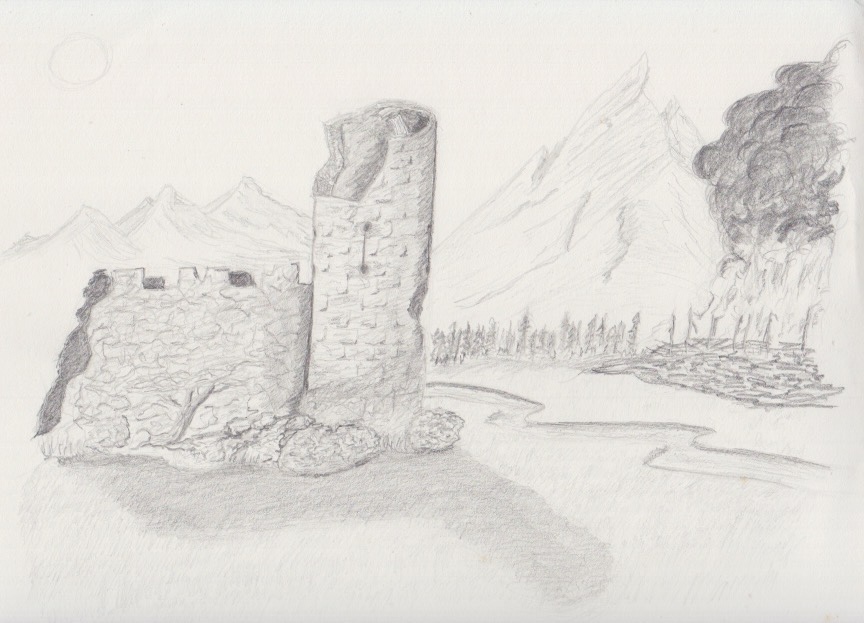
A surviving drawing, unfinished

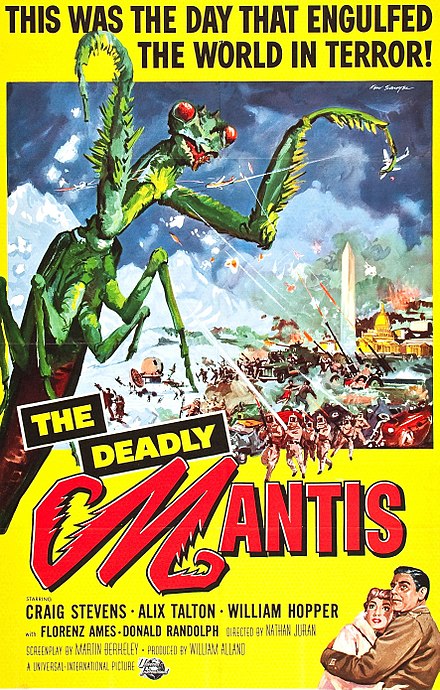
Praying for Mantis

Now this is a Cold War movie.  And I mean “cold.”  The Deadly Mantis is one of those movies that hovers between “so bad it’s good” and just plain “so bad.”  I was kind of rooting for the mantis.  In any case, this was an ambitious movie for the time but it reflects the post-war paranoia in the United States.  It also makes very abundant use of stock footage, much of it military.  You almost expect a recruiting ad at the end.  (It does thank the Ground Observer Corps in the closing credits.)  Okay, so here’s the story.  A volcano in the south Atlantic causes the calving of an enormous Arctic iceberg near the North Pole.   That iceberg contains the frozen body of a 200-foot praying mantis from dinosaur times.  Even earlier.   Said frozen mantis, quite hungry after millions of years, begins attacking Arctic radar bases and flying south.  The Air Force calls in a paleontologist to help identify what they’re looking for.

The mantis is so big that it prefers people for food, although, one might note, a polar bear would’ve been easier prey.  In any case, given the technology limitations of the time, the military has trouble keeping track of the insect as it flies over the most populous part of the country.  They do get the cloudiness of the East Coast about right.  Eventually they shoot it down—actually a fighter jet crashing into it does the job—over Newark and the mortally wounded mantis crawls into the Lincoln Tunnel (called “The Manhattan Tunnel” in the film).  By this point the viewer is saying “just let the poor thing die in peace,” but they pump smoke into the tunnel, presumably to hide wires and other props, and commit a protracted insecticide.  

Now, I’m one of those people who hates to hurt any animal.  The death twitches of an insect are quite troubling, so I try to catch what I can indoors and release them.  I have trouble with the instructions to kill spotted lantern flies—it’s not their fault that they’re here.  The movie shows a bravado regarding the military and a machismo regarding the main female character that hearkens back to why it was so necessary to evolve out of the fifties.  Of course, we learned nothing from The Deadly Mantis and have catapulted back into a new Cold War and an even more robust military.  William Alland, the producer, had a real love of this genre of movie, and for that we have much to be grateful.  But even the big bug genre can produce a real groaner now and then.


Sister Monsters

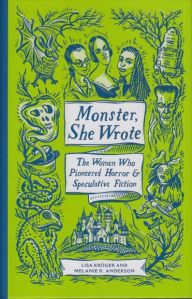
Every once in a while you read an inspirational book.  I’m hoping readers will keep in mind that inspiration comes from different locations for some of us.  Monster, She Wrote: The Women Who Pioneered Horror and Speculative Fiction, by Lisa Kröger and Melanie R. Anderson, is a source of inspiration.  With the usual Quirk Books touches, this isn’t a tome heavy on literary criticism, but it is a wonderful compendium of brief bios on women who walk(ed) on the dark side.  I find books like this encouraging in a number of respects.  First of all, these are women who did what they loved and were recognized for it.  Secondly, it gives the rest of us some hope that getting through the establishment to actual publication isn’t as impossible as presses would have us believe.  And third, it’s also a lot of fun.

It isn’t often pointed out that women played a major role in the development of the horror genre.  Some of the earliest Gothic novels were by Ann Radcliffe and Margaret Cavendish.  Probably the first fully fledged horror novel was Frankenstein, by Mary Shelley.  The real learning kicks in when the other names come out—many women found, and continue to find, the genre compelling.  Most of them, like most of us, are lost to history, but many of them have been rediscovered.  Here again is cause for hope; those of us who write, I think, have our eyes set on the far distant future.  We’re inscribing our “Kilroy was here” on paper—I still can’t think of ebooks as actually existing—in hopes that those down the road might know us a little better.  The fact that some of our sisters have been found suggests that we too may be resurrected some day.

There’s no plot here, and the point isn’t to present some great discovery.  This is a book that encourages women to be who they are through example.  The fact that it involves monsters and horror is simply a bonus.  As a non-female reading this it struck me time and again that women have long been informed of what they should or could do by men.  Men don’t like to see women knowing as much as they do about the shadow side of human existence, even as they relegated them to the shadows.  It’s my hope that this book will inspire women to be themselves.  And if they want to invite monsters along, so much the better.


Bitten by Religion

The Essex Serpent isn’t what it appears to be.  Sarah Perry’s debut American novel (although it’s her second elsewhere, publishing being the strange beast that it is) was much anticipated.  Like the serpent itself, the novel is difficult to describe.  It comes down to a minister, a widow, and the people with whom they associate.  Instead of going through the complex storyline, I would instead note that once again a novel that explores religion has garnered quite a lot of attention.  It’s difficult to believe the official narrative that we’re constantly fed that religion is well beyond its expiration date when it continues to appear in print media as a prime motivator for people in all kinds of situations.  Novels, however, aren’t popular in the way television, movies, and video games are, so this is worth pondering.

While novels are sometimes disparaged in higher education, their clientele tends to be an educated one.  It takes more commitment to sit down and read a 400-page tome than it does to flip on some device and meander from app to app, channel to channel, or website to website.  Novel reading takes some concentrated effort.  Remembering characters and connections across a span of days or weeks as you wend your way through.  And one thing novelists do, at least in my experience, is explore the way religion makes us who we are.  I don’t choose novels for that reason; I thought The Essex Serpent would be a monster story (remember, I don’t read reviews before reading the book).

My guess is that if you read this blog you’re a potential reader of novels like this, so I won’t offer any spoilers.  The book is suffused with biblical language, as befits a story with a clergyman as a major character.  The protagonist, however, is an irreligious widow on a journey of self-discovery.  Having been dominated by a wealthy husband, she now explores paleontology in a Victorian context.  Although the year is never stated, the novel manages to find that Gothic near-ghost-story feel with the close interplay of death by consumption and fear of the dark.  It’s not a scary book by any means, although there’s plenty of mist in Essex, and a little gruesome detail of what people can do to each other.  The novel caught my attention via reviews I never read and has left me pondering what I’ve just experienced.  And it has reinforced my conviction that, despite what the critics may say, religion is what motivates us, whether we admit it or not.  And serpents may not be what they seem.